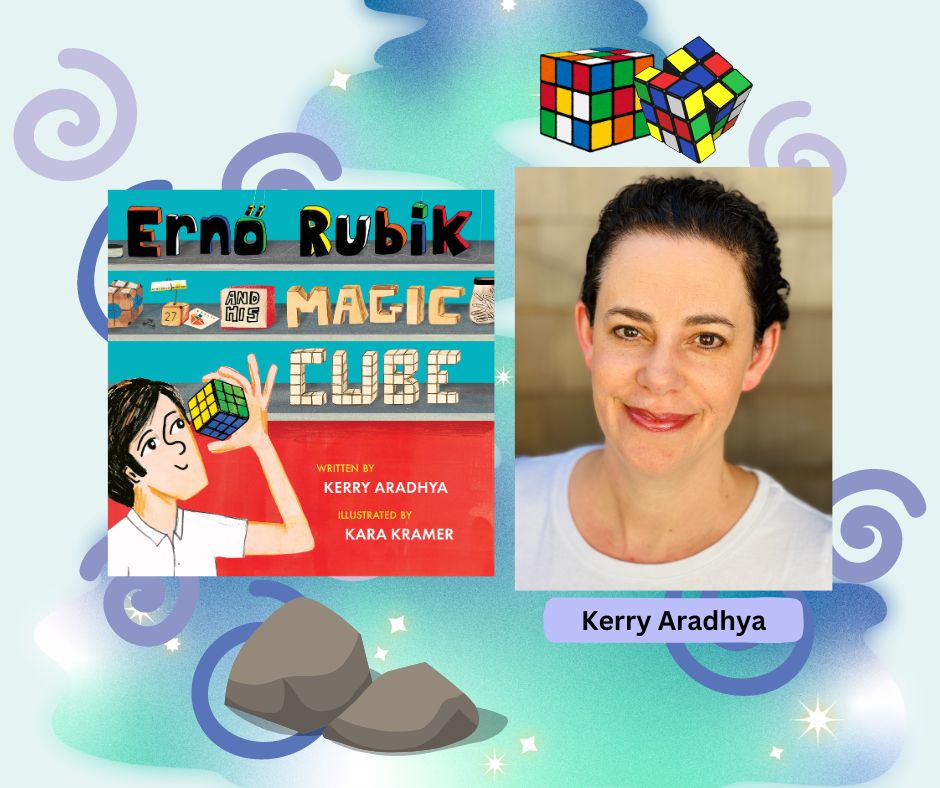
Nature as a Nurturer by Kerry Aradhya

I’m excited to welcome author Kerry Aradhya to Frog on a Blog! Her debut picture book, Ernő Rubik and His Magic Cube, which is a biography of Hungarian architect and inventor Erno Rubik, the creator of the iconic Rubik’s Cube, just published this month by Peachtree. As you may know, the focus of my blog changed this year to feature animal and nature-themed picture books almost exclusively, so when Kerry reached out to say that nature played a pivotal role in Rubik’s creative process, I was intrigued. I asked Kerry to write a guest post about the role nature played in Rubik’s creative process and how nature might also help the creative process of picture book authors. Lucky us, she gladly agreed! Please read Kerry’s fantastic guest article below. If you’re a picture book writer or any type of creative, you just might be inspired!

Nature as a Nurturer by Kerry Aradhya

What do you do when you’re stuck on a revision or can’t quite figure out the ending (or maybe the middle, if you’re like me) of your latest picture book manuscript? Has nature ever factored into your solution?

In Ernő Rubik and His Magic Cube (my debut picture book with illustrator Kara Kramer), Ernő Rubik encounters his own unique problems as he sets out to design a cube made up of smaller cubes that twist and turn around each other. One of those problems is that he needs a way to hold all the smaller cubes together so his three-dimensional model doesn’t fall apart. Although his passion for puzzles and his background in art and architecture came in handy, it was nature that arguably played the biggest role in helping him find a solution.

During my research for this book, I learned that young Ernő Rubik spent many summer vacations by the lake with his family, and those memories stayed with him throughout his life. In his memoir Cubed: The Puzzle of Us All, Rubik poetically describes several of his experiences by the lake, including how the water and surrounding hills transformed during a storm. “There is darkening in the water, then a white line races towards you, followed closely by a pitch-black mass, which only a second ago was an innocent, gentle green,” he writes. He clearly understood the power, surprise, and inspiration that nature can bestow.
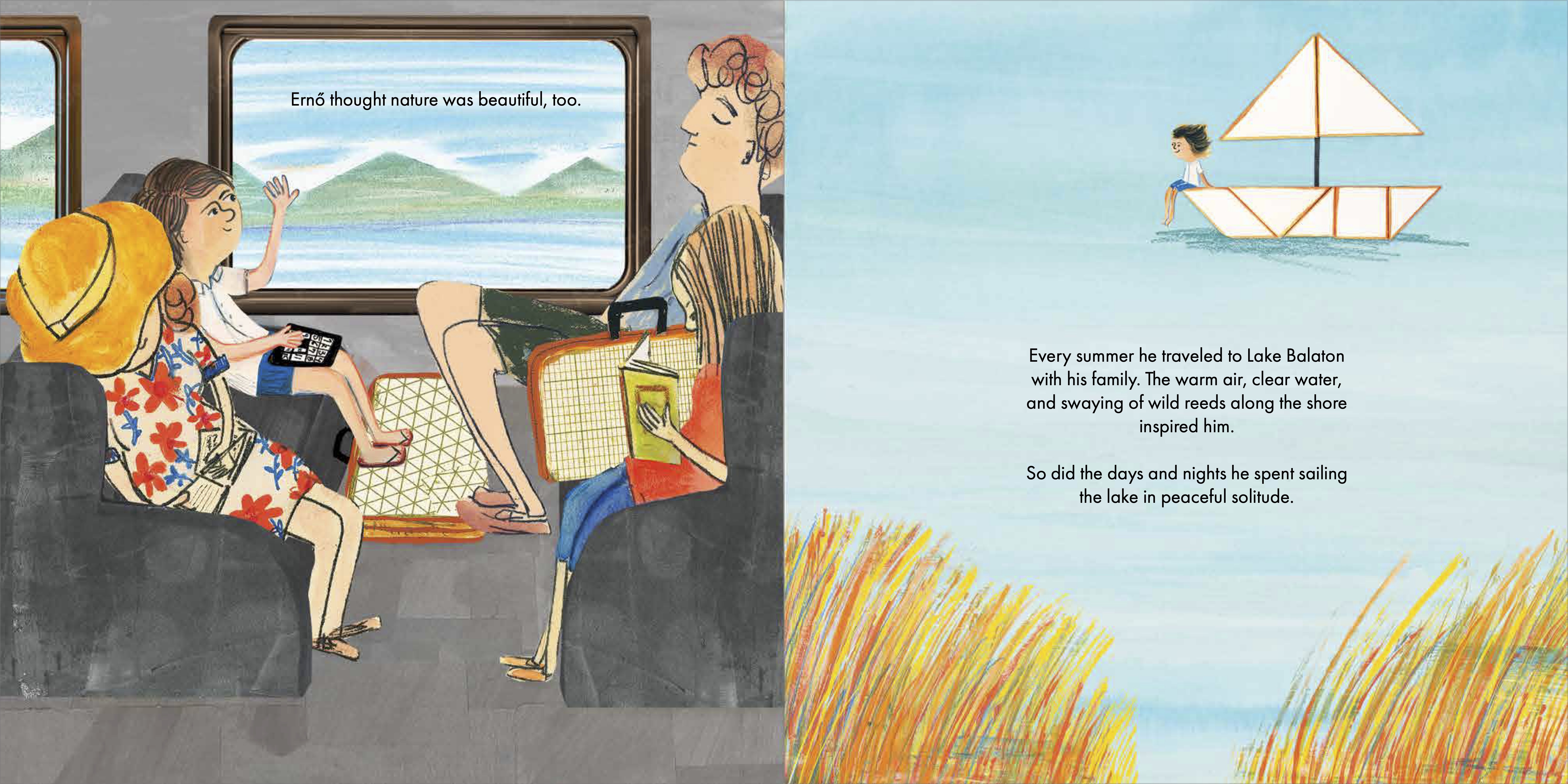
Interior from Erno Rubik and His Magic Cube. Text © 2024 by Kerry Aradhya. Illustrations © 2024 by Kara Kramer. Used with permission from Peachtree Publishing Inc. All rights reserved.

Years later, it was during a walk by another body of water—the Danube River—that Ernő Rubik came up with the idea to use a round internal mechanism to hold all the pieces of his cube together. Watching the river water swirling and twirling around some round pebbles along the shore was the impetus. When he set out for his walk that day, Rubik probably had no idea how it would affect his creative process. But, given his lifelong connection to nature, he likely had an inkling that it could affect it in some way.
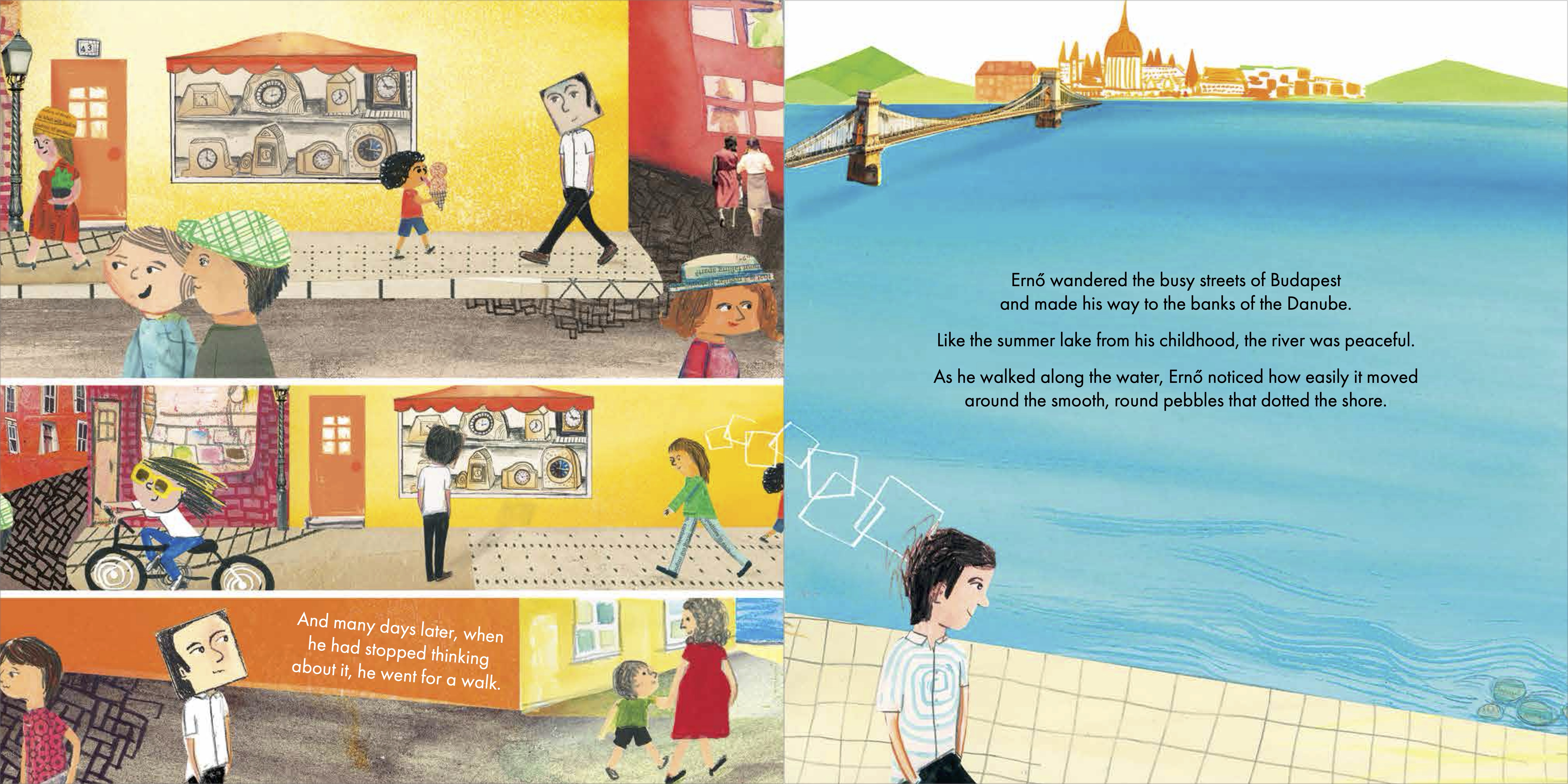
Interior from Erno Rubik and His Magic Cube. Text © 2024 by Kerry Aradhya. Illustrations © 2024 by Kara Kramer. Used with permission from Peachtree Publishing Inc. All rights reserved.

As I reflect back on all the manuscripts I’ve written over the years, I see that nature has played a role in my creative process as well. In fact, I recently (meaning just a few minutes ago, as I was writing this post) reviewed all the poems I have published in children’s magazines and discovered that two-thirds of them have nature themes! Now that I’m thinking about it, I do remember walking in our neighborhood many times, paying attention to the sights and sounds around me, letting my mind roam freely, catching any interesting ideas that fluttered by, so I could play with them when I got home.

Although it’s difficult to find the time and resources for overnight writing retreats, I’ve been fortunate to have gone on a few over the past decade. The longest was a week spent at the Wellstone Center in the Redwoods, near the Santa Cruz Mountains in Northern California. Nestled among the redwoods, with a garden outside my door and trails through the forest only steps away, I had one of the most productive weeks I’ve ever had in terms of my creative writing.

In each of these scenarios, being away from my normal environment, responsibilities, and stressors allowed me to relax and open my mind, because that’s what nature does—whether you’re in it for days, hours, or merely minutes. So next time you’re stuck on a revision or can’t quite figure out the ending (or maybe the middle, if you’re like me) of your latest picture book manuscript, consider spending some time in nature. It could affect your creative process in ways you might not expect, or even realize. Nature is powerful, surprising, inspiring. Nature is a nurturer.


Kerry Aradhya has loved puzzling over words and immersing herself in the creative process ever since she was a little girl growing up in Erie, Pennsylvania. She is the author of the picture book biography Ernő Rubik and His Magic Cube (Peachtree, 2024) and more than a dozen poems in award-winning children’s magazines such as Babybug, Ladybug, and Highlights High Five. She also supports young writers in her role as a mentor and collaborating artist with the nonprofit Society of Young Inklings. 

When not writing for children, Kerry works as a freelance science writer and editor, performs with a quirky modern dance ensemble, and occasionally muses about children’s literature and dance at her blog, Picture Books & Pirouettes. She lives in the San Francisco Bay Area with her husband, their two daughters, and one cute but naughty pooch named Sofie.

To keep up with Kerry, visit her website https://www.kerryaradhya.com/. Or follow her on social media: Twitter/X: https://twitter.com/kerryaradhya, Instagram: https://www.instagram.com/kerry.aradhya/, Blog: http://kerryaradhya.blogspot.com

Building a Diverse Library: Practical Tips for Families and Educators by Shetal Shah

Please welcome children’s book author Shetal Shah to Frog on a Blog. Her debut Shakti Girls: Poems of Inspiring Indian Women launched just this week and is perfect for Women’s History Month! Through 13 poetic, biographical stories and colorful portraits (by artist Kavita Rajput), the book introduces kids to real Indian women who’ve accomplished incredible things in the fields of science, politics, sports, math, and activism and exemplify Shakti, a Hindi word meaning feminine energy and strength, power, and a force to be reckoned with. Shetal is a former educator currently pursuing her mission to positively impact and inspire girls from all backgrounds with her writing and to bring diversity to bookshelves. I asked her to stop by and talk about the importance of showing diversity in children’s literature and diversifying curriculum to bring visibility to all students. Let’s hear from Shetal!

The year was 1999. I was a senior in high school experiencing a heavy dose of seniorities and found myself at the local Barnes & Noble more often than planned. On one of my weekly trips, I walked into the store and a beautiful henna-inspired cover with a name that felt familiar caught my attention. The author, Jhumpa Lahiri, I knew right away was of Indian descent. Could it be that a South Asian author made it to the New York Times Bestseller list? This was new to me. I immediately grabbed the book, Interpreter of Maladies, and ran home to dig in. After a few days of indulging her words, I felt a sense of comfort, peace, and home that I had never felt from reading especially the novels assigned at school. It wasn’t long before I returned to the bookstore and actively sought out the works of other South Asian authors, including Arundhati Roy, Chitra Banerjee Divakurni, and Salman Rushdie. While there were few at the time, I knew getting my hands on as many as possible would recreate the feeling of being seen and understood as much as my heart needed.

I know my experience is not unique. Scholar Rudine Sims Bishop, who famously coined the phrase “mirrors and windows”, explained that “literature transforms human experience and reflects it back to us, and in that reflection, we can see our own lives and experiences as part of the larger human experience. Reading, then, becomes a means of self-affirmation…” When children see themselves in book pages, they feel seen and valued. They feel a sense of belonging and acceptance, no longer an outlier or exception to the full American story. As a window, diverse books expose children to different cultures and contexts helping them expand their capacity to appreciate and understand differences. “Research has shown that children notice race as early as six months, begin to internalize bias between the ages of two and five, and can become set in their beliefs by age 12.” If children are not exposed to the diversity of the world starting at a young age, then they will not be prepared to navigate and reap the benefits of this diverse world when they are adults. What better way to start than with books?

Whether it’s small steps or broad strokes, any action toward building a more inclusive curriculum and school or home library will make a positive difference in a child’s life. Families, schools, and educators either in a diverse or homogenous community can use any of the following ideas to get started:

  1. Develop an annual ritual of evaluating books in your curriculum and library. What percentage of books reflect characters from diverse backgrounds? How many were written by people of color? From here, create a SMART goal to strive for to grow your diverse library.
  2. Assess the books in your (or your child’s) curriculum, including summer reading lists. What percentage of characters and themes reflect diverse cultures and identities? Are students and families from diverse backgrounds and identities reflected in these books? Identify the gaps and find the titles to fill those gaps. For schools and educators, set a numerical goal or standard to ensure that future book lists are representative of diverse backgrounds. Families can reach out to their teachers and suggest or donate titles to add to the class library.
  3. Do your children love story time? Rotate diverse themes and characters when reading to them. Set some rules or routines to ensure you include a number of diverse selections every day.
  4. Not sure where to find diverse books? You can use tools like Diverse Book Finder, Social Justice Books, and even social media to help you discover diverse titles.
  5. Shop for books at your local BIPOC-owned bookstore. Consider partnering with them to host your next school book fair or birthday party!

Setting measurable goals and developing intentional strategies and tactics to reach those goals is an effective strategy for building more diversity and inclusion in a school’s curriculum and school or home library. By focusing on these concrete goals, you are ensuring there is measurable progress being made to close any gaps and help your children feel validation and belonging while offering a window into another world. As I moved on from high school, I sought out educational settings as both student, teacher, and mother where inclusion was starting to become normalized. As a result, I started to see myself as a valuable member of society who has something unique to contribute. I can only imagine what impact this would have made on me had I grown up with access to more diverse books. Better late than never, I say.


SHETAL SHAH grew up to the sounds of Bollywood and the delicious smells of her mother’s Indian cooking in the suburbs of New York City. As a second-generation Indian-American, Shetal hoped to one day see more stories of girls like her fill the shelves of local bookstores.

A former educator, Shetal taught world history in all-girls schools where she was reminded how curriculum and literature inclusive of women from diverse backgrounds can have a positive impact on girls’ self-esteem, identity development and belonging. Shetal also developed and led numerous educator workshops, presenting at national conferences covering topics on pedagogy and diversity and inclusion.

Shetal currently lives in Atlanta, Georgia, with her husband and her two young boys while pursuing her writing and mission to bring diversity to bookshelves with stories that inspire. “Shakti Girls” is her inspiring debut.

Follow Shetal on social media:

Facebook | Twitter: @ShetalWrites 

Instagram: @Shetal.Shah.Writes and @Shakti_Girls

A Labor Of Love: Harriet And The Little French Doll

FrenchDollPNG_FrontCover

The treasured story of Harriet and the Little French Doll has been passed down from my grandmother Harriet to my mother Shirley and finally to me. The events in the story, which take place over three Christmases, really happened to my grandmother when she was a young girl in the early 1900s.

In 1944, she typed the story, drew and painted illustrations for it, and handmade her own little book, complete with a cloth cover, and gave it to her daughter Shirley for her seventh birthday. Today, I’m proud to be the current keeper of the original book. The first half of the story introduces readers to all eighteen members of Harriet’s doll family (she loved dolls!), and the second half features the very special little French doll.

With an eye toward making the story available to others, I decided to recreate it using Amazon’s Kindle Kids’ Book Creator. I designed the book in Microsoft Publisher, with some minor text edits, and the addition of a foreword and an About the Author page. I included all of the original art, which I had snapped photos of and transferred to my computer. Surprisingly, the art required very little touching up. Then I converted the document to PDF and uploaded it into the Kids’ Book Creator, which saved it as a file on my computer.

After that, I opened Kindle Direct Publishing and followed the instructions to complete the book. This was my first time using Kindle Direct Publishing and I discovered there is a bit of a learning curve. But I sorted everything out, and now I’m pleased to report that a Kindle version and a paperback version of Harriet and the Little French Doll are now available on Amazon.

My grandmother was a special person. She lived with my family since before I was born and helped to raise my five siblings and me. I have many fond memories of time spent with Gramma. And I remember, too, that she was always writing, either with typewriter or pen.

She was very talented, both artistically and as an author. She was a self-taught poet who wrote her first poem at the age of 11. She went on to write hundreds of poems over her lifetime. Many appeared regularly in magazines and newspapers, including Ideals, which, to this day, often still publishes her poetry in its special Christmas issue. I know without a doubt that I inherited the writer’s gene from her.

Image19_Harriet (Age 11)

My grandmother Harriet at age 11 with the little French doll (on the right)

My purpose for recreating my grandmother’s story, Harriet and the Little French Doll, is to share a tiny bit of her life and talent with the world.

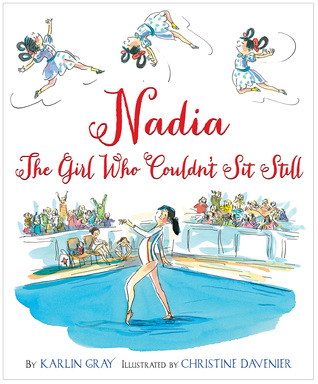
My View Book Review: Nadia by Karlin Gray

25897738

Title: Nadia: The Girl Who Couldn’t Sit Still

Author: Karlin Gray

Illustrator: Christine Davenier

Publisher/Year: Houghton Mifflin Harcourt/2016

Perfect For: Young gymnasts, Olympic fans, Biography collections

Nadia Comaneci was born in Romania on November 12, 1961. From an early age, she was filled with boundless energy, which sometimes got her into trouble. She especially liked to climb trees and even tried to climb her family’s Christmas tree one year. But instead of reaching the top, she ended up underneath the fallen tree. Nadia’s mother signed her up for gymnastics lessons to help her expel her energy in a positive way.

One day, while cartwheeling around the playground at school, she was spotted by Bela Karolyi. He asked Nadia to join his gymnastics school. Bela and his wife Marta became Nadia’s coaches. Before long, Nadia was “flying from bar to bar, from floor to vault, and high above the beam.” A few years later, she was competing and winning trophies and metals in national competitions. In 1976, Nadia and her Romanian teammates entered the arena for the Olympic Games in Montreal, Canada. During the games, Nadia was the first gymnast to ever receive a perfect ten score. She was just fourteen years old.

Author Karlin Gray has written a fantastic account of Nadia Comaneci’s life. Nadia: The Girl Who Couldn’t Sit Still is extremely well written and enjoyable to read. Though packed with facts, the book feels like a story and doesn’t overwhelm the reader. Illustrator Christine Davenier’s artwork is full of life and movement, perfectly capturing the essence of young Nadia. 

Growing up, I had an older sister who could walk on her hands, turn cartwheels with ease, and bend completely over backwards so that both hands and both feet were touching the floor. I was lucky if I could pull off a forward somersault across the floor.

People who can do these extraordinary feats of balance have always fascinated me. They seem to have an incredible sense of body position, something I will never fully understand. I think that’s why the gymnastic events during the Summer Olympics are some of my favorites to watch. I’m amazed at what these young men and woman can do. They make it look so effortless, though I know weeks, months, even years of practice have gained them that level of skill. Still, I can’t help but think, that like Nadia Comaneci (and my sister), they were born with a special gift.

Nadia: The Girl Who Couldn’t Sit Still would make a special gift too!