Interview Alert: Joyce Uglow (+ 2 Giveaways!)

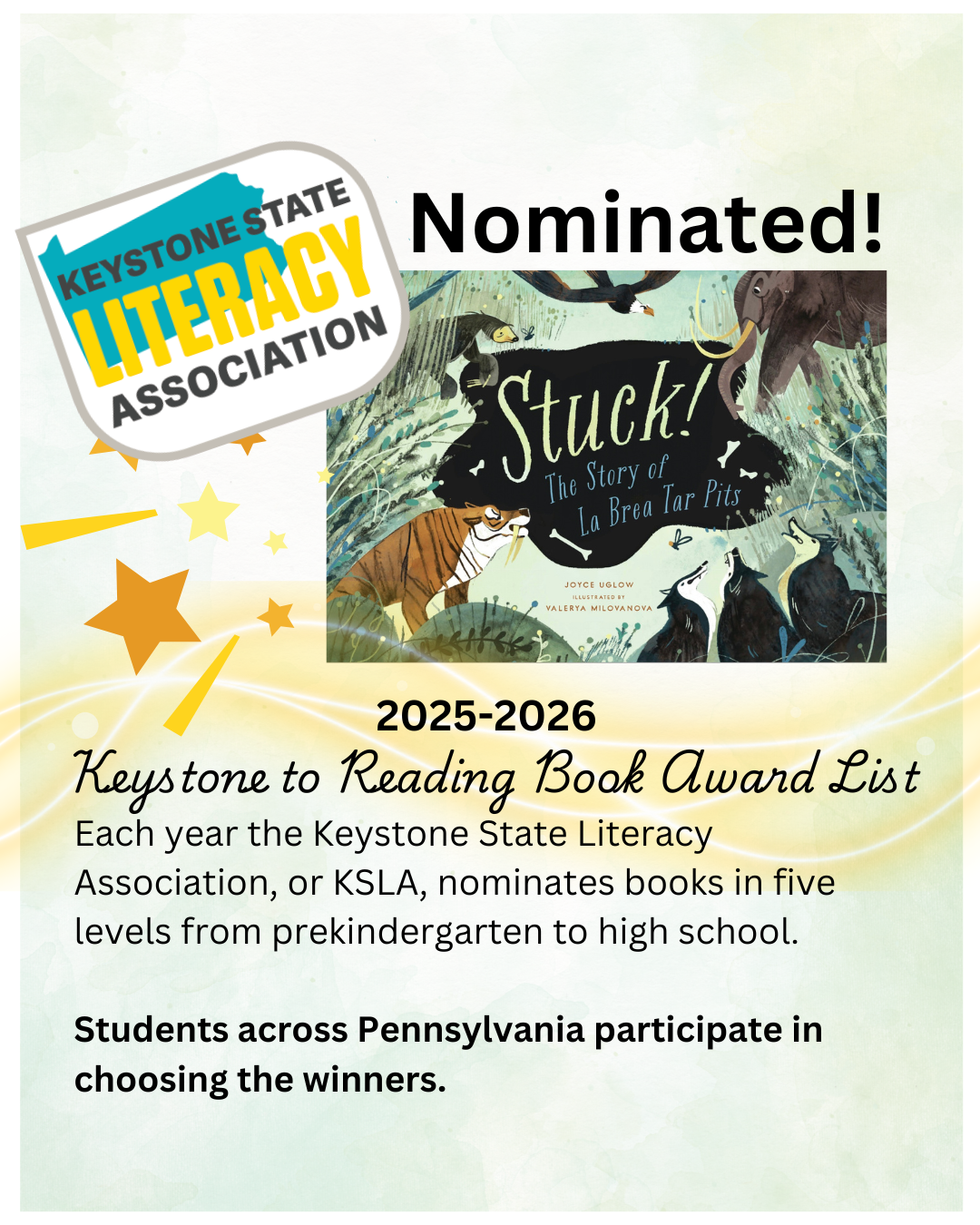
I’m so excited to welcome picture book author, poet, and educator Joyce Uglow to Frog on a Blog! Joyce’s beautiful nonfiction picture book Stuck! The Story of La Brea Tar Pits published in March by Bushel & Peck Books and features gorgeous illustrations by Valerya Milovanova.

Joyce writes lyrical children’s literature about nature, science, and our planet, and her writing motto is “Be curious. Stay unwaveringly committed to seeking answers.” No doubt it’s that curiosity that led her to write about the La Brea Tar Pits, a subject that I, too, find fascinating. Let’s get right to Joyce’s incredible and thoughtful interview! Read to the end to find out how you can win either a signed copy of Stuck! The Story of La Brea Tar Pits or a picture book manuscript critique! (All text and images in this interview are copyrighted by the author or illustrator)

Congratulations on the publication of your fascinating new nonfiction picture book Stuck! The Story of La Brea Tar Pits! Tell us a bit about the book and what inspired it.

JU: Lauri, thank you so much for inviting me to Frog on a Blog to share my debut nonfiction picture book.

Stuck! The Story of La Brea Tar Pits is a lyrical origin story of the most active urban excavation site in the world. To those who’ve never been to LA, it is a surprise to find La Brea Tar Pits located in Hancock Park on Wilshire Boulevard in Los Angeles, CA. This is where asphalt still seeps to the surface from underground. It is more than a simple origin story of the animals getting stuck or pulled out as fossils, however.

Stuck! is really about staying aware, being curious, and finding ways to search for ponds without bubbles. And climate change…mega change in fact!  

I was immediately sucked in and taken aback by the incredible stories that got stuck in what is called “the tar” in English (or “la brea” in Spanish). I began my research by standing and staring at the massive exhibits in the museum at La Brea. Smilodon fatalis (A.K.A. Saber-toothed cat) captivated me. I knew I wanted to tell Smilodon’s story. I read research and newspaper articles online and books about the Tar Pits. I traveled back to LA and attended a workshop for educators. Learning a great deal along the way, I introduced myself to La Brea paleoecologist. Dr. Emily Lindsey and paleobotanist, Dr. Regan Dunn. They agreed to chat with me online via Zoom. In those conversations, I shared the text and preliminary artwork to ensure the accuracy.

La Brea Tar Pits holds the best record of Ice Age ecosystems anywhere on earth. Millions of fossils, encompassing everything from mammoth tusks and tree trunks to snake jaws and beetle wings, have been found in the La Brea Tar Pits. Over the past century, these fossils have led to some of the biggest discoveries in paleontology, giving scientists insight into the biology, behavior, and ultimate demise of some of prehistory’s most charismatic players. This includes evidence about the largest extinction event since the dinosaurs disappeared.

Valerya Milovanova’s illustrations are so detailed and dynamic. What were your thoughts when you saw the completed art for the first time?

JU: Valerya Milovanova’ artwork brings soft greens and blues to the black of the asphalt seeps and browns of the unearthed fossils. The story begins by showing Harlan’s Ground Sloth meandering for a drink. The tension is noticed in the first spread as unsuspecting sloth gets stuck.

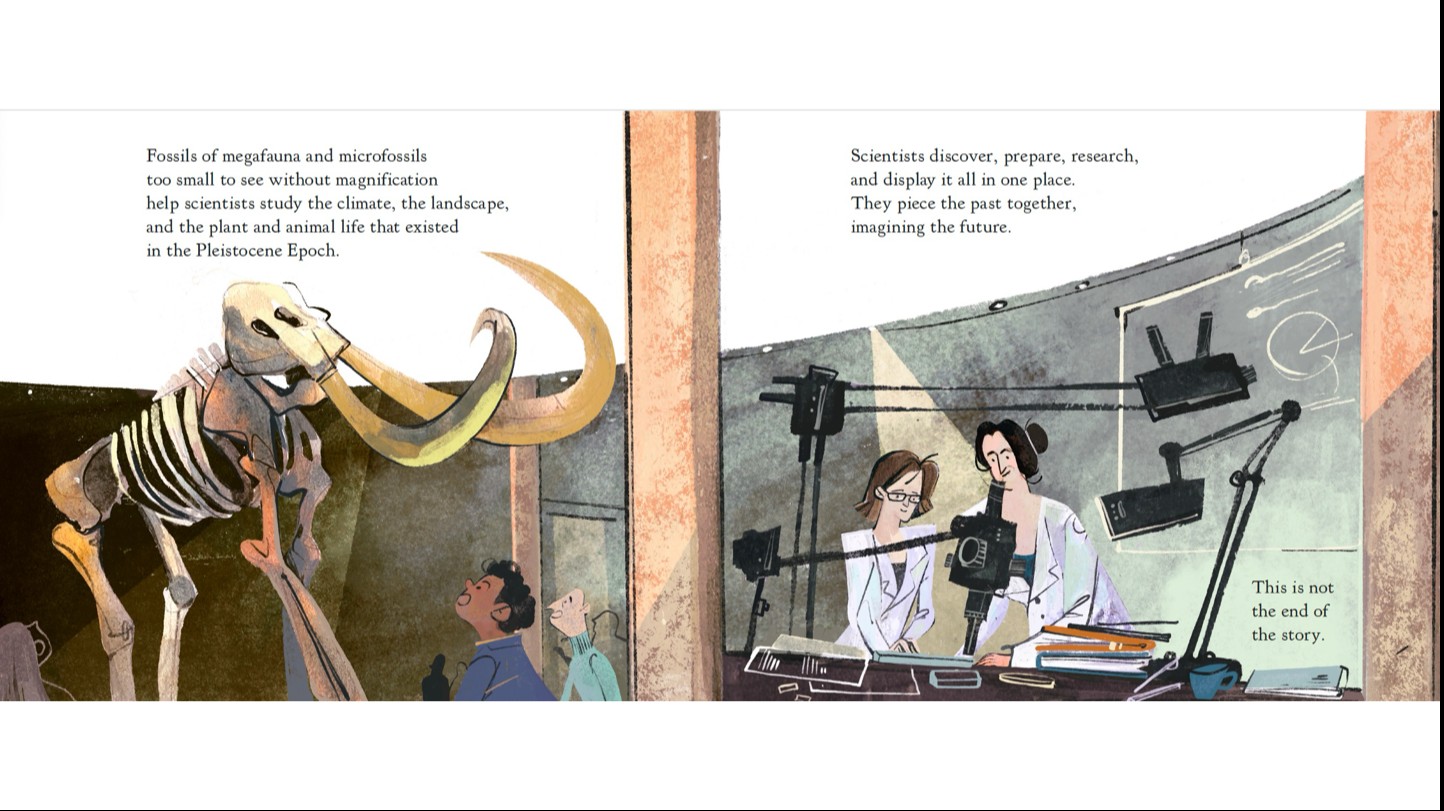
I was given the opportunity to take a look at Valerya’s art at an early stage and twice more before our book went on to its first printing. I could not stop smiling. We made a couple of changes in the art. The spread below shows the museum’s fossil lab. In early art, the two scientists were men. I asked for a change to depict Dr. Emily Lindsey and Dr. Regan Dunn. I love it!
Why are picture books, particularly nonfiction picture books about animals and nature, important for children? And do you think your background as an educator affects your writing?

JU: Science is often pulled from the news and made into picture books. I find it fun to take intriguing information and pare it down into kid-relatable narration using lyrical language. I especially love writing about bees, trees, families, cave art, parks, rocks—anything that makes me ask questions. Truthfully, I remember my own childhood questions. I must have driven my parents and teachers bonkers. 🙂

Picture books are the perfect way to enrich school curriculum, provide discussion talking points for family vacations, and enjoy the beauty of our world. As an elementary classroom teacher, I used picture books to teach writing, add to our social studies and science lessons, and to enjoy.

Yes. Almost four decades with students definitely gives me a leg up on thinking like a kid and reacting like a teacher who teaches the kids in front of me. I believe in teaching the child rather than teaching the book.

Spoiler alert… In the final spread of Stuck!, a dragonfly soars above the city of LA in search of a spot to lay her eggs. She flies on rather than getting stuck in today’s stickiness in the park. In my author visits, I like to draw attention to curiosity and the importance of asking questions. But I also talk with kids about avoiding “sticky situations”. School counselors can use picture books to get kids talking in much the same way. You know, finding a pond without bubbles.

The hooks in Stuck! include: paleontology, paleoecology, paleobotany, fossils, Ice Age animals, climate change, environment, and, in general, STEM (science, technology, engineering, math). One of the coolest things I found in my research is that fossils contain records that can provide information for the future.

For example, La Brea researchers connected human-caused fires to the largest extinction event (Ice Age) since the dinosaurs disappeared. Humans coexisted alongside Ice Age megafauna for 2,000 years. Charcoal remains were found in Tar Pits fossils in the last 300 of those years. Hmmm… the drying, the warming, the loss of plant life with subsequent loss of herbivores and then carnivores, the fires… Stuck! is a book that connects everyday with Earth Day, National Fossil Day, and the impact of humans on the environment. Whether I am speaking to kids and adults at book stores, library story times, or schools, I connect Stuck! The Story of La Brea Tar Pits to caring for our planet. I hope that someday humans will reduce the use of plastic, plant and plan for the future. We have the knowledge. By acting responsibly, we can stay clear of ponds with sticky bubbles.
You’re also a poet. Do you write poetry for children or for adults? And would you share an excerpt from one of your poems?

JU: I’ll start my answer with some literacy research cuz that’s who I am too. 🙂

Reading one to three picture books to children per day over a year’s time is proven to enhance children’s quantity and quality of emotion vocabulary exposure. Picture books provide the opportunities for emotional literacy development that is needed for children’s capacity to construct and categorize their own and others’ emotional experiences. It also facilitates learning from others, enabling children to affectively align in peer interactions. “Picture books contain vocabulary that is more emotionally intense than models of child-directed speech, and picture books typically feature narratives containing emotional situations and opportunities for emotion talk.” (Source of the information above.) Poetry goes hand in hand with writing picture books.

I write kidlit poetry and love to condense my research findings into spare text for picture books.  

From mid-March to mid-April, Cindy Mackey, fellow picture book poet and I hosted a STUCK! Bumblebee Poetry and Illustration Challenge on Instagram, BlueSky, and SubStack. During the 35-day challenge, we sent out one-word prompts on Joyce’s Instagram and BlueSky and on Cindy’s Instagram and Cindy’s BlueSky. We encouraged readers to use the prompts to spark their own poetry and illustration creativity. Each word was pulled directly from the text of our lyrical picture books.

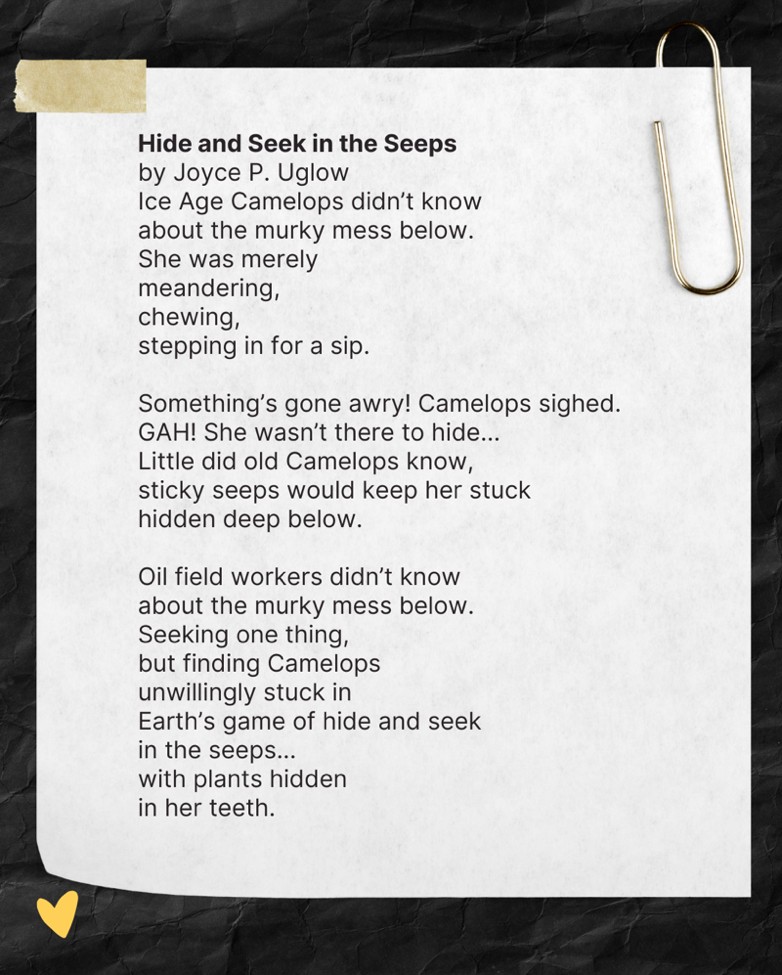
Hide and Seek in the Seeps uses a variation on the hide and seek poetry form. HERE is a link to my website where you can find all of the prompts and poetry form descriptions.
What other fascinating topics are you currently writing about?

JU: I have nonfiction picture books out on submission. I love to focus on our planet’s natural beauty and destinations where families can visit. In addition, I have a nonfiction picture book biography of an author-illustrator whose life was dedicated to art and inspiring kids to create their own art. This person is an important contributor to children’s literature. Her art had stories to tell.
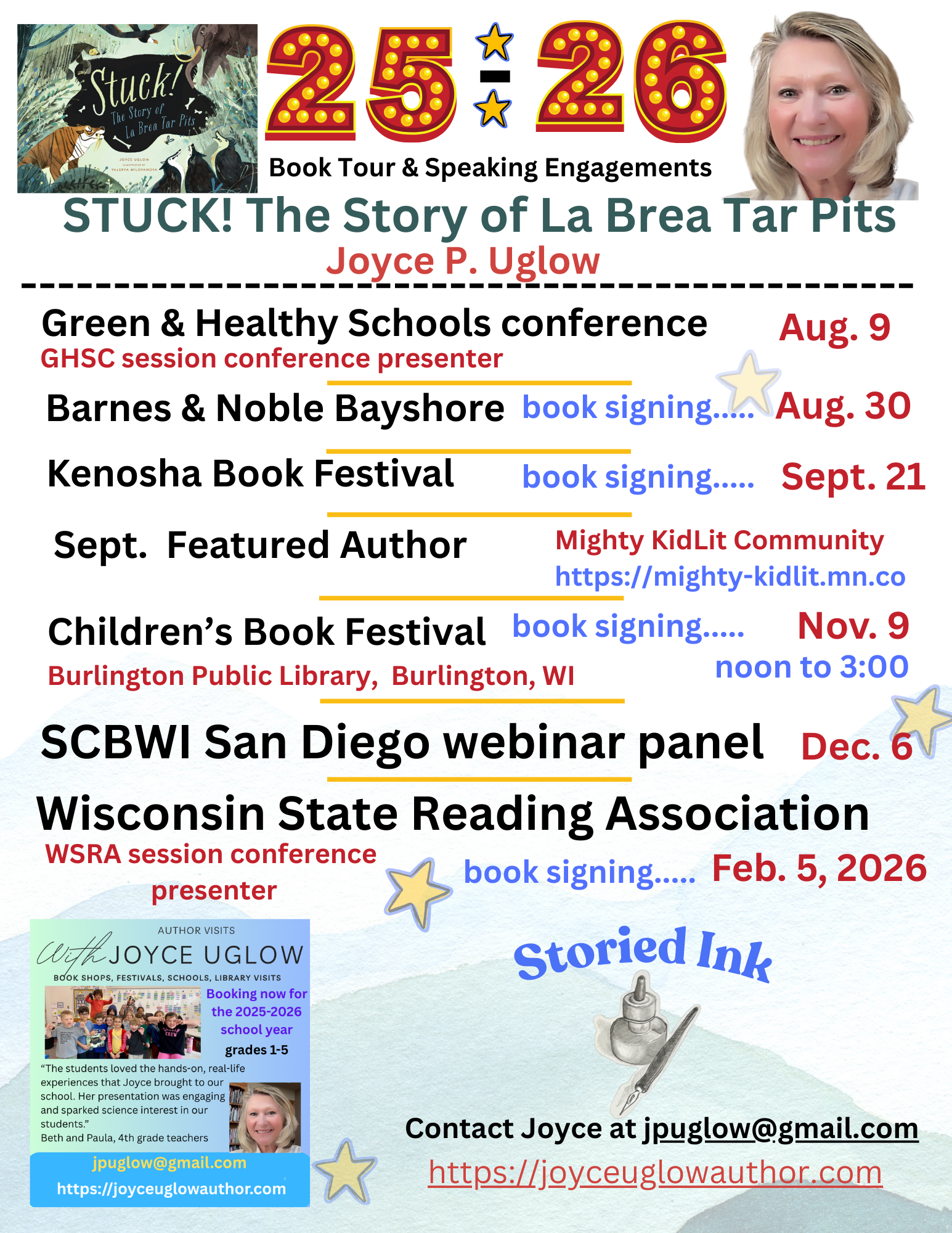
Joyce Uglow has been asking questions and collecting words since an early age. Retired, she now writes picture books and poetry for children who are also intrigued by words and our wondrous world, books that educators, librarians, and kids tell each other about. She currently serves as SCBWI Wisconsin’s Co-Regional Advisor and in 2026 will take on mentees as a part of the Mighty Mentor in the Mighty KidLit platform. She is unwaveringly committed to sparking kids’ interestsHer mantra… elevate others & prioritize joy.

She enjoyed a wonderful 37-year career in schools, beginning as a teacher for students who needed that little something special in order to be successful with literacy. She was fortunate to have worked with students who taught her a great deal about being there for them. She, in fact, taught many, many kids to read through writing. Her experiences in classrooms and resource rooms, led her to the school office where she had the pleasure of serving as principal at Lyons (a K-4 building) and Dyer School (a 4-6 grade building). Both buildings housed public school Montessori programs as well as traditional and resource programs. Along with her career path, she got actively involved on the Board of Directors and conference planning for the Wisconsin State Reading Association (WSRA). Besides serving as WSRA president, one of her favorite volunteer positions had to do with the Young Authors Festivals. When she retired from her day job as principal, she put her mind to work on writing for children. It was a natural next career for her.

To learn more about Joyce and her books, visit her online:

Website: http://joyceuglowauthor.com

Linktree: https://linktr.ee/jpuglow?utm_source=linktree_admin_share 

Instagram: https://www.instagram.com/jpuglow/?hl=en 

BlueSky: https://bsky.app/profile/jpuglow.bsky.social 

SubStack: https://substack.com/@jpuglow

Goodreads: https://www.goodreads.com/user/show/9178331-joyce-uglow  Pinterest          https://www.pinterest.com/jpuglow/

Pinterest: https://www.pinterest.com/jpuglow/


2 GIVEAWAYS!

Folks, we have two fantastic giveaways today! Joyce is generously offering a signed copy of her fabulous book Stuck! The Story of La Brea Tar Pits to one lucky winner AND a picture book manuscript critique to another lucky winner. Just comment on this post by September 29th and mention if you’d like to be entered to win the book or the critique or either. I’ll choose two winners at random and connect them with Joyce. Good luck! (Book giveaway open to US residents only)
Three “Pawsitively” Perfect Picture Books For National Foster A Pet Month (My View Book Review)

Title: Bless Our Pets: Poems of Gratitude for Our Animal Friends

Author: Fourteen authors, including Lee Bennett Hopkins

Illustrator: Lita Judge

Publisher/Year: Eerdmans Books for Young Readers/2024

Topic/Theme: Pets, human/animal companionship, poetry anthology, expression of gratitude

Favorite Line: If I could pick a pet to pet, the pet I’d pick is you. (from “A Letter to My Guinea Pig” by Darren Sardelli)

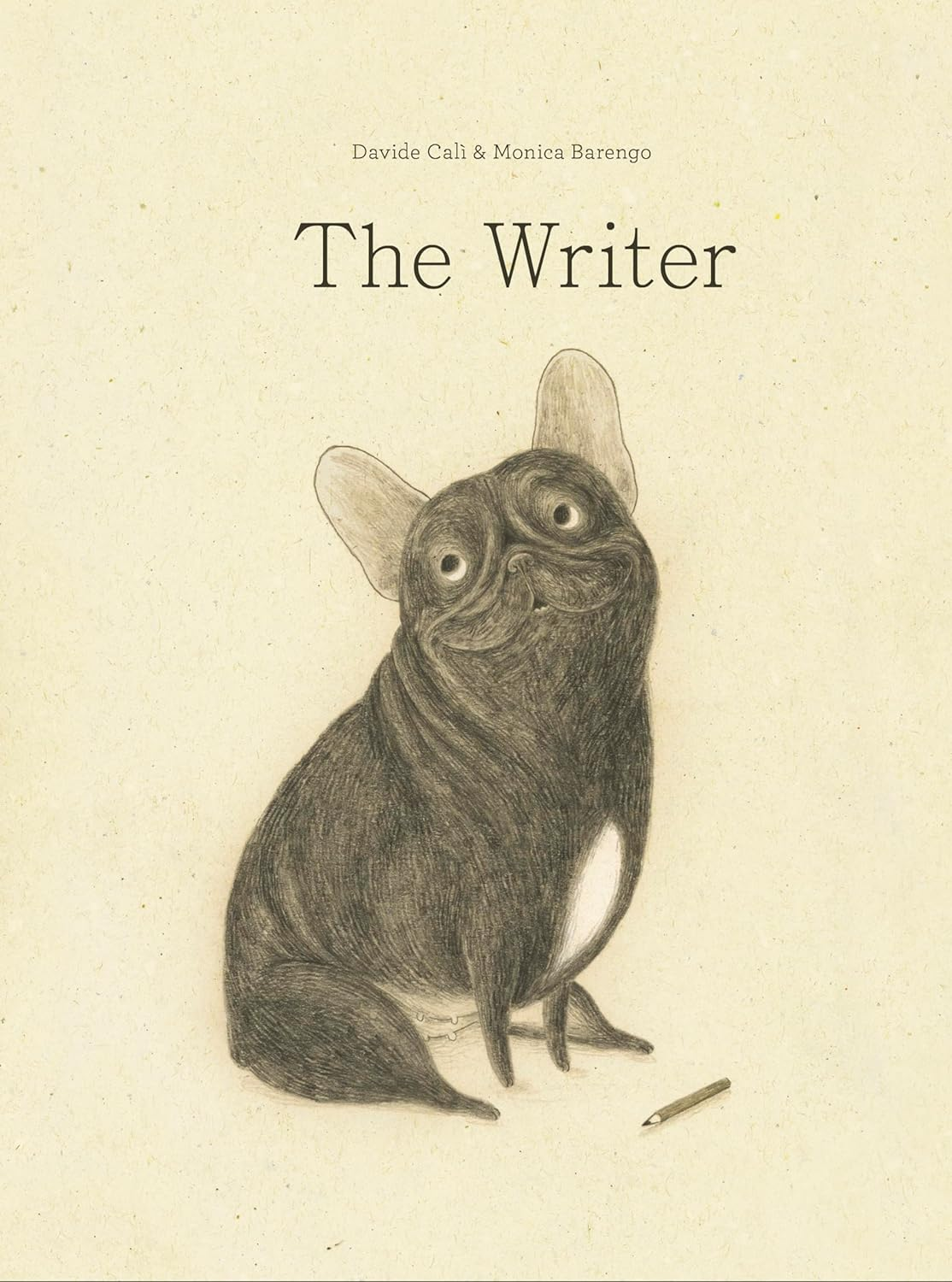
Title: The Writer

Author: Davide Cali

Illustrator: Monica Barengo

Publisher/Year: Eerdmans Books for Young Readers/2022

Topic/Theme: Dogs, human/animal companionship, writer’s life

Of Note: New York Public Library Best Illustrated Children’s Books Award (2022)

Title: No Cats in the Library

Author: Lauren Emmons

Illustrator: Lauren Emmons

Publisher/Year: Simon & Schuster/Paula Wiseman Books/2024

Topic/Theme: Cats, human/animal companionship, libraries and librarians, books, reading

Of Note: School Library Journal starred review


Happy National Foster A Pet Month! Kids love pets of all kinds! Growing up with a pet or two helps kids learn compassion and how to care for others. Taking care of pets helps kids learn to be responsible too. And the great joy and love both the kids and the pets feel is so special. If you have room in your home and your heart to foster (or better yet, adopt) a pet from a shelter or rescue organization, please consider it. Here’s the ASPCA’s list of Top 5 Reasons to Foster an Animal in Need and the Best Friends Animal Society’s list of Top 10 Reasons to Foster a Pet. Take a look when you get a moment. In the meantime, enjoy three great picture books all about–you guessed it–pets!

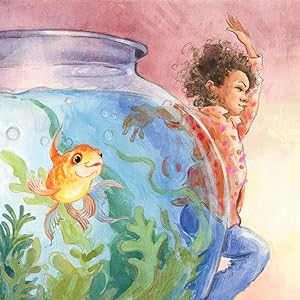
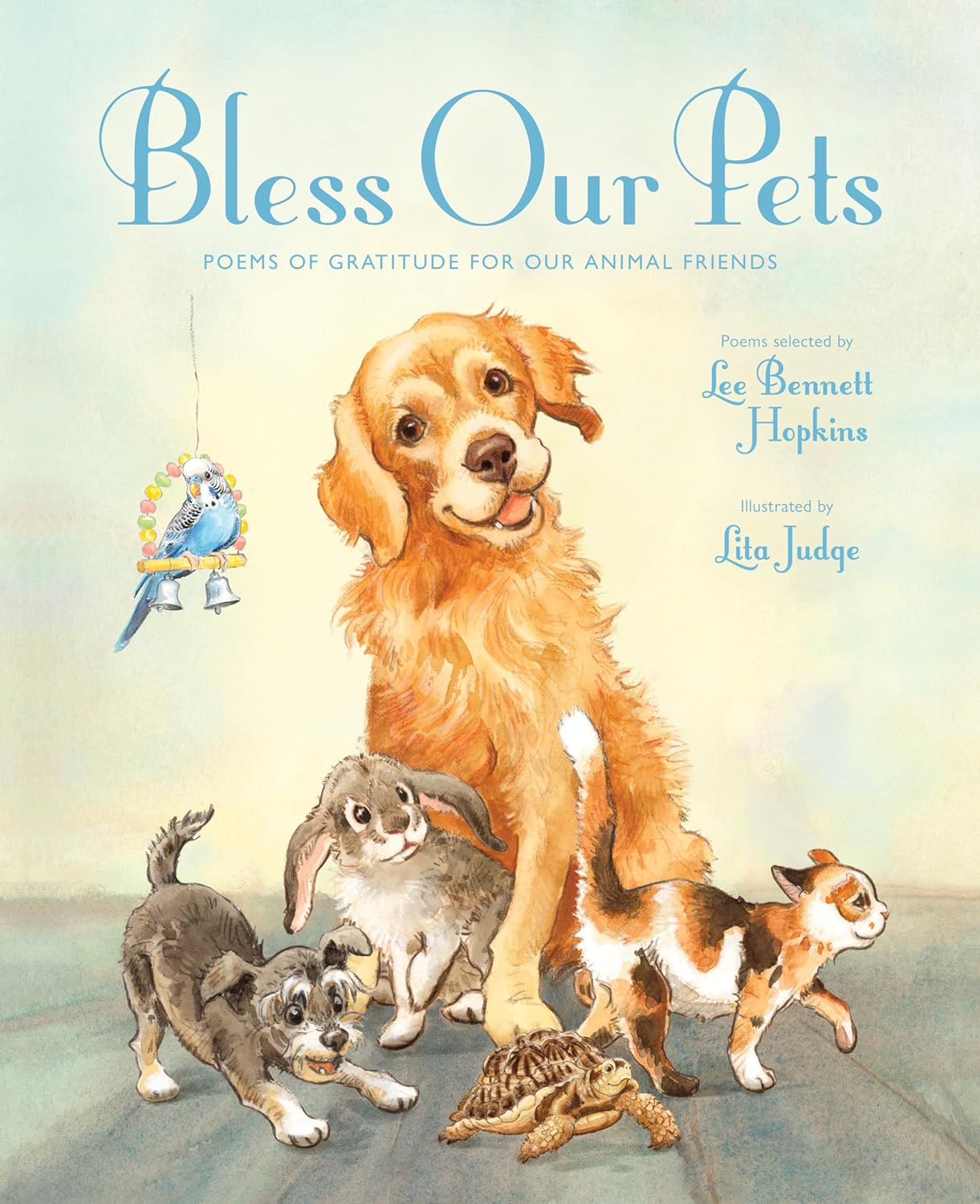
Bless Our Pets is a lovely celebration of pets, all kinds, from the majestic horse to the tiny mouse. Fourteen authors have contributed a poem to this collection. Some rhyme. Some do not. But all convey a child’s love (or at least their wonder, as in the case of the snake) for an animal who has touched their lives, including a parakeet, a hamster, a kitten, and more. Charming and expressive watercolor and colored pencil illustrations by Lita Judge accompany each poem. Kids will enjoy the text and pictures together and will likely experience a range of emotions as some of the poems are joyful, such as “Goldfish” by Linda Trott Dickman, and others perhaps a bit sad, such as “My Old Dog” by Lee Bennett Hopkins. The other 12 contributors are Ann Whitford Paul, Rebecca Kai Dotlich, Eric Ode, Ralph Fletcher, Sarah Grace Tuttle, Kristine O’Connell George, Darren Sardelli, B.J. Lee, Charles Ghigna, Lois Lowry, Prince Redcloud, and Joan Bransfield Graham.

Image from Bless Our Pets/copyright © 2024 by Lita Judge

From the jacket flap: One of the last books edited by beloved poet Lee Bennett Hopkins, this endearing anthology expresses children’s gratitude for creatures big and small. [It’s] the perfect tribute to the animal friends who bring so much joy into our everyday lives.


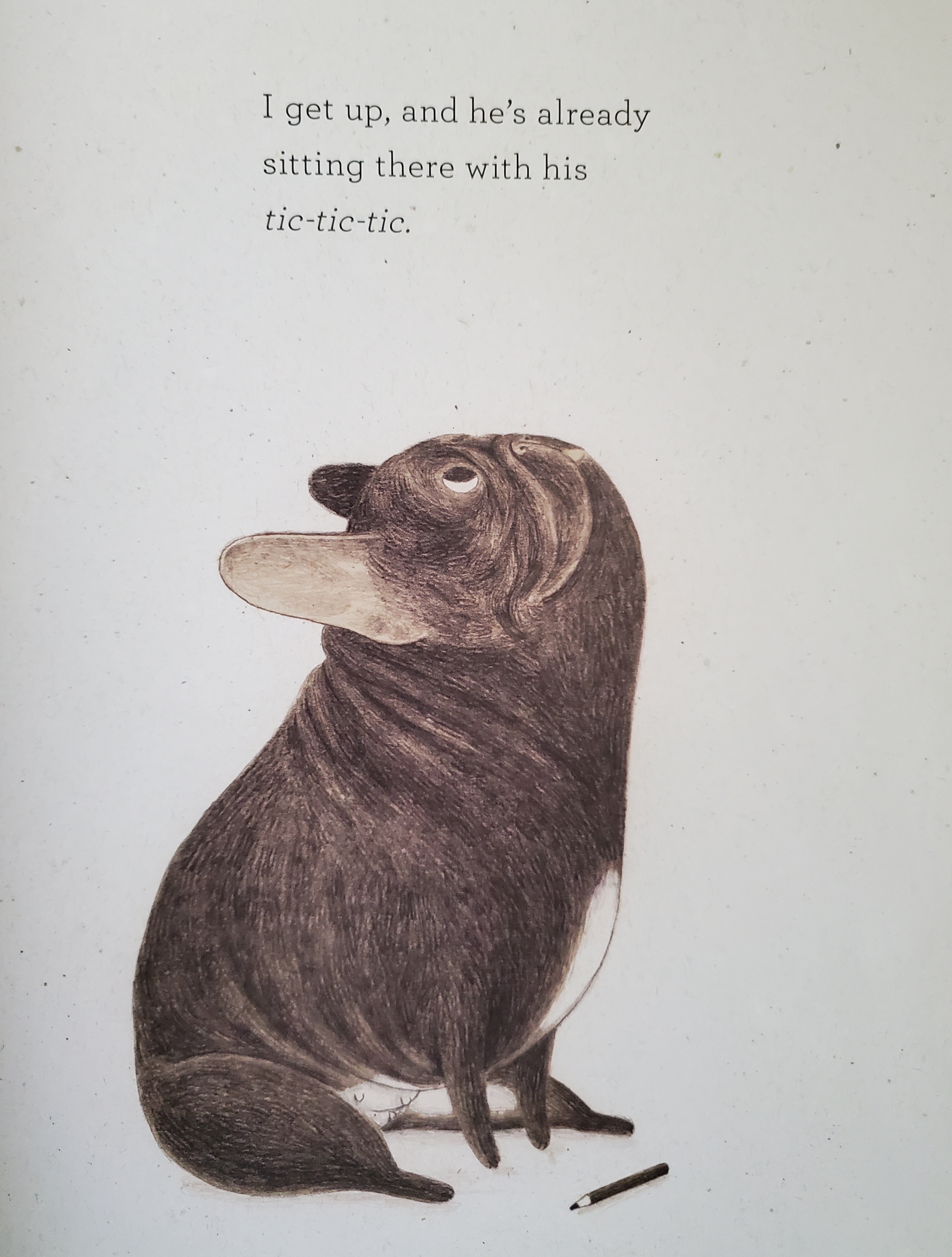
Originally published in Italy, The Writer, by Davide Cali, is the kind of picture book that would appeal to both kids and adults. It stars an adorable French bulldog who watches his human companion type, type, type all day long on his laptop. The clever dog feels it’s his responsibility to make sure his human takes breaks to eat and go for walks. But he needs help. So he plays matchmaker. But things don’t go as planned. The engaging and unusual illustrations by artist Monica Barengo, which were rendered using graphite pencil and digital media, nicely capture the varied expressions of the dog, from who’s point of view the story is told. The story flows at a pleasing pace. Text is sparse, leaving plenty of room for the art. Adults, especially dog-owning writers, will likely relate strongly to the writer’s somewhat solitary life depicted in the book. And kids will love the dog’s many amusing poses and antics. And they may just learn a little something about what it’s like to be a writer.

Image from The Writer/copyright © 2022 by Davide Cali and Monica Barengo

From the back cover: A dog has an important job to do, especially if his human is a writer. But even the world’s best French bulldog can’t do everything. Maybe this perfect pair needs someone new in their lives.


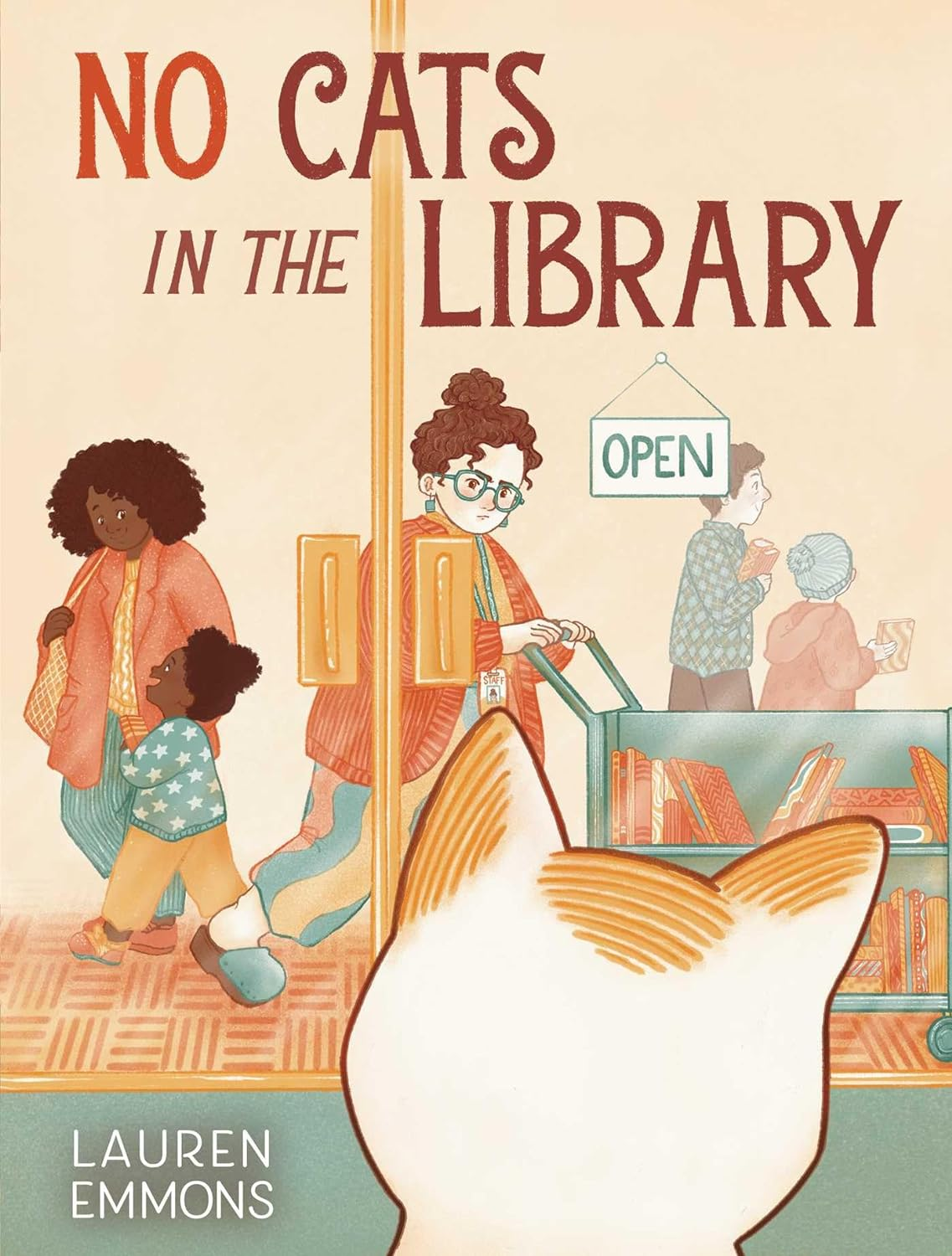
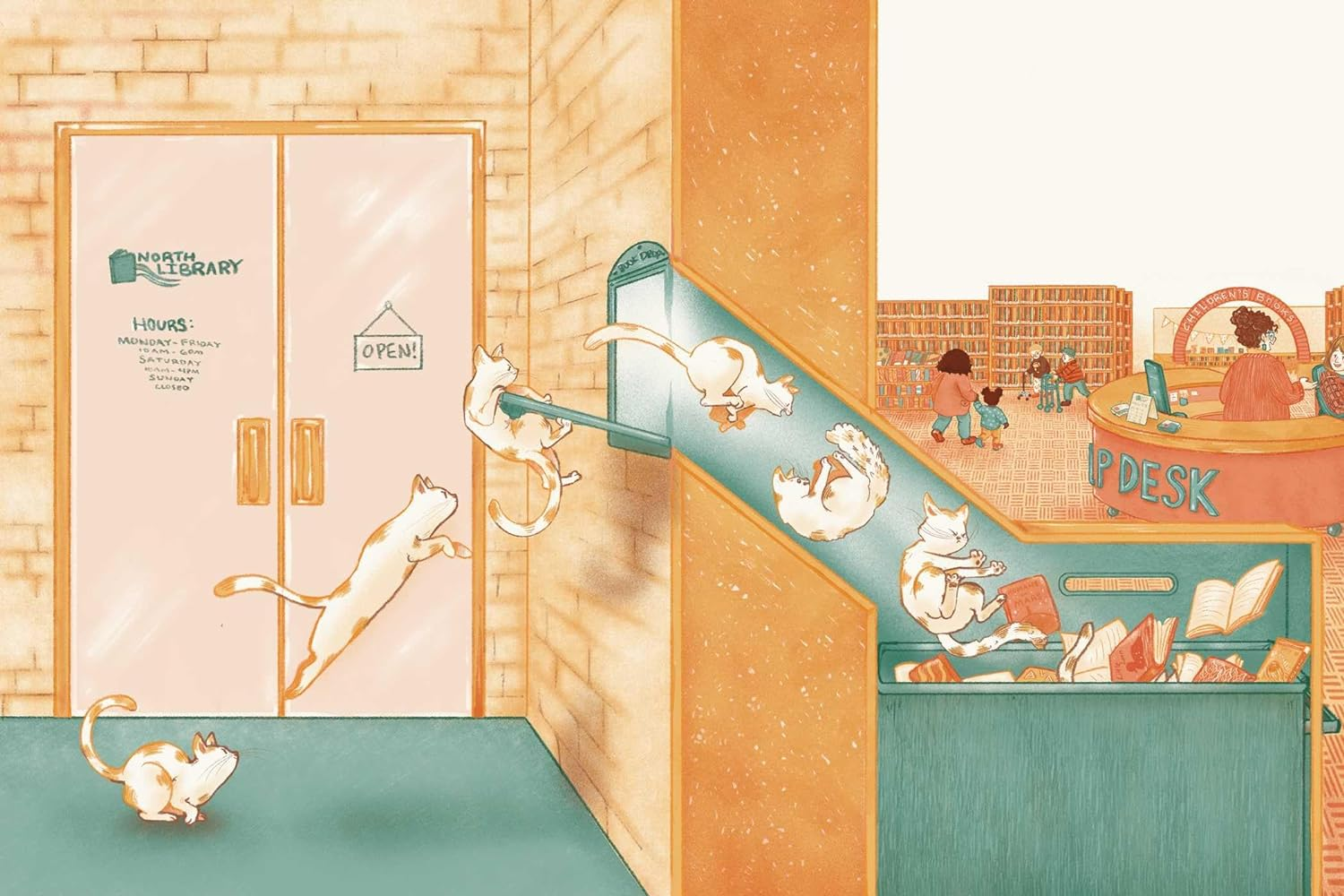
Written and illustrated by Lauren Emmons, No Cats in the Library is a heartwarming story about a sweet stray cat named Clarisse who loves books, especially the kind with pictures. When she discovers the library and tries to get inside, she’s thwarted by the ever-vigilant librarian. She finally sneaks in through the book drop and makes her way to the children’s section where a little girl reads to her, and they both benefit from the experience. Clarisse got to hear a story, and the girl gained confidence in her reading abilities. Hopefully, now, the librarian will let Clarisse stay. The colorful and adorable digitally created illustrations depict a diverse group of kids and adults. This book is overflowing with library and literacy love, and as a former library assistant, I highly recommend it. Studies show that reading to animals helps kids improve their reading skills and build confidence. Wouldn’t it be fun if this was the book a child picked to read to a cat or dog?

Image from No Cats in the Library/copyright © 2024 by Lauren Emmons

From the jacket flap: Meet Clarisse! She’s a clever cat who loves books. She may not understand the dark, squiggly lines, but she can’t get enough of the pictures. One day she stumbles upon a magical building where people walk in empty-handed and come out with an armload of books. She has to find a way inside!


Adult male parakeets have a blue cere (the area above the beak containing the nostrils), while an adult female parakeet’s cere is brown.

Writing a Single Story Using a Variety of Poetry Styles by Kathleen Long Bostrom

It is my pleasure to welcome multi-published, award-winning children’s book author and poet extraordinaire Kathleen Long Bostrom back to Frog on a Blog. I featured Kathleen in the summer of 2020 when her board book Will You Be Friends with Me? came out. She spoke about the connection between writer and illustrator and trusting the publisher and illustrator to help bring your story to life. To read that post, please click HERE.

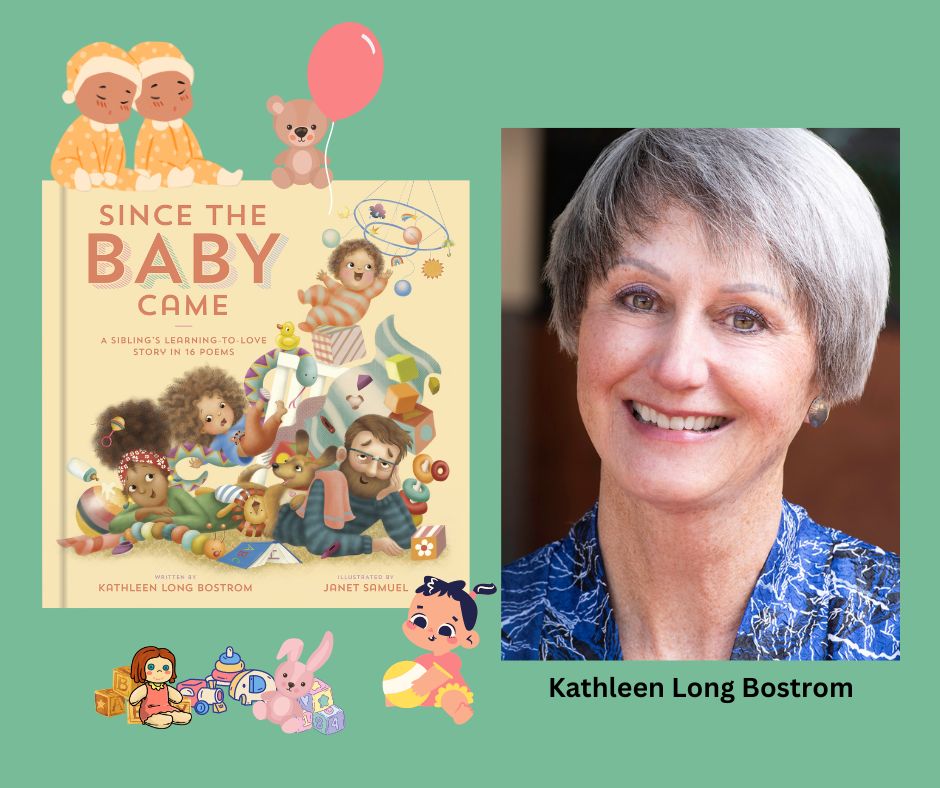
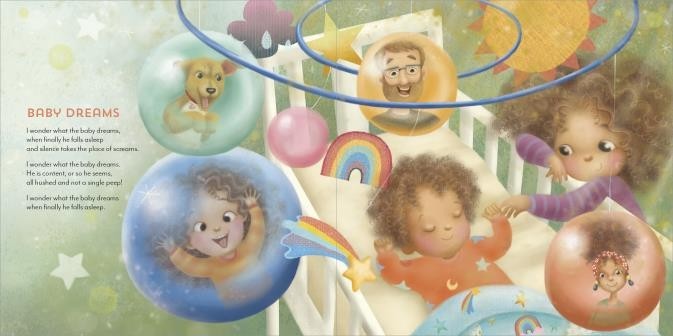
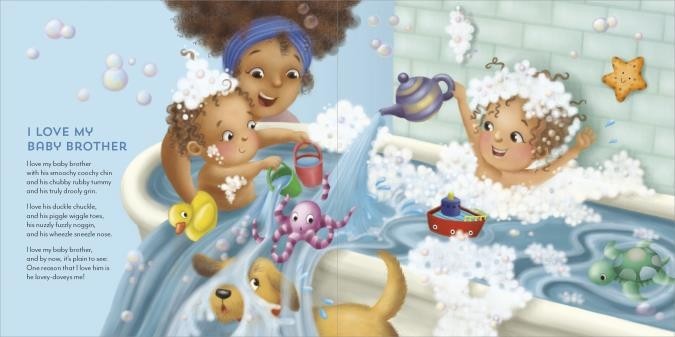
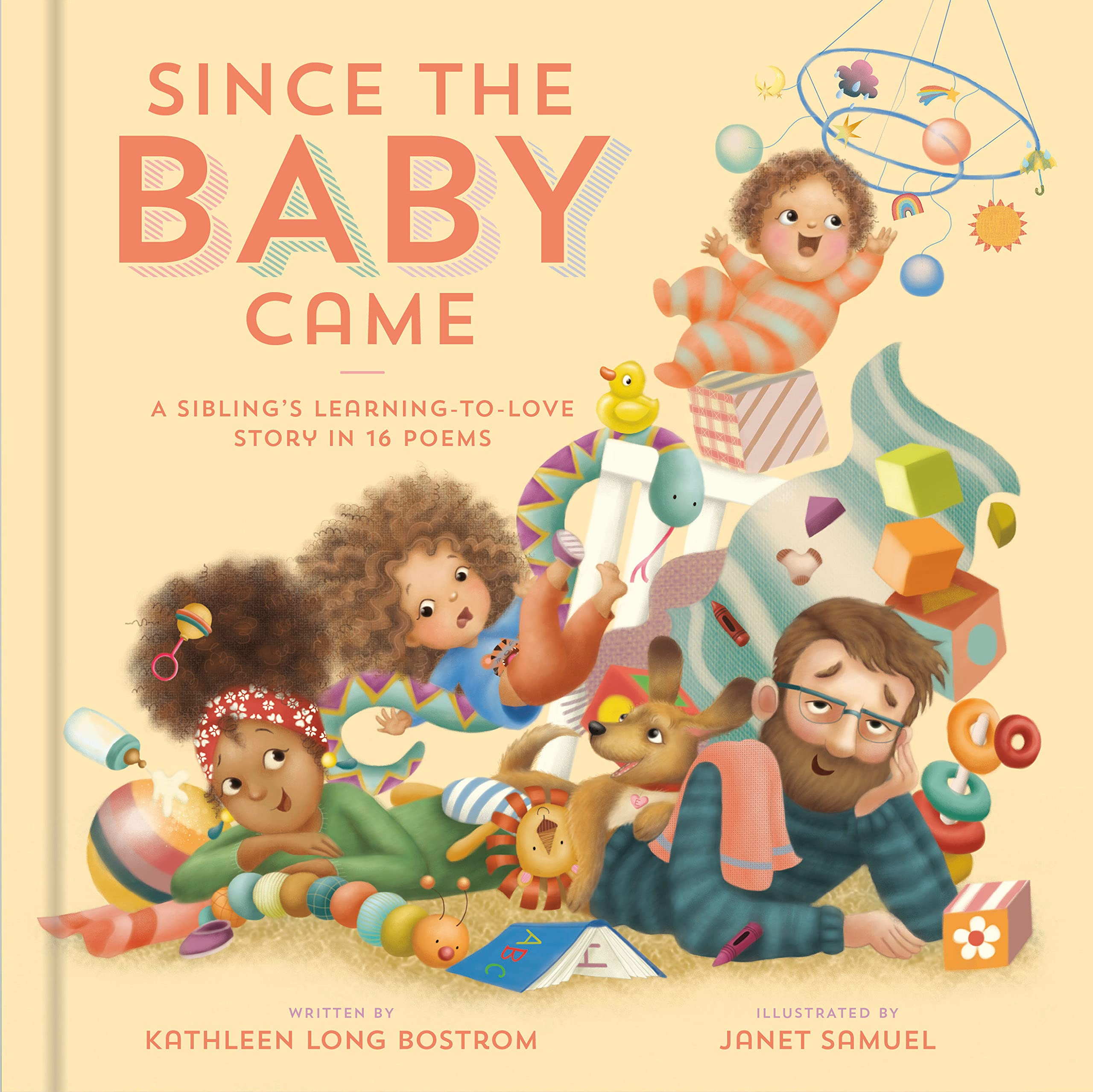
Today, Kathleen’s here to share her latest picture book Since the Baby Came: A Sibling’s Learning-to-Love Story in 16 Poems and talk a bit about her process of writing a book in different poetic forms. This book officially released this week from WaterBrook and features adorable, playful, and detailed illustrations by Janet Samuel. It’s perfect for Mother’s Day, Father’s Day, and baby showers or simply to help a child navigate welcoming a new sibling into the family. It’s also a great choice for children and adults to learn about different poetry styles, including the very tricky Villanelle, of which Kathleen gives an example below. Let’s hear from Kathleen!

Dr. Seuss taught me how to read. Not literally, of course (I read once that he didn’t particularly like children!) but through his marvelous books. The Cat in the Hat was my favorite. Through these playful, rhyming stories I not only learned to read but also fell in love with poetry.

When I began to write books for children, I felt drawn to writing in rhyme. I kept hearing that editors did not want to look at manuscripts in rhyme. Why not, I wondered? Don’t most children love rhyming picture books? As I began attending writer’s conferences, I learned the reason. Time and again, editors declared, “We get so many poorly rhymed manuscripts, we don’t even want to see them anymore.”

If I was going to write in rhyme, I had to do it well. No forced rhymes, no using stanzas that rhyme by twisting a sentence into something a person would never say. I worked hard at it, yet it never felt like work. I loved it! When I began to get books accepted for publication, many of them were written in rhyme.

After twenty-five years of publishing books, I am still learning, still loving the process of writing in poetry.  

Around the time I retired from serving as a pastor and turned to writing full-time, my best friend and I attended a children’s writing conference. She was then working as an editor in educational publishing. During lunch, I asked, “What are the areas in early education where more good books are needed?” Without hesitation, she replied, “Poetry.”

“Aha!” I thought. “I can do that!”

But what would make a story told in poetry unique? I researched the books currently on the market and looked for the gaps.

Then it hit me: write a single story in verse, but not limited to the rhyming couplets that I and most other authors used. Could I write a single story using a variety of styles of poetry? I read books that described different poetic forms. Was I surprised! I knew about haiku, limericks, sonnets. But Villanelle? Cinquain? Triolet? Fascinating!

I had to tell a story with all the necessary components: beginning, middle, end, including an arc with conflict and resolution. I wanted to write a story that would be pertinent to the lives of young children. I wanted to tell a story that would engage young readers, and in the playfulness of poetry, whether they were old enough to learn the specifics of the forms or not.

I pondered many potential topics but landed on the story of a young child learning about the imminent arrival of a new baby who must then face the reality of this huge change. I wanted to explore all the possible emotions—excitement, confusion, frustration, and ultimately joy—thus affirming that all emotions are part of the journey, to be welcomed and honored.

Once I carved out an idea for the full story, I needed to figure out which poem forms to use for each component. This took months! Each of the sixteen poems had to work within the story arc, but also to be a complete and independently executed poem.

Take the Villanelle: nineteen lines of poetry comprised of five tercets (three-line stanza) and one quatrain (four-line stanza). The first and third lines of the first stanza repeat alternately in the following stanzas. And the two lines of the refrain also form the final couplet (two lines) in the ending quatrain!

Here’s how it looks in my poem, “When Will This Baby Go Away?”

When will this baby go away?

He’s all mixed up with day and night.

Don’t tell me that he’s here to stay.

***

He cannot even talk or play.

Those dirty diapers are a fright!

When will this baby go away?

***

He sleeps and eats and cries all day.

Such bad behavior isn’t right.

Don’t tell me that he’s here to stay.

***

Please send him back. I’ll even pay!

I took his hand—he took a bite!

When will this baby go away?

***

Oh, why do babies act this way?

That belly button! What a sight!

Don’t tell me that he’s here to stay.

***

Will he become more fun someday?

I can’t imagine that he might.

When will this baby go away?

Don’t tell me that he’s here to stay.

This one poem took months. I worked on the book for two years. What fun I had! On my writing days, I could hardly wait to get up and get started. The hours flew by. Hours and hours and hours, rewrite after rewrite.

I could go on and on about all the forms, but I’d end up writing a book about writing a book! Instead, read the book first, and simply enjoy the story (and the fabulous illustrations by Janet Samuel). Then read the descriptions of the poem forms at the back. Which ones catch your fancy?

Try writing your own. Start with a limerick, or haiku (senryu), or a simple, rhyming couplet. Have fun with it! Let the words dance and sing on the page.

Maybe even try your hand at a Villanelle? You can do it!

I’d love to read your poetry. Thank you for reading mine.

Kathleen Long Bostrom is an award-winning author of over fifty books for children. Her books are published in over twenty languages. She is an ordained pastor in the Presbyterian Church (USA) who now writes full time. As a middle child, Kathy was both the new baby and the older sister who later became a mother of three herself. She knows whereof she rhymes!

For more information, please visit kathleenlongbostrom.com.

Happy Book Birthday to SINCE THE BABY CAME by Kathleen Long Bostrom!

Title: Since the Baby Came: A Sibling’s Learning-to-Love Story in 16 Poems

Author: Kathleen Long Bostrom

Illustrator: Janet Samuel

Publisher: Waterbrook & Multnomah Kids

Release Date: May 2, 2023

Format: Hardcover

Summary: Since the Baby Came offers a unique take on a timeless topic. The heartfelt and humorous drama unfolds completely in verse, addressing the full range of emotions a young child experiences when a new baby joins the family—from surprise and confusion to feelings of neglect and jealousy to wholehearted tenderness and affection. The book also introduces young children to the playfulness and fun of various forms of poetry, from senryu to villanelle.

For more information and parent/teacher resources, click HERE!

Also, please come back and visit this Friday when Kathleen will stop by to talk about her process of writing a book in different poetic forms. Don’t miss it!


Do you have a children’s picture book coming out soon? I’d love to wish it a Happy Book Birthday here on Frog on a Blog! CLICK for more information.

Building a Diverse Library: Practical Tips for Families and Educators by Shetal Shah

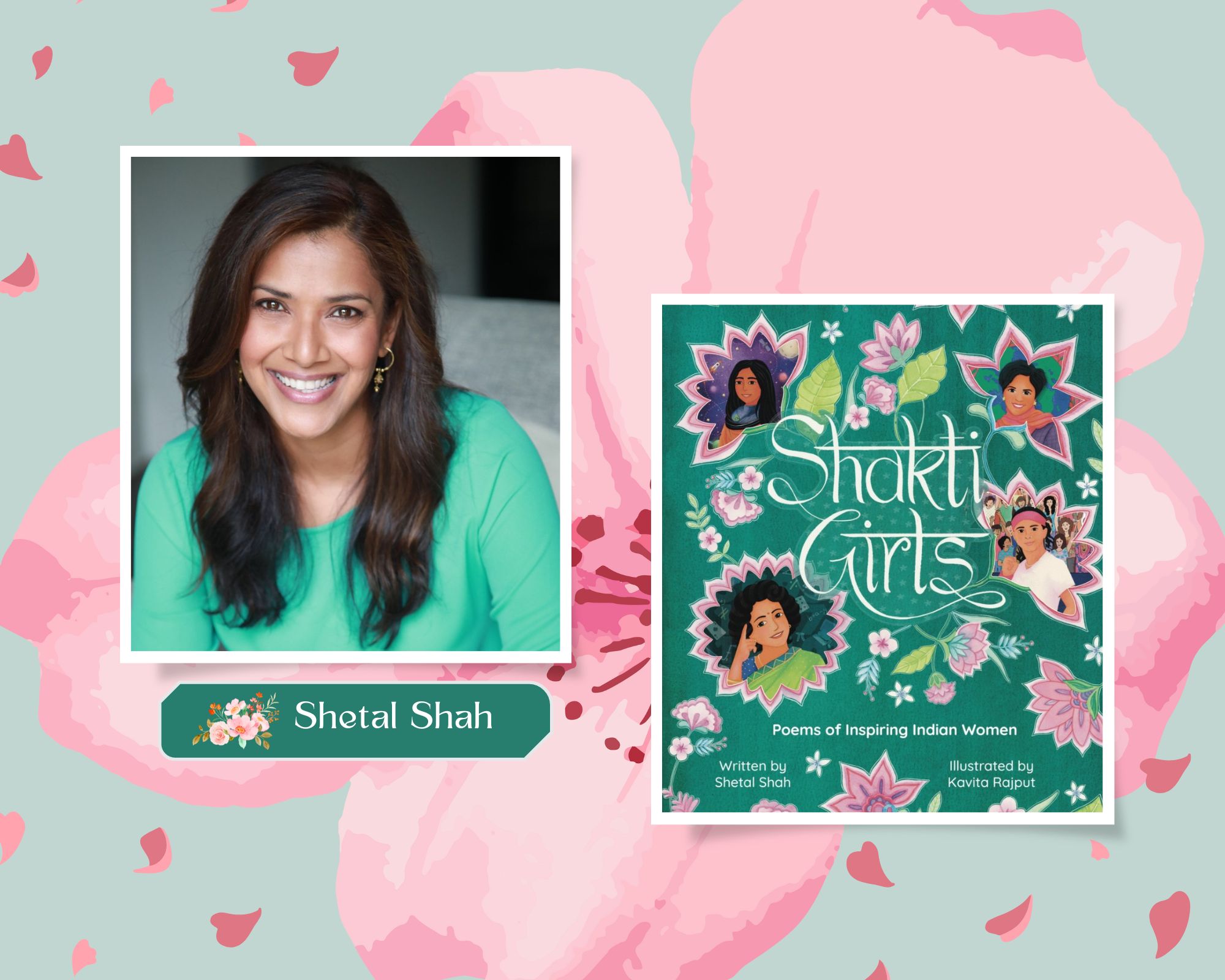
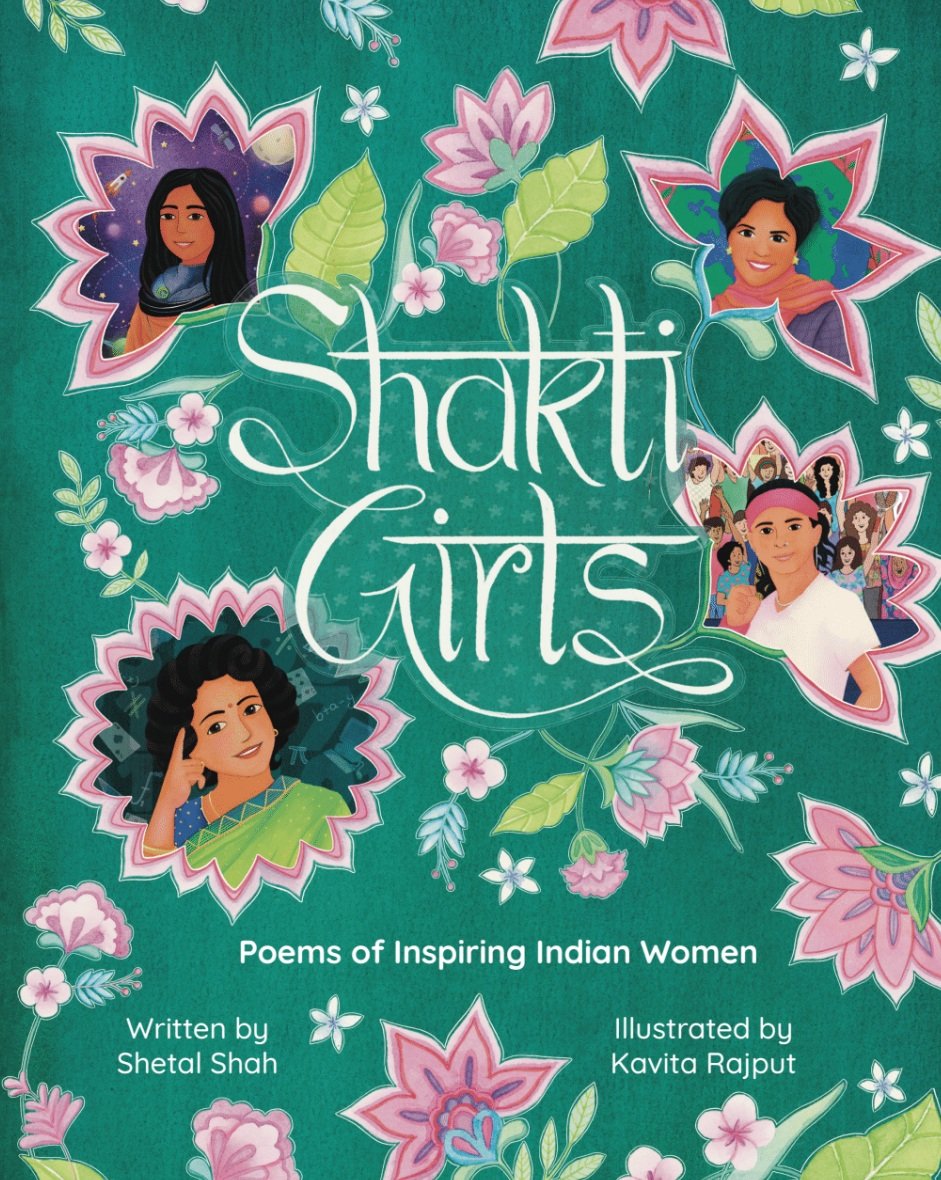
Please welcome children’s book author Shetal Shah to Frog on a Blog. Her debut Shakti Girls: Poems of Inspiring Indian Women launched just this week and is perfect for Women’s History Month! Through 13 poetic, biographical stories and colorful portraits (by artist Kavita Rajput), the book introduces kids to real Indian women who’ve accomplished incredible things in the fields of science, politics, sports, math, and activism and exemplify Shakti, a Hindi word meaning feminine energy and strength, power, and a force to be reckoned with. Shetal is a former educator currently pursuing her mission to positively impact and inspire girls from all backgrounds with her writing and to bring diversity to bookshelves. I asked her to stop by and talk about the importance of showing diversity in children’s literature and diversifying curriculum to bring visibility to all students. Let’s hear from Shetal!

The year was 1999. I was a senior in high school experiencing a heavy dose of seniorities and found myself at the local Barnes & Noble more often than planned. On one of my weekly trips, I walked into the store and a beautiful henna-inspired cover with a name that felt familiar caught my attention. The author, Jhumpa Lahiri, I knew right away was of Indian descent. Could it be that a South Asian author made it to the New York Times Bestseller list? This was new to me. I immediately grabbed the book, Interpreter of Maladies, and ran home to dig in. After a few days of indulging her words, I felt a sense of comfort, peace, and home that I had never felt from reading especially the novels assigned at school. It wasn’t long before I returned to the bookstore and actively sought out the works of other South Asian authors, including Arundhati Roy, Chitra Banerjee Divakurni, and Salman Rushdie. While there were few at the time, I knew getting my hands on as many as possible would recreate the feeling of being seen and understood as much as my heart needed.

I know my experience is not unique. Scholar Rudine Sims Bishop, who famously coined the phrase “mirrors and windows”, explained that “literature transforms human experience and reflects it back to us, and in that reflection, we can see our own lives and experiences as part of the larger human experience. Reading, then, becomes a means of self-affirmation…” When children see themselves in book pages, they feel seen and valued. They feel a sense of belonging and acceptance, no longer an outlier or exception to the full American story. As a window, diverse books expose children to different cultures and contexts helping them expand their capacity to appreciate and understand differences. “Research has shown that children notice race as early as six months, begin to internalize bias between the ages of two and five, and can become set in their beliefs by age 12.” If children are not exposed to the diversity of the world starting at a young age, then they will not be prepared to navigate and reap the benefits of this diverse world when they are adults. What better way to start than with books?

Whether it’s small steps or broad strokes, any action toward building a more inclusive curriculum and school or home library will make a positive difference in a child’s life. Families, schools, and educators either in a diverse or homogenous community can use any of the following ideas to get started:

  1. Develop an annual ritual of evaluating books in your curriculum and library. What percentage of books reflect characters from diverse backgrounds? How many were written by people of color? From here, create a SMART goal to strive for to grow your diverse library.
  2. Assess the books in your (or your child’s) curriculum, including summer reading lists. What percentage of characters and themes reflect diverse cultures and identities? Are students and families from diverse backgrounds and identities reflected in these books? Identify the gaps and find the titles to fill those gaps. For schools and educators, set a numerical goal or standard to ensure that future book lists are representative of diverse backgrounds. Families can reach out to their teachers and suggest or donate titles to add to the class library.
  3. Do your children love story time? Rotate diverse themes and characters when reading to them. Set some rules or routines to ensure you include a number of diverse selections every day.
  4. Not sure where to find diverse books? You can use tools like Diverse Book Finder, Social Justice Books, and even social media to help you discover diverse titles.
  5. Shop for books at your local BIPOC-owned bookstore. Consider partnering with them to host your next school book fair or birthday party!

Setting measurable goals and developing intentional strategies and tactics to reach those goals is an effective strategy for building more diversity and inclusion in a school’s curriculum and school or home library. By focusing on these concrete goals, you are ensuring there is measurable progress being made to close any gaps and help your children feel validation and belonging while offering a window into another world. As I moved on from high school, I sought out educational settings as both student, teacher, and mother where inclusion was starting to become normalized. As a result, I started to see myself as a valuable member of society who has something unique to contribute. I can only imagine what impact this would have made on me had I grown up with access to more diverse books. Better late than never, I say.


SHETAL SHAH grew up to the sounds of Bollywood and the delicious smells of her mother’s Indian cooking in the suburbs of New York City. As a second-generation Indian-American, Shetal hoped to one day see more stories of girls like her fill the shelves of local bookstores.

A former educator, Shetal taught world history in all-girls schools where she was reminded how curriculum and literature inclusive of women from diverse backgrounds can have a positive impact on girls’ self-esteem, identity development and belonging. Shetal also developed and led numerous educator workshops, presenting at national conferences covering topics on pedagogy and diversity and inclusion.

Shetal currently lives in Atlanta, Georgia, with her husband and her two young boys while pursuing her writing and mission to bring diversity to bookshelves with stories that inspire. “Shakti Girls” is her inspiring debut.

Follow Shetal on social media:

Facebook | Twitter: @ShetalWrites 

Instagram: @Shetal.Shah.Writes and @Shakti_Girls

Poetry Month Book Review: An Emotional Menagerie: Feelings from A to Z

Title: An Emotional Menagerie: Feelings from A to Z

Illustrator: Rachael Saunders

Publisher/Year: The School of Life/2021


I admit it, I don’t post about poetry very often here on the Frog. But, April is Poetry Month, and what better way to celebrate than by sharing a children’s picture book filled with fun poems? And lovely illustrations, featuring adorable animals?

But An Emotional Menagerie: Feelings from A to Z by The School of Life, with amazing art by Rachael Saunders, is more than a fun read. It features 26 emotions from anger to melancholy to zeal, each one encompassing a two-page spread with a new animal and setting. The goal of the book is to help children develop emotional literacy. Some of the featured emotions are more straight forward, such as boredom, fear, or happiness. And some are more complex, such as embarrassment, insecurity, or vulnerability.

Sample from L is for Loneliness:

If Loneliness was an animal,

It would glide throughout the deep:

No ears to hear its lonely song,

No company to keep.

Children experience many different emotions, and some have difficulty expressing them properly or even articulating what they’re feeling, leaving them with another feeling–confusion. An Emotional Menagerie aims to help children understand and deal with their feelings and emotions in a healthy way.

Though the rhyme isn’t perfect in every stanza, children will still likely be engaged listeners as an adult reads them each poem. And they will definitely enjoy viewing the charming animal pictures while they listen.

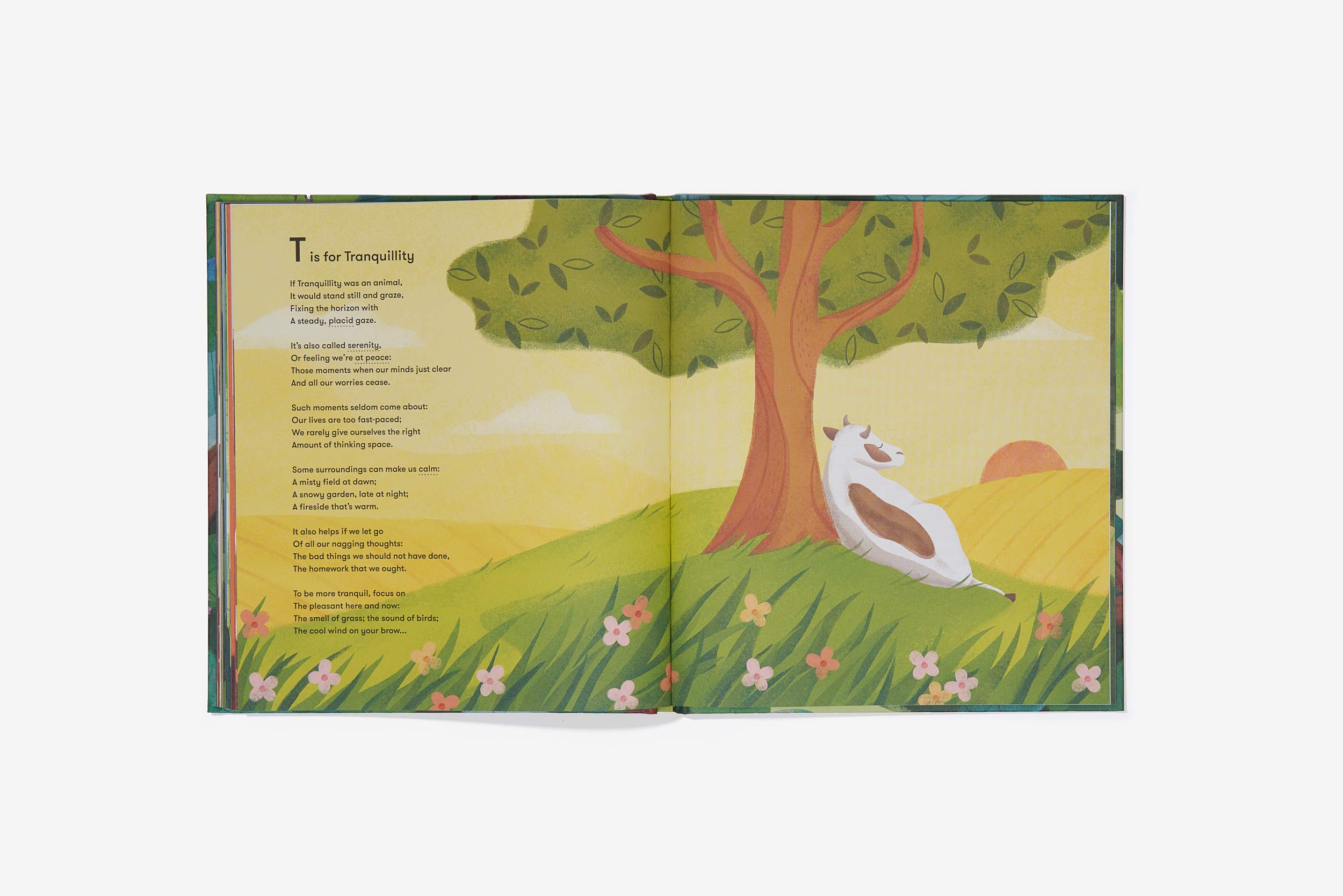
My favorite spread: T is for Tranquility

During these extra-trying days, I can’t think of a better time to share a book about emotions with our kids.