
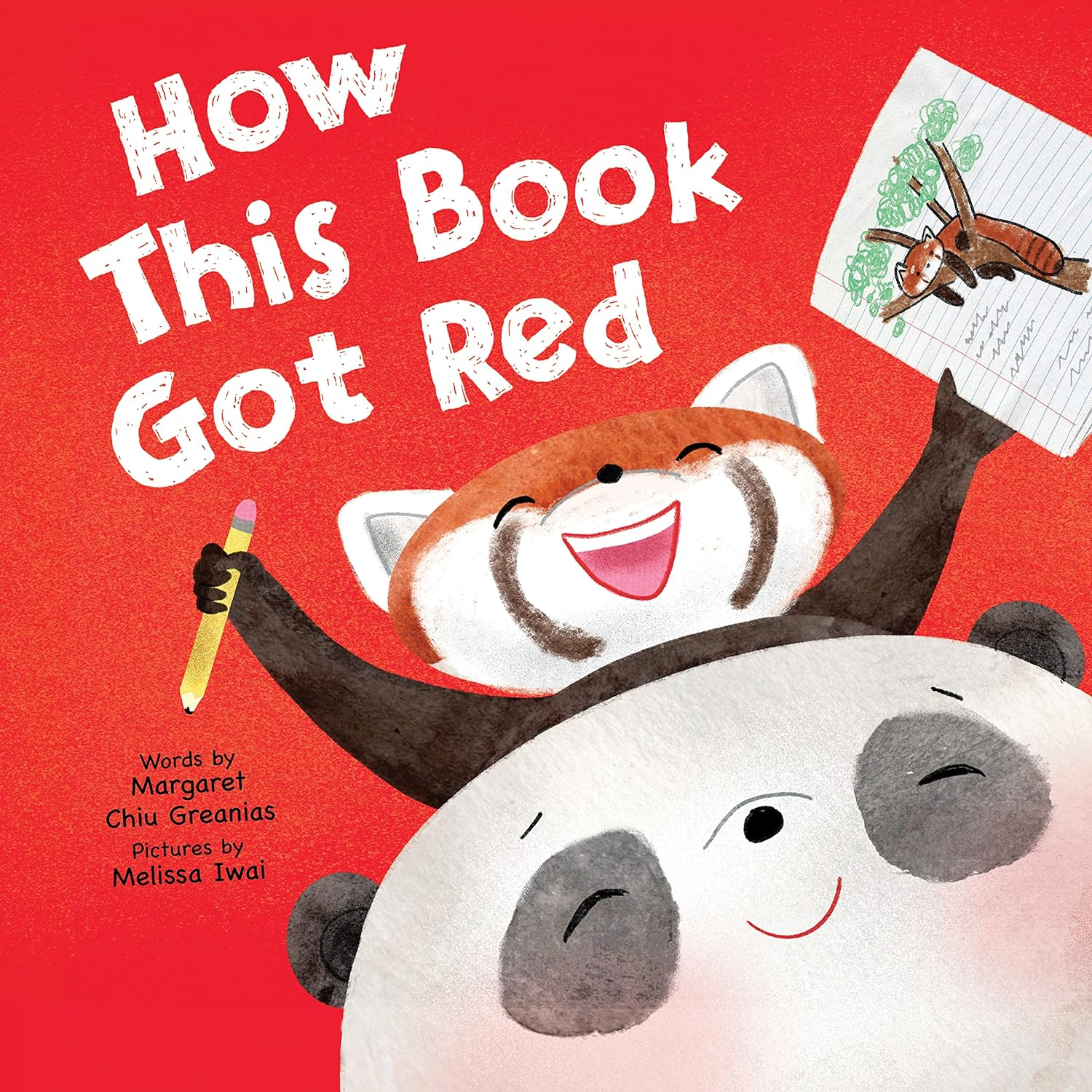
Title: How This Book Got Red
Author: Margaret Chiu Greanias
Illustrator: Melissa Iwai
Publisher/Year: Sourcebooks Jabberwocky/2023
Favorite Line from the Book: “This will be better than bamboo bubble tea!” ~Red
What’s the first thing that pops into your head when you think about a panda? Probably the lovable, ever-popular black and white panda bear, right? That would be true for me, too, if my local zoo didn’t have red pandas. Red pandas are small, tree-dwelling mammals native to the forests of the Himalayas, Nepal, Tibet, Bhutan, and China. They have the fluffiest tails ever and are just so cute. They’re also endangered due to habitat loss and poaching, so I’m thankful that my zoo is dedicated to their conservation.
I was thrilled to hear about Margaret Chiu Greanias’s new picture book How This Book Got Red, which stars a red panda named Red and her best friend Gee, a giant panda. One day, Red and Gee settle down together to read a book about pandas, but the only pandas in the book, and in the books at the bookstore, are the black and white ones. Upset by this realization, Red endeavors to write her own book all about red pandas. But she struggles to get her words down on paper and complete her book. She thinks, if there are no books about red pandas, it must be because no one wants to read about them. But she soon learns that’s not the case at all. And with a little help from Gee, she finishes writing her book, and it becomes a great success.
On the surface, How This Book Got Red is a sweet picture book about a red panda who decides to write a book about red pandas. But there’s a deeper layer to this story. Representation. Margaret Chiu Greanias, the daughter of Taiwanese immigrants, says, “Like Red, the main character in How This Book Got Red, I didn’t see myself in books when I was growing up.” She goes on to say, “I grew up feeling less than others. When I looked in the mirror, I saw someone who didn’t match my idea of pretty and never would.” Margaret says she didn’t value who she was because people who looked like her were not represented in the books she read. She believes “that the more everyone understands how the lack of representation affects those rendered invisible, the less children will grow up feeling the way I did.” In a starred review, Kirkus Reviews said: “Greanias illustrates perfectly, in a way that children will intuitively understand, why it’s so crucial for everyone to see themselves depicted in media…”
A secondary layer in the book reflects a struggle that most writers will connect with: Trying to write when the words just won’t come. Believing you have nothing of value to say, nothing that anyone’s going to want to read. Taking a chance and pouring yourself onto the page and then sending your work out into the world with a deep breath in your lungs and hope in your heart. Yep, I certainly can relate to that.
The illustrations, by Melissa Iwai, created using watercolors, colored pencils, and digital tools, are charming, colorful, and clearly done by a talented artist who has the skills and experience to bring personality to Red, Gee, and all their panda pals. Red is just so endearing! ❤️ As a bonus, readers will find a few facts about real red pandas on the front and back endpapers.
Most people recognize the black and white panda, but I think there should totally be more books about red pandas. If you’ve ever seen one in person, like I have, you know I’m right. They are Adorable with a capital A, just like this book. And something tells me that How This Book Got Red will inspire kids to be writers, hopefully, writing the kinds of stories they want to see, ones that represent them!



 Lauri Fortino's Frog On A (B)Log