
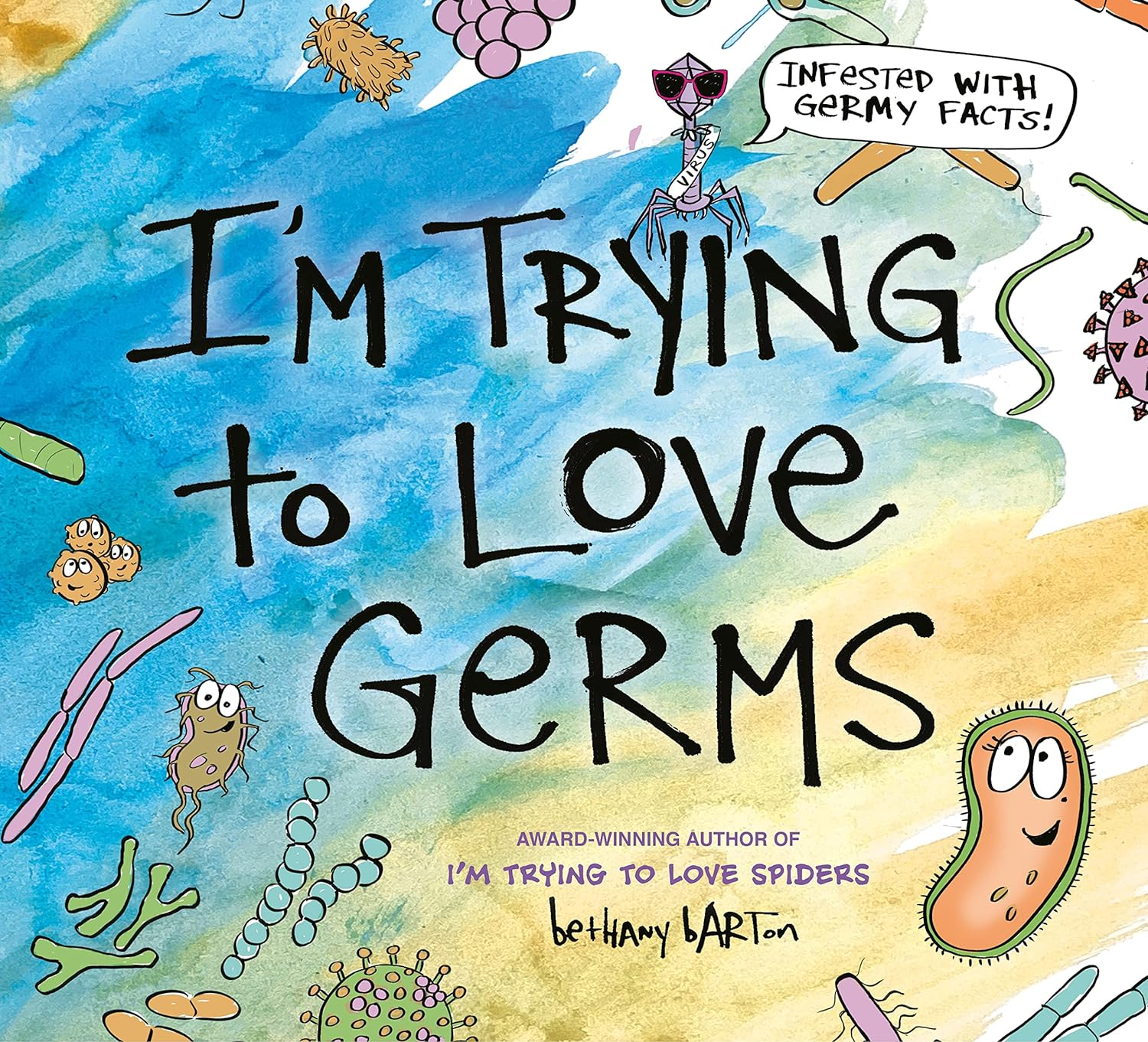
Title: I’m Trying to Love Germs
Author: Bethany Barton
Illustrator: Bethany Barton
Publisher/Year: Viking Books for Young Readers/2023
Favorite Line from the Book: And sometimes just appreciating how different something is can make you love it!
Can germs be cute? They can if they was drawn by Bethany Barton, the author and illustrator of I’m Trying to Love Germs, an informational fiction picture book that earned a starred review from School Library Journal! This fun book is the latest in Bethany’s popular I’m Trying to Love series, which includes I’m Trying to Love Spiders, I’m Trying to Love Garbage, I’m Trying to Love Rocks, and more.
Before I sat down to read this book, I was a tiny bit skeptical that I would like it. After all, it’s about germs. But the cover is so engaging–as are the covers of all of Bethany Barton’s books–so I kept an open mind. With easy-to-understand language and lots of humor in both text and art, I learned a ton about germs (a.k.a. in the scientific community as microbes or pathogens) and kids will, too, because books like this make learning fun!
In the story, a talking germ helps an unseen narrator (and readers) understand more about microbes and pathogens and develop an appreciation for these microscopic organisms. I’m Trying to Love Germs is chock-full of interesting scientific facts, such as humans have billions of helpful microbes in their bodies, and the four most common types of pathogens are bacterium, virus, fungus, and protozoan. You’ll discover doctors and scientists who work with germs, which germs make you sick, and how to avoid getting sick or how to get better if you do. More complicated scientific terms and concepts are simplified on each page, with pronunciation assistance included. Bonus back matter speaks to the importance of washing your hands so that you don’t spread germs to others.
As a good first introduction, teachers and parents may find this book useful in explaining illness or even the pandemic to children. With loads of delightful illustrations (done in ink, watercolor, and Photoshop) and even a few interactive elements, I’m Trying to Love Germs brings a potentially heavy STEM concept to life in a simple and humorous way, so much so that kids may just find germs fascinating!

 Lauri Fortino's Frog On A (B)Log