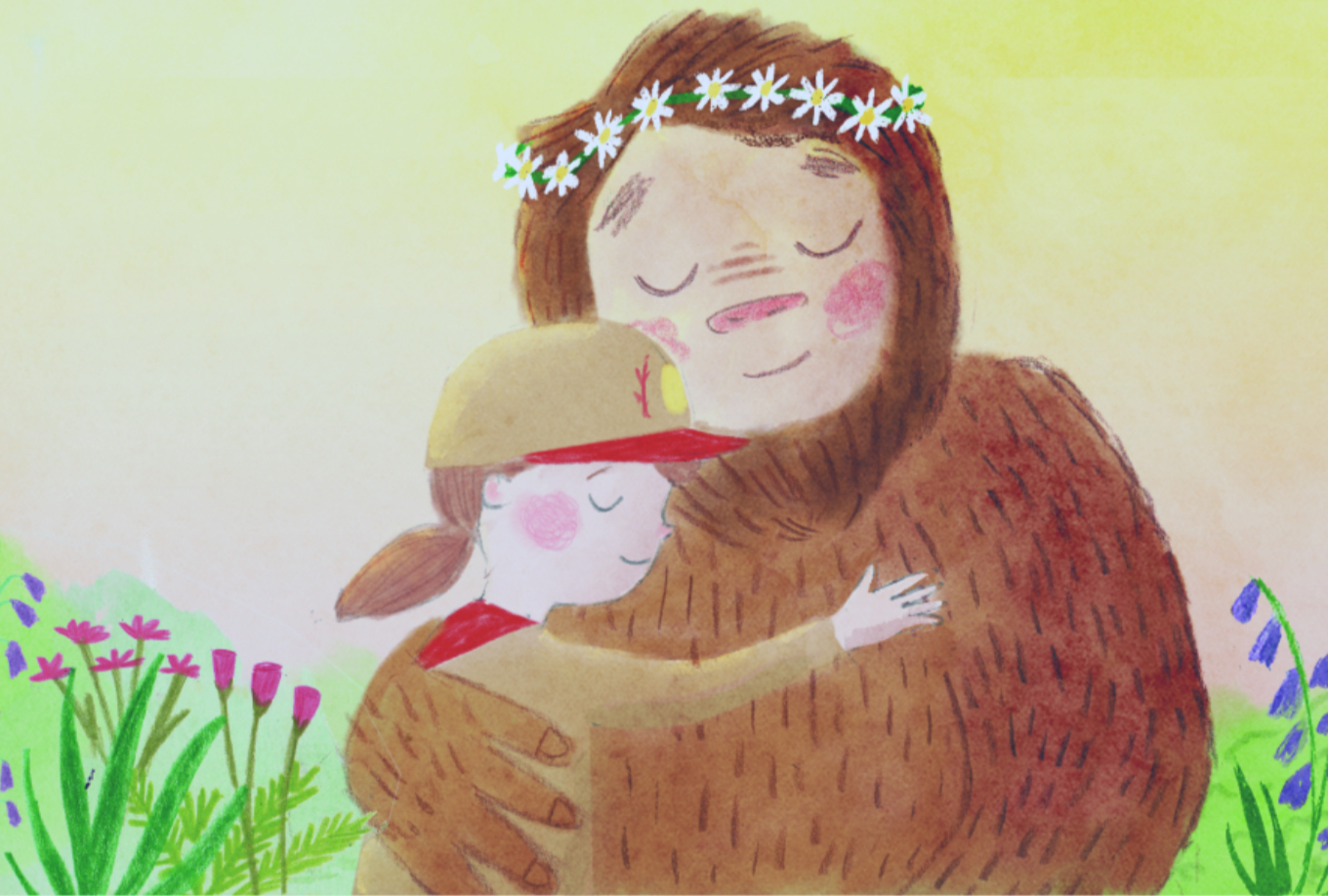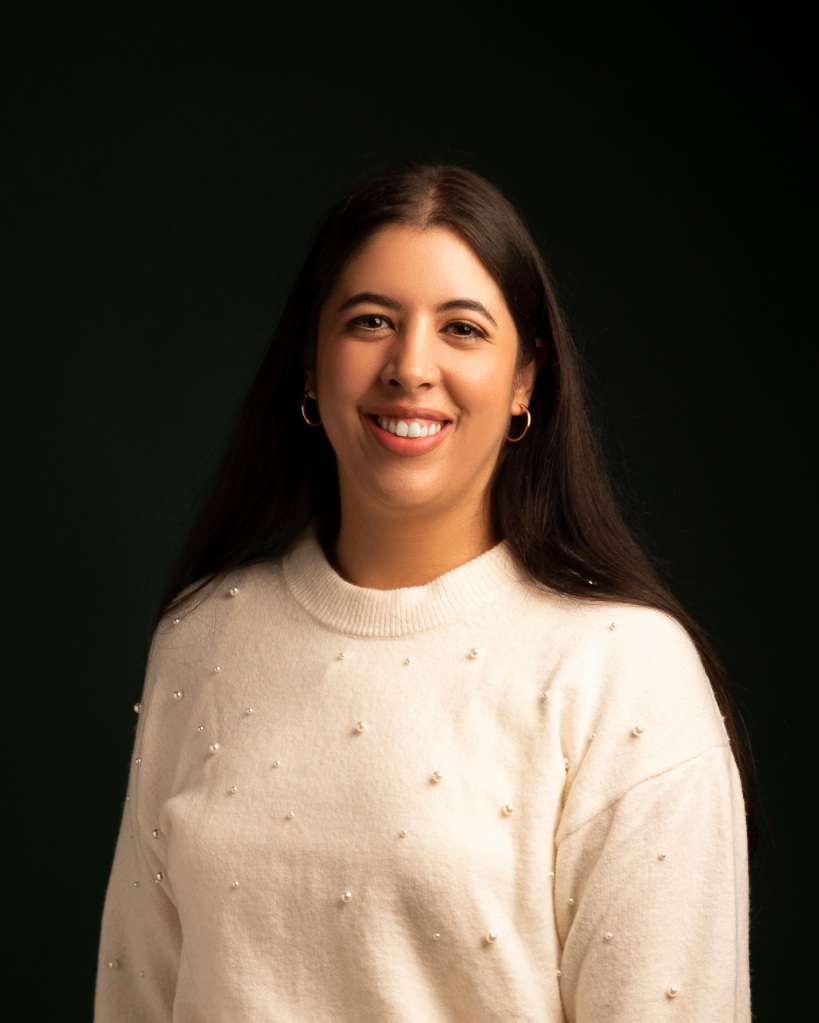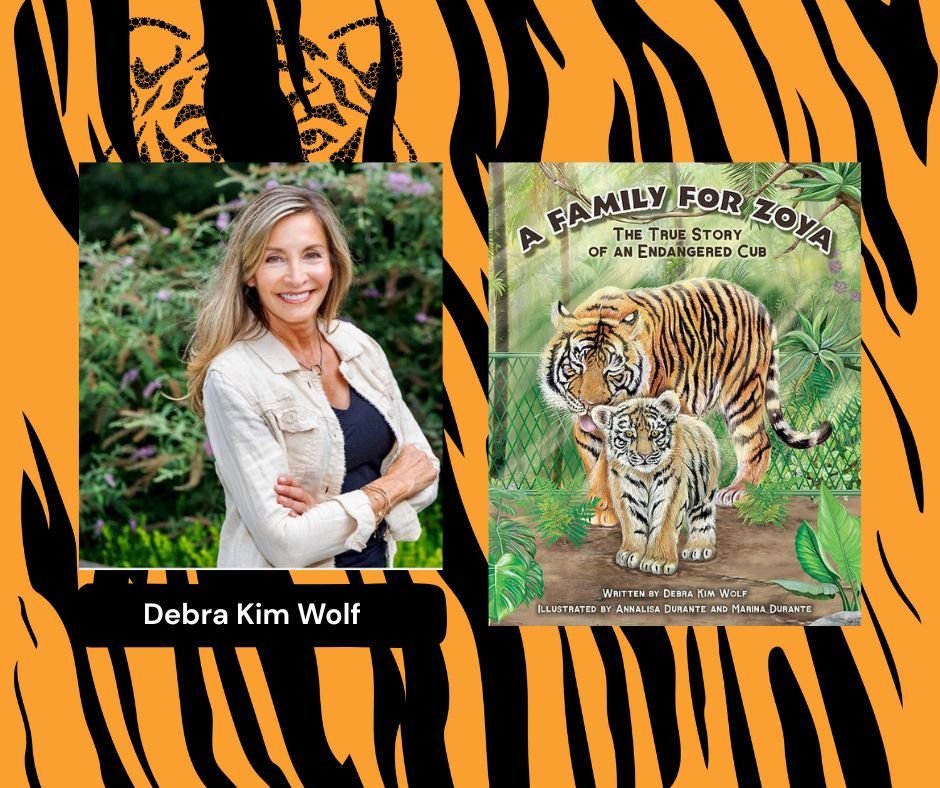
Interview Alert: Debra Kim Wolf

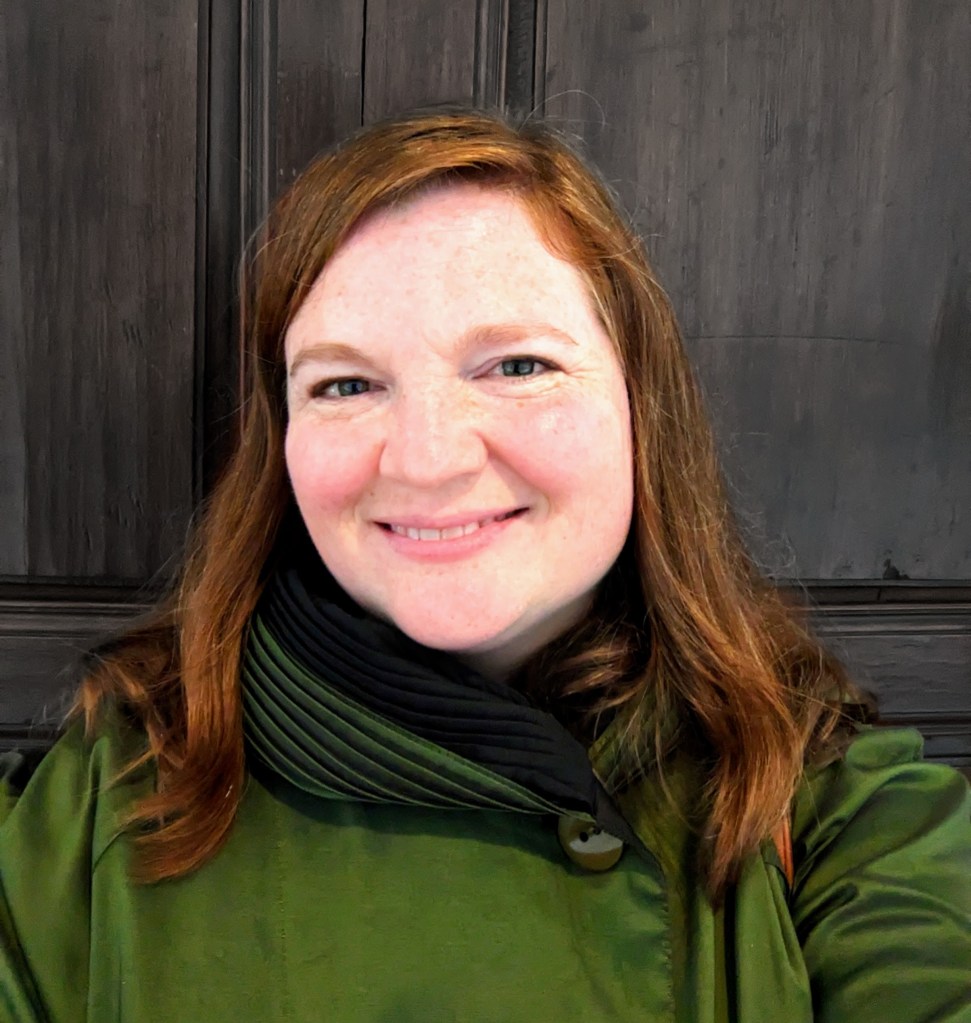
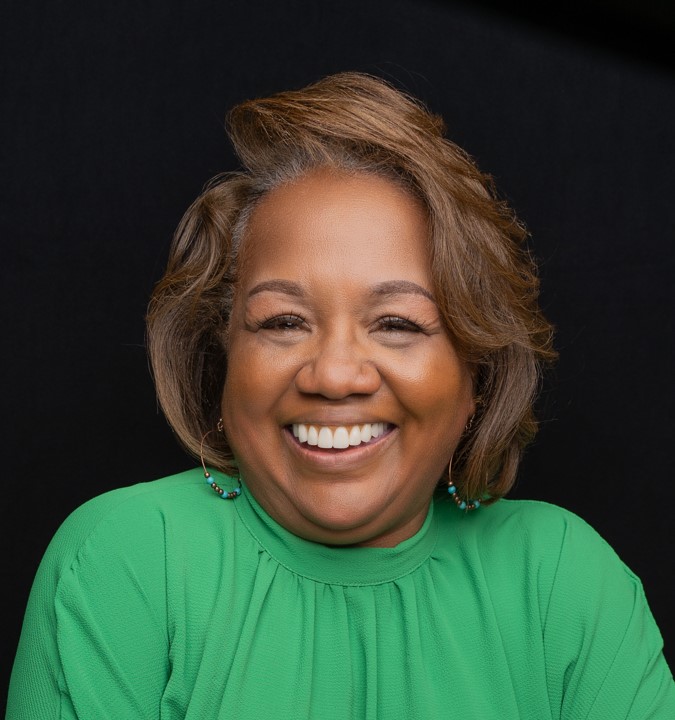
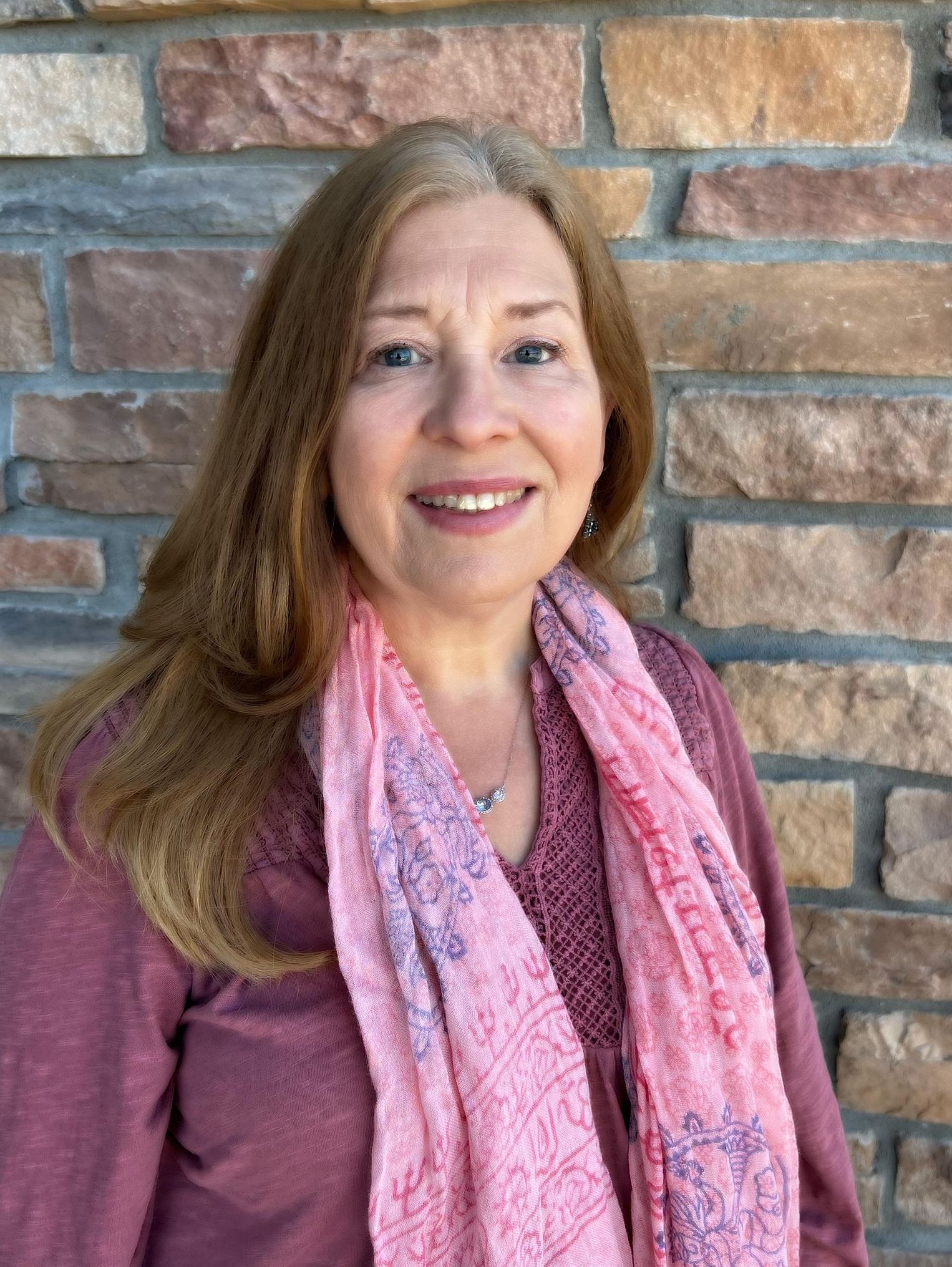
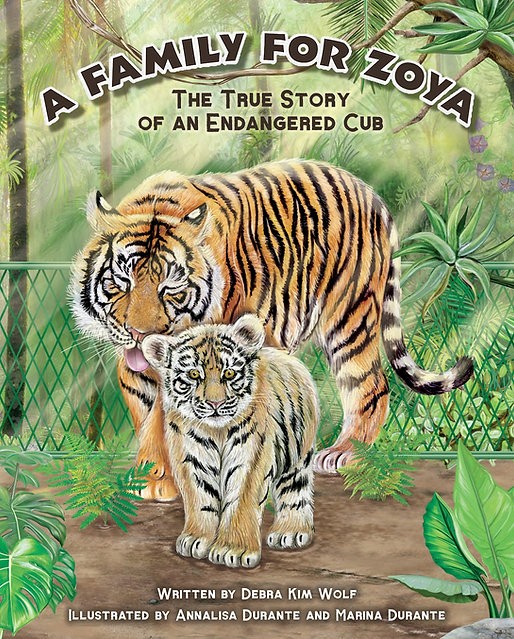
Please welcome children’s book author and land conservation attorney Debra Kim Wolf to Frog on a Blog. Debra’s nonfiction picture book A Family for Zoya: The True Story of an Endangered Cub published this past summer by Platypus Media and features lovely realistic and detailed illustrations by twin sister nature and science artists Annalisa and Marina Durante.

I love that Debra chose to write about an endangered Amur tiger cub at the Philadelphia Zoo. My local zoo has Amur tigers (a favorite of my twin sister!) as well, and a male and a female cub were born there just last year. Let’s hear more from Debra about her special book and her passion for conservation and nature!

(All text and art from the book are the property of the author and illustrators.)

Congratulations on the publication of your beautiful debut nonfiction picture book A Family for Zoya: The True Story of an Endangered Cub! What inspired you to write this heartwarming story?

DW: I appreciate the chance to share my story with your readers, Lauri. 

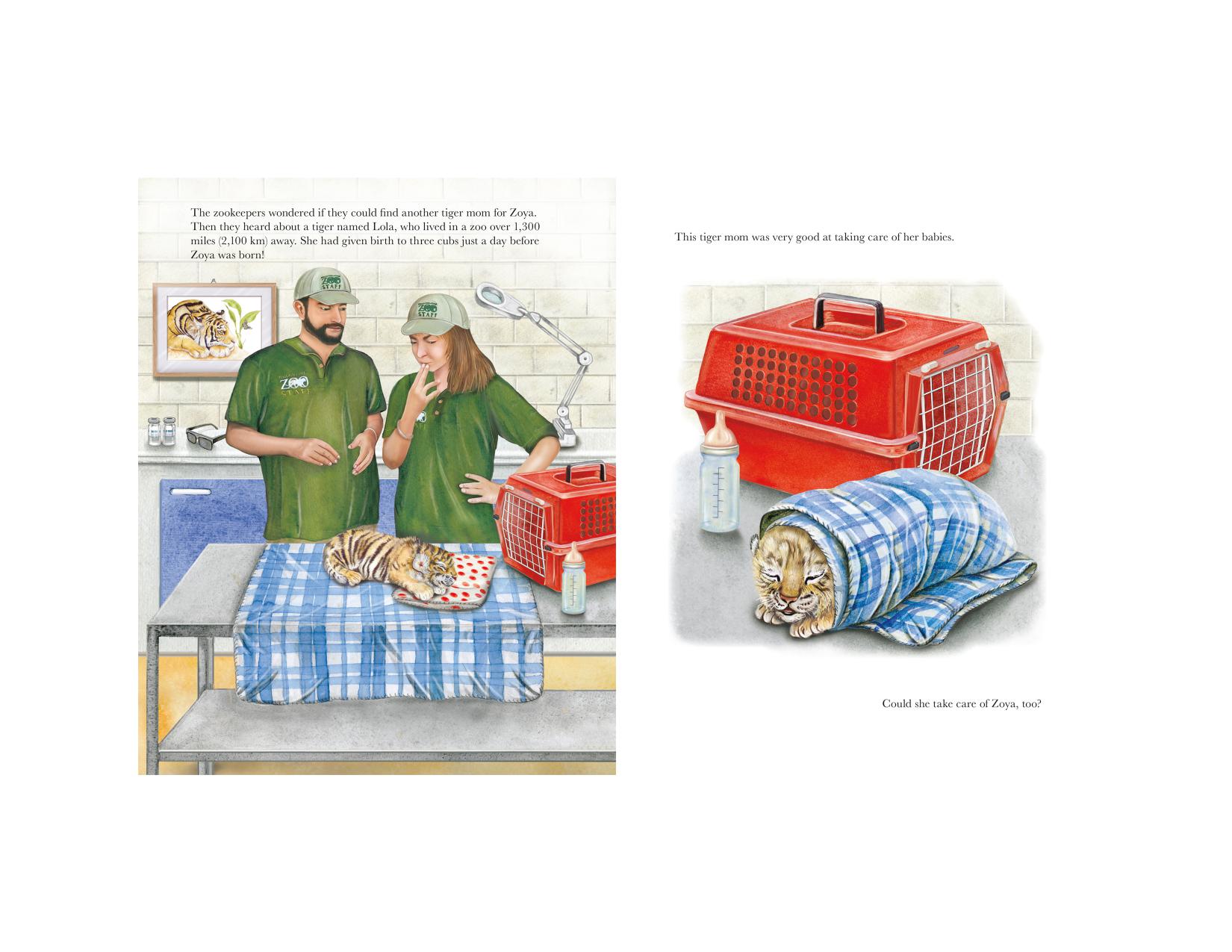
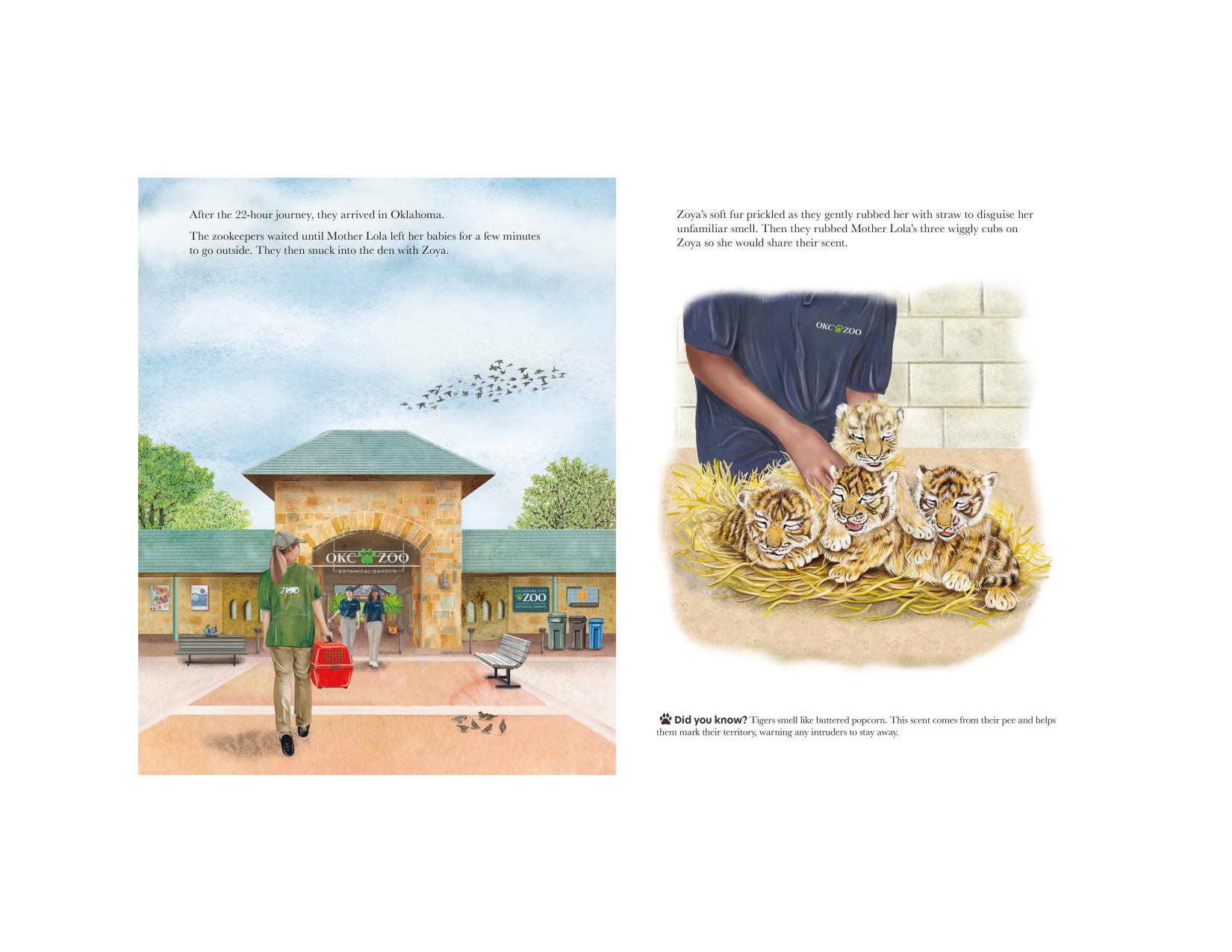
I was at the Philadelphia Zoo several years ago when I first learned about little Zoya, the only survivor from a litter of five critically endangered Amur tiger cubs. Zoya was rejected by her mother, which is apparently not uncommon for first-time tiger mothers. The zookeepers knew it would be much better for Zoya to be raised by a tiger rather than by humans. So they transported her to the Oklahoma City Zoo, hoping that a Sumatran tiger who recently had her own litter there would foster her. And, in fact, Zoya became the first cub ever to be “adopted” by another tiger subspecies! That heartwarming true storyand the cute photos of Zoya and her new tiger familymade me think it would be an inspiring book for children. 

Why do you feel it’s important for children to learn about animals, nature, and
conservation?

DW: Even as a little kid growing up near the Appalachian Trail, I knew I wanted to be involved in protecting nature. I went on to become a land conservation lawyer, working to protect farms and creating trails and parks. But kids today are exposed to too much information about how we humans have messed up the environment. At a certain point, they may start feeling that nothing they can do will help or make a difference—which is absolutely untrue! I want to write stories that are entertaining but also show children how caring people can make a real difference for our planet. Zoya’s story highlights the incredible dedication of scientists and animal care specialists in three different zoos across the country. By saving this genetically rare tiger cub—who went on to have two healthy litters of her own—these caring folks kept alive fresh genes that one day could help make wild tigers healthier.

The ingenious way the publisher structured the book makes the story multi-layered: the main text focuses on Zoya’s fight for acceptance and love; the sidebars and back matter explain more about Amur tigers, genetic diversity, and efforts to protect wild tigers via the Tiger Conservation Campaign. So the book can appeal to a wide age range. I’ve even had adults tell me they learned a lot about tiger conservation by reading the story.
You’re also a songwriter! Do you write songs for children or for adults? And what
inspires your lyrics?

DW: For a long time, my creativity expressed itself via songwriting. I’d be driving or walking and a song hook or partial song lyrics would pop into my head. Sometimes I had to pull my car over to jot ideas down before they floated away! I was thrilled to win quite a few national honors and awards for songwriting. Unfortunately, my singing and guitar playing is mediocre at best, so I’m not a performing artist.

A few years ago, for some reason, ideas for children’s books started “coming through,” too. I’ve amassed dozens of decent ideas I keep in a file folder, but there’s simply not enough time to write or polish even a fraction of them!
Please tell us about One Little Earth, the nonprofit you founded.

DW: I started and ran a successful environmental film festival in Philadelphia for a number of years until Covid shut us down. We pivoted and turned into a nonprofit that supports nature access and nature literacy for underserved kids. We’ve sent underprivileged kids to nature summer camp, donated hundreds of environmentally-themed books to Title 1 schools and after-school programs, subsidized outdoor field trips and camps, and brought in authors and illustrators to talk to kids about the creative process. You can learn more at www.OneLittleEarth.org.

Can you share a bit about your next book?

DW: My next book—a humorous story about the food chain—will be published by Science Naturally in late 2026.
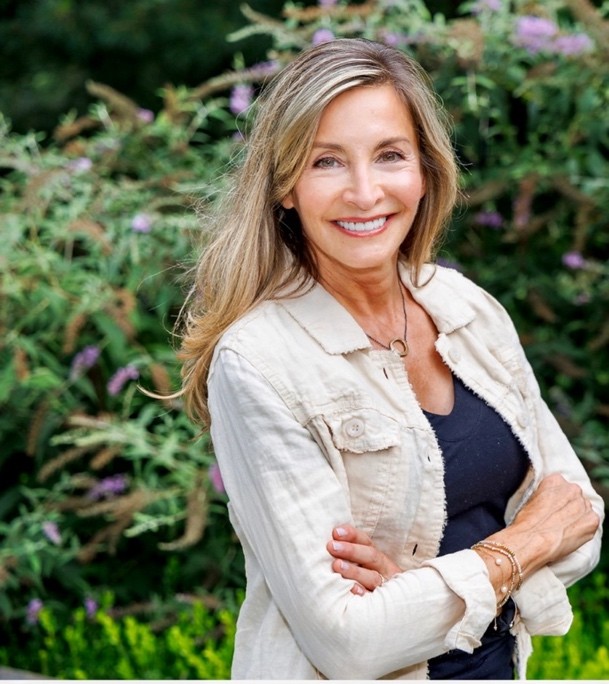
Debra Wolf is a land conservation attorney (under her married name, Debra Wolf Goldstein), author, an award-winning songwriter, and a tree hugger. She served as vice president of Philadelphia’s Fairmount Park Commission for a dozen years, and co-founded the Philadelphia Environmental Film Festival. She directs One Little Earth, a nonprofit supporting outdoor programs, films, and books to inspire young nature lovers. Debra is the proud recipient of PennFuture’s “Woman of Lifetime Achievement in Conservation” award. The mother of two grown children, Debra lives in the Philadelphia area with her husband and spunky cockapoo.

Learn more about Debra Kim Wolf and her books by visiting www.DebraKimWolf.com.


Book Information

A FAMILY FOR ZOYA: THE TRUE STORY OF AN ENDANGERED CUB

by Debra Wolf, illustrated by Annalisa & Marina Durante  

(Platypus Media, July 2025) 

Ages 6-9, Grades 1-4, ISBN 978-1-951995-29-4, Hardcover, 40 pages

https://www.platypusmedia.com/product-page/a-family-for-zoya

Debra is donating 100% of her profits to the Tiger Conservation Campaign.
Interview Alert: Joyce Uglow (+ 2 Giveaways!)

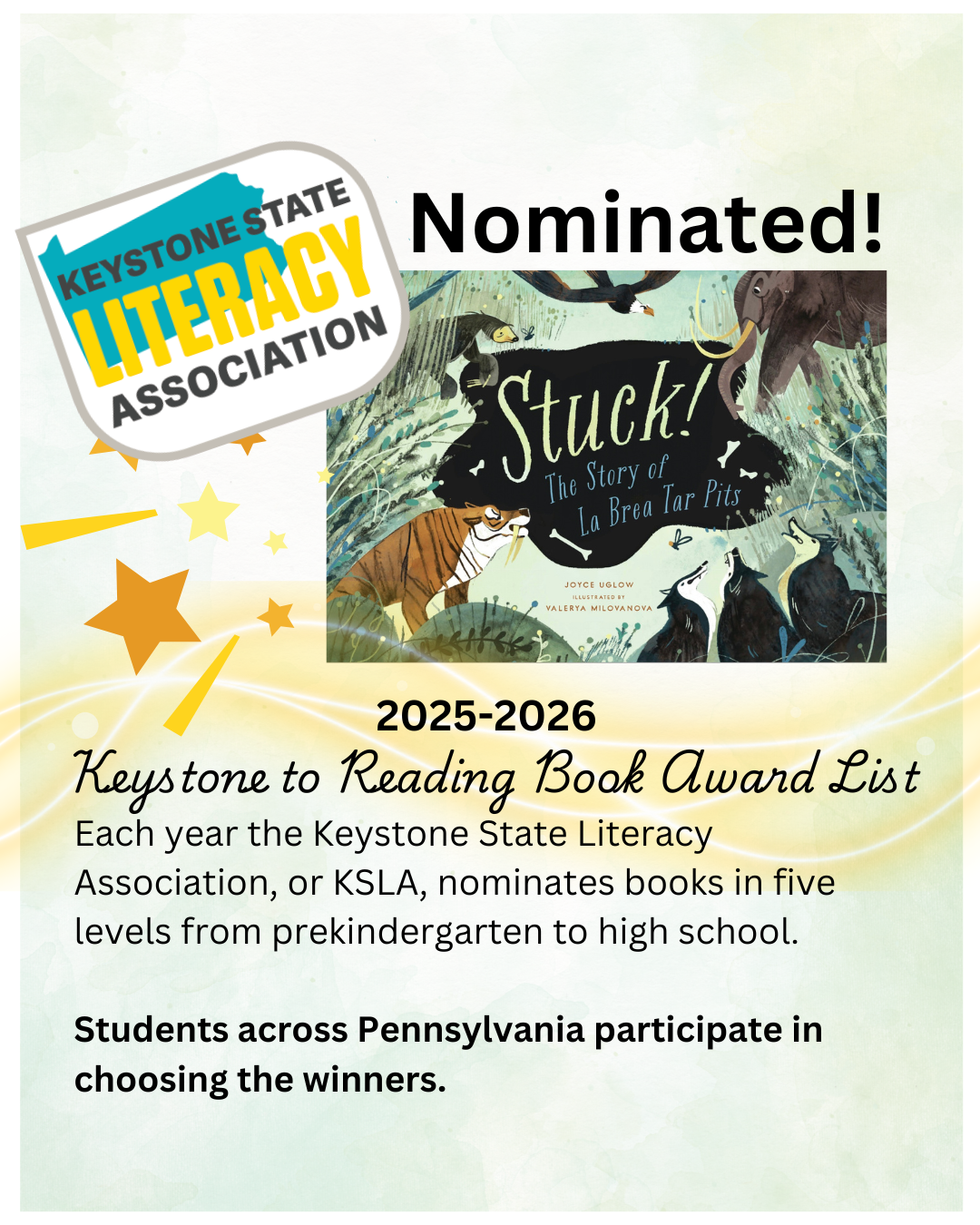
I’m so excited to welcome picture book author, poet, and educator Joyce Uglow to Frog on a Blog! Joyce’s beautiful nonfiction picture book Stuck! The Story of La Brea Tar Pits published in March by Bushel & Peck Books and features gorgeous illustrations by Valerya Milovanova.

Joyce writes lyrical children’s literature about nature, science, and our planet, and her writing motto is “Be curious. Stay unwaveringly committed to seeking answers.” No doubt it’s that curiosity that led her to write about the La Brea Tar Pits, a subject that I, too, find fascinating. Let’s get right to Joyce’s incredible and thoughtful interview! Read to the end to find out how you can win either a signed copy of Stuck! The Story of La Brea Tar Pits or a picture book manuscript critique! (All text and images in this interview are copyrighted by the author or illustrator)

Congratulations on the publication of your fascinating new nonfiction picture book Stuck! The Story of La Brea Tar Pits! Tell us a bit about the book and what inspired it.

JU: Lauri, thank you so much for inviting me to Frog on a Blog to share my debut nonfiction picture book.

Stuck! The Story of La Brea Tar Pits is a lyrical origin story of the most active urban excavation site in the world. To those who’ve never been to LA, it is a surprise to find La Brea Tar Pits located in Hancock Park on Wilshire Boulevard in Los Angeles, CA. This is where asphalt still seeps to the surface from underground. It is more than a simple origin story of the animals getting stuck or pulled out as fossils, however.

Stuck! is really about staying aware, being curious, and finding ways to search for ponds without bubbles. And climate change…mega change in fact!  

I was immediately sucked in and taken aback by the incredible stories that got stuck in what is called “the tar” in English (or “la brea” in Spanish). I began my research by standing and staring at the massive exhibits in the museum at La Brea. Smilodon fatalis (A.K.A. Saber-toothed cat) captivated me. I knew I wanted to tell Smilodon’s story. I read research and newspaper articles online and books about the Tar Pits. I traveled back to LA and attended a workshop for educators. Learning a great deal along the way, I introduced myself to La Brea paleoecologist. Dr. Emily Lindsey and paleobotanist, Dr. Regan Dunn. They agreed to chat with me online via Zoom. In those conversations, I shared the text and preliminary artwork to ensure the accuracy.
La Brea Tar Pits holds the best record of Ice Age ecosystems anywhere on earth. Millions of fossils, encompassing everything from mammoth tusks and tree trunks to snake jaws and beetle wings, have been found in the La Brea Tar Pits. Over the past century, these fossils have led to some of the biggest discoveries in paleontology, giving scientists insight into the biology, behavior, and ultimate demise of some of prehistory’s most charismatic players. This includes evidence about the largest extinction event since the dinosaurs disappeared.

Valerya Milovanova’s illustrations are so detailed and dynamic. What were your thoughts when you saw the completed art for the first time?

JU: Valerya Milovanova’ artwork brings soft greens and blues to the black of the asphalt seeps and browns of the unearthed fossils. The story begins by showing Harlan’s Ground Sloth meandering for a drink. The tension is noticed in the first spread as unsuspecting sloth gets stuck.

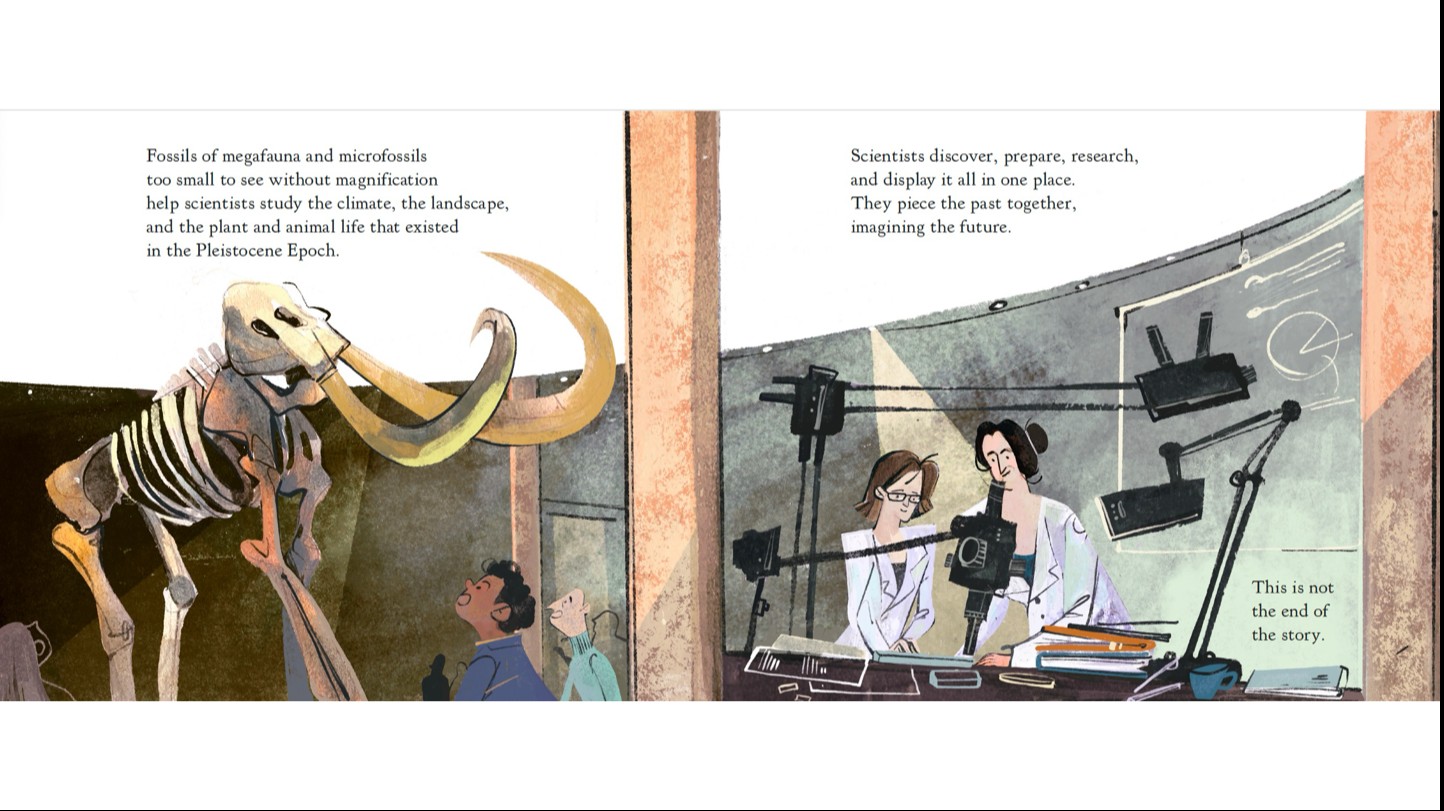
I was given the opportunity to take a look at Valerya’s art at an early stage and twice more before our book went on to its first printing. I could not stop smiling. We made a couple of changes in the art. The spread below shows the museum’s fossil lab. In early art, the two scientists were men. I asked for a change to depict Dr. Emily Lindsey and Dr. Regan Dunn. I love it!
Why are picture books, particularly nonfiction picture books about animals and nature, important for children? And do you think your background as an educator affects your writing?

JU: Science is often pulled from the news and made into picture books. I find it fun to take intriguing information and pare it down into kid-relatable narration using lyrical language. I especially love writing about bees, trees, families, cave art, parks, rocks—anything that makes me ask questions. Truthfully, I remember my own childhood questions. I must have driven my parents and teachers bonkers. 🙂

Picture books are the perfect way to enrich school curriculum, provide discussion talking points for family vacations, and enjoy the beauty of our world. As an elementary classroom teacher, I used picture books to teach writing, add to our social studies and science lessons, and to enjoy.

Yes. Almost four decades with students definitely gives me a leg up on thinking like a kid and reacting like a teacher who teaches the kids in front of me. I believe in teaching the child rather than teaching the book.

Spoiler alert… In the final spread of Stuck!, a dragonfly soars above the city of LA in search of a spot to lay her eggs. She flies on rather than getting stuck in today’s stickiness in the park. In my author visits, I like to draw attention to curiosity and the importance of asking questions. But I also talk with kids about avoiding “sticky situations”. School counselors can use picture books to get kids talking in much the same way. You know, finding a pond without bubbles.

The hooks in Stuck! include: paleontology, paleoecology, paleobotany, fossils, Ice Age animals, climate change, environment, and, in general, STEM (science, technology, engineering, math). One of the coolest things I found in my research is that fossils contain records that can provide information for the future.

For example, La Brea researchers connected human-caused fires to the largest extinction event (Ice Age) since the dinosaurs disappeared. Humans coexisted alongside Ice Age megafauna for 2,000 years. Charcoal remains were found in Tar Pits fossils in the last 300 of those years. Hmmm… the drying, the warming, the loss of plant life with subsequent loss of herbivores and then carnivores, the fires… Stuck! is a book that connects everyday with Earth Day, National Fossil Day, and the impact of humans on the environment. Whether I am speaking to kids and adults at book stores, library story times, or schools, I connect Stuck! The Story of La Brea Tar Pits to caring for our planet. I hope that someday humans will reduce the use of plastic, plant and plan for the future. We have the knowledge. By acting responsibly, we can stay clear of ponds with sticky bubbles.

You’re also a poet. Do you write poetry for children or for adults? And would you share an excerpt from one of your poems?

JU: I’ll start my answer with some literacy research cuz that’s who I am too. 🙂

Reading one to three picture books to children per day over a year’s time is proven to enhance children’s quantity and quality of emotion vocabulary exposure. Picture books provide the opportunities for emotional literacy development that is needed for children’s capacity to construct and categorize their own and others’ emotional experiences. It also facilitates learning from others, enabling children to affectively align in peer interactions. “Picture books contain vocabulary that is more emotionally intense than models of child-directed speech, and picture books typically feature narratives containing emotional situations and opportunities for emotion talk.” (Source of the information above.) Poetry goes hand in hand with writing picture books.

I write kidlit poetry and love to condense my research findings into spare text for picture books.  

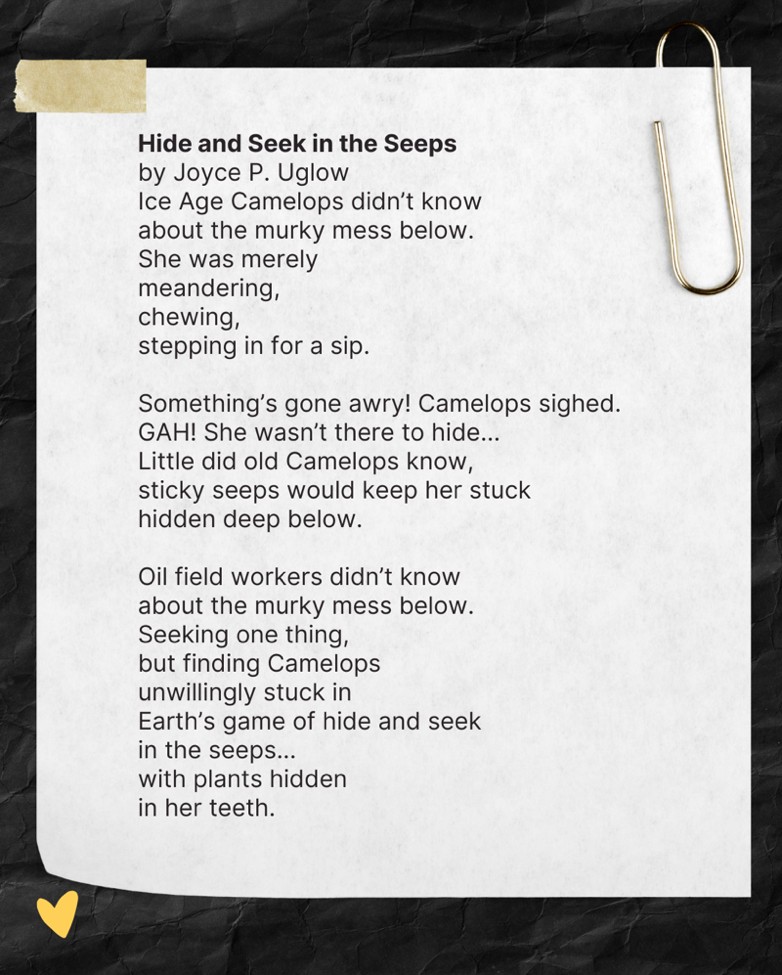
From mid-March to mid-April, Cindy Mackey, fellow picture book poet and I hosted a STUCK! Bumblebee Poetry and Illustration Challenge on Instagram, BlueSky, and SubStack. During the 35-day challenge, we sent out one-word prompts on Joyce’s Instagram and BlueSky and on Cindy’s Instagram and Cindy’s BlueSky. We encouraged readers to use the prompts to spark their own poetry and illustration creativity. Each word was pulled directly from the text of our lyrical picture books.

Hide and Seek in the Seeps uses a variation on the hide and seek poetry form. HERE is a link to my website where you can find all of the prompts and poetry form descriptions.

What other fascinating topics are you currently writing about?

JU: I have nonfiction picture books out on submission. I love to focus on our planet’s natural beauty and destinations where families can visit. In addition, I have a nonfiction picture book biography of an author-illustrator whose life was dedicated to art and inspiring kids to create their own art. This person is an important contributor to children’s literature. Her art had stories to tell.

Joyce Uglow has been asking questions and collecting words since an early age. Retired, she now writes picture books and poetry for children who are also intrigued by words and our wondrous world, books that educators, librarians, and kids tell each other about. She currently serves as SCBWI Wisconsin’s Co-Regional Advisor and in 2026 will take on mentees as a part of the Mighty Mentor in the Mighty KidLit platform. She is unwaveringly committed to sparking kids’ interestsHer mantra… elevate others & prioritize joy.

She enjoyed a wonderful 37-year career in schools, beginning as a teacher for students who needed that little something special in order to be successful with literacy. She was fortunate to have worked with students who taught her a great deal about being there for them. She, in fact, taught many, many kids to read through writing. Her experiences in classrooms and resource rooms, led her to the school office where she had the pleasure of serving as principal at Lyons (a K-4 building) and Dyer School (a 4-6 grade building). Both buildings housed public school Montessori programs as well as traditional and resource programs. Along with her career path, she got actively involved on the Board of Directors and conference planning for the Wisconsin State Reading Association (WSRA). Besides serving as WSRA president, one of her favorite volunteer positions had to do with the Young Authors Festivals. When she retired from her day job as principal, she put her mind to work on writing for children. It was a natural next career for her.

To learn more about Joyce and her books, visit her online:

Website: http://joyceuglowauthor.com

Linktree: https://linktr.ee/jpuglow?utm_source=linktree_admin_share 

Instagram: https://www.instagram.com/jpuglow/?hl=en 

BlueSky: https://bsky.app/profile/jpuglow.bsky.social 

SubStack: https://substack.com/@jpuglow

Goodreads: https://www.goodreads.com/user/show/9178331-joyce-uglow  Pinterest          https://www.pinterest.com/jpuglow/

Pinterest: https://www.pinterest.com/jpuglow/


2 GIVEAWAYS!

Folks, we have two fantastic giveaways today! Joyce is generously offering a signed copy of her fabulous book Stuck! The Story of La Brea Tar Pits to one lucky winner AND a picture book manuscript critique to another lucky winner. Just comment on this post by September 29th and mention if you’d like to be entered to win the book or the critique or either. I’ll choose two winners at random and connect them with Joyce. Good luck! (Book giveaway open to US residents only)

Interview Alert: Elayne Crain

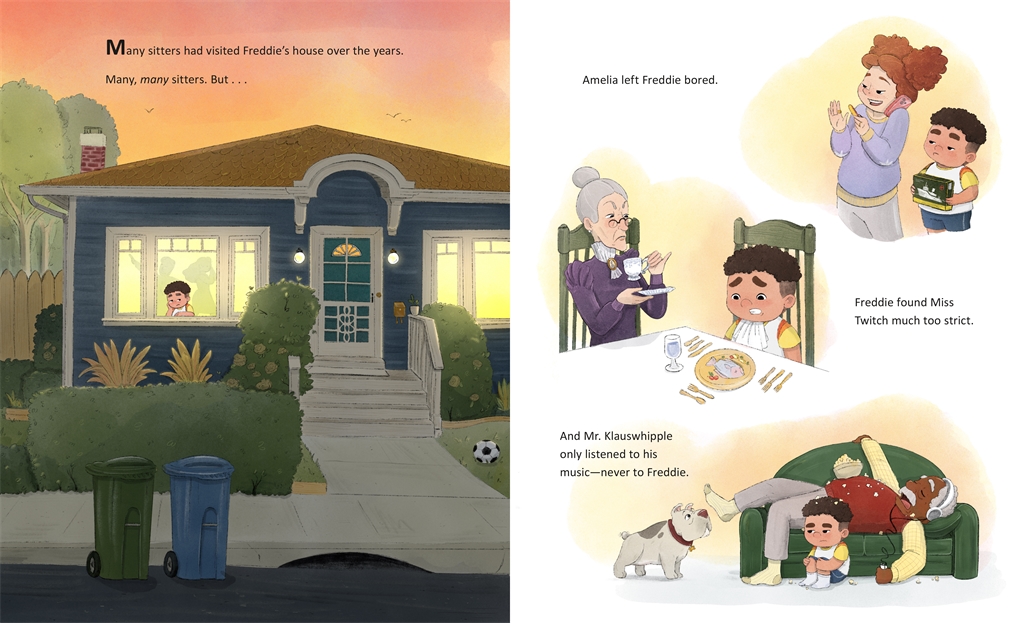
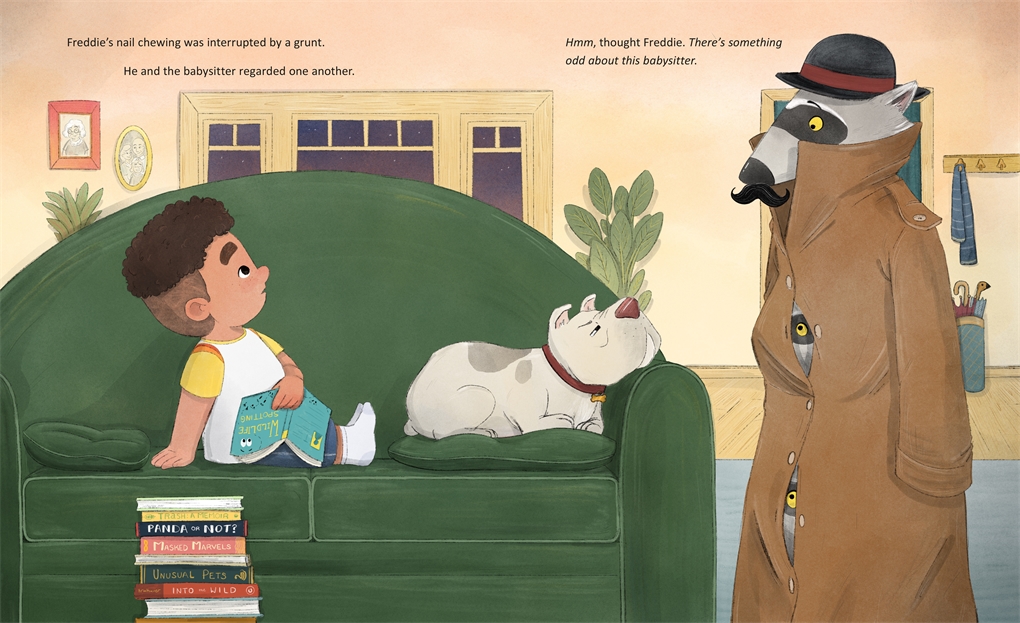
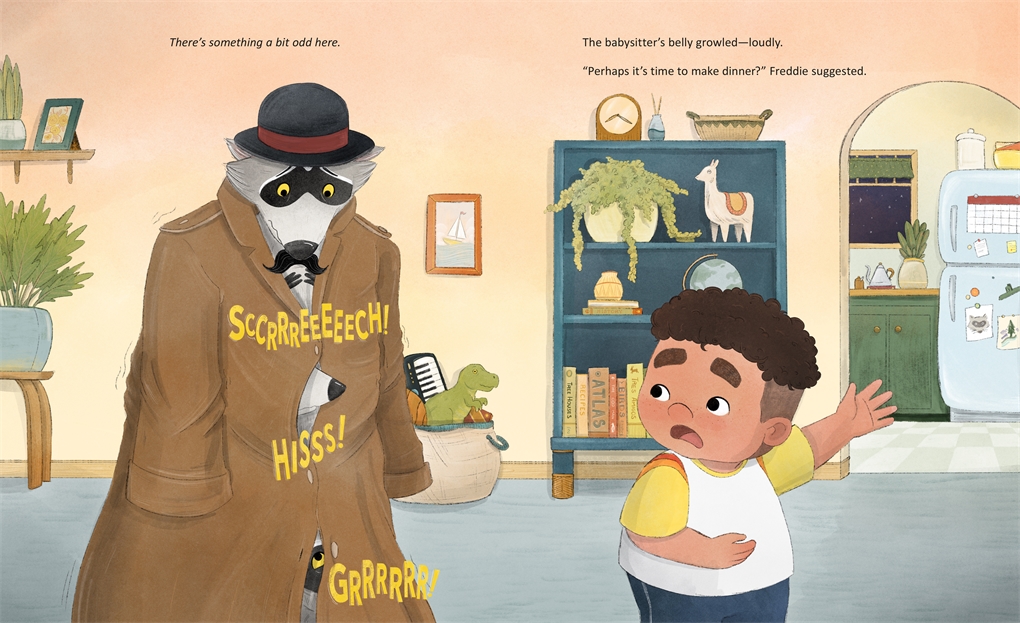
I’m excited to welcome picture book author Elayne Crain to Frog on a Blog! Elayne was my picture book writing mentor for a few months through an Inked Voices mentorship program. Elayne is super sweet and so funny and just a genuinely nice person. She’s here today to talk about her rib-tickling debut picture book There’s Something Odd About the Babysitter, which published in June from Feiwel & Friends and is a July/August 2025 Kids’ Indie Next pick over at the American Booksellers Association. Please enjoy the interview! (Bonus: You won’t want to miss Elayne’s five literary “star qualities” of picture books!)

Huge congratulations on the publication of your hilarious debut picture book There’s Something Odd About the Babysitter! Please tell us a bit about the story and what inspired it.

EC: Hi, Lauri! It’s so lovely to chat with you again! Like most picture books, the punchiness of the form belies the years of work that went into making it. 😊 But I will say I was a babysitter, first for my brothers and then for others, from about age 8 onward, and since both my parents worked, I certainly had my fair share of sitters throughout my lifetime. So, I knew I was very interested in (and hopefully suited to) telling some sort of babysitting-related tale.

There were lots and lots of things that went into both the plotting, and the writing, over years of revisions, especially some of what I find funny (including, but not limited to, the name Freddie—a nod to a Steve Martin character I loved as a child—plus some viewing of Shaun the Sheep with my kids). Everything got blended into the ol’ Elayne Crain Brain™…et voilà: this strange mix!

Text © Elayne Crain, 2025. Image © John Ledda, 2025.

How excited were you when you saw the illustrations for the first time?

EC: I was very, very excited—like, “Drop everything—I just saw an email!” excited! I will say, I was also very lucky—I got to see the first sketches, as well as the rounds in-between. So, it wasn’t all just one big “Christmas morning” final illustration smorgasbord, but rather a series of lovely surprise courses over time. I know that doesn’t typically happen, especially for first-time authors, but it was such a great learning experience for me to get just a peek behind the visual storytelling curtain in that way! I’m still so honored to have been trusted to witness some of John’s process for this story—he really is fabulous.

When did you begin writing with an eye toward being published? And do you write other things besides picture books?

EC: If I’m being honest, I always cared about being published someday (in at least a daydream sort of way), so I guess from day one—actually before, because the dream came many decades before the actual hard work. 😂 While I’ve always been a writer and puzzler at heart, the big difference came from finally admitting to myself that if my dream of being published was going to happen, I would need to, you know, start doing real work to get there. That didn’t happen until my 40s, and I haven’t hit my 50s yet, so it’s fair to say it was a steep learning curve to specifically write picture books, despite having written (in lots and lots of forms) my whole life.

Besides picture books, I enjoy writing poetry, middle-grade fiction, and writing about my writing (aka, blogging). I also have some adult writing (not “racy” adult, but, say, a guide to yard sale shopping, a few half-formed mysteries, stuff like that). Maybe someday that will go somewhere, but I think I’m meant to write for children, really, and picture books are certainly my favorite literary forms. It’s so nice to finally really understand that about myself.

Text © Elayne Crain, 2025. Image © John Ledda, 2025.

What is one of your favorite recent picture books? What is one of your favorite classic picture books?

EC: Oh, boy. I have so many favorites. I’m going to cop out re: recent and point to my Goodreads, because I’ve done a lot of work there to catalog some of the many, and why.

Growing up, for my first four years, my favorite picture books were the handful we had in our house, which I bet I can recall even now: The Monster at the End of This Book, The Very Hungry Caterpillar, Farmer Small, Cowboy Small, Where the Wild Things Are, The Giant Jam Sandwich, Scuffy the Tugboat, A Tiny Family, Curious George, Madeline, Lovable Lyle, and Are You My Mother? (which I think of as a picture book—the pictures add essential story information, such as with the Snort). Although once I was finally a schoolkid, with regular access to a school library, that was a game-changer. I would check out nearly anything, and repeatedly hogged anything funny, by James Marshall or Shel Silverstein, or folk-tale-related. I often went before school, sitting in the hallway until it opened each day, since my mom’s work schedule meant she dropped me off well before school started.

Why do you think picture books are important for children?

EC: This is a great question, because it really gets to the heart of what makes picture books so incredibly powerful (not only for children, but *especially* for children). And it’s something I have thought about a lot, though I will undoubtedly continue to do so.

I think, for me, picture books have five literary “star qualities”:

Immersiveness. Because the visual storytelling is so deep and so gorgeous, the child reader who does not yet read words can read the visual story alongside their grownup, and comprehend even more than the adult, since they are taking in the full information (while the adults are often very caught up with the words while reading).

Theater (or, “ The Theatre!”, if you must). Outside of many lullabies (which, honestly, I’ve been shocked to hear many parents aren’t even really doing anymore—instead, relying on professional music, which is so very sad to me!), picture books are going to be most children’s first taste of theater, with their parents and caregivers as the performers. In my subgenre, humor, the fact that (if I write the story ‘right’) the parent could suddenly seem like a comedic genius to their child is not lost on me, and I highly value that “bonding over” aspect, the strange sort of catharsis that both the performer, and the audience, go through, once a story is brought to life in this way.

Interactivity. One notable asterisk to the theater of a picture book is that, of course, it’s not ONLY the read-alouders who are involved in the performance of a picture book. So often, you can work with the format to bring the audience IN, even more than theatre—say, by joining in a chorus (which we call a refrain), or by including meta elements (which, for my money, The Monster at the end of the Book is the absolute gold standard). In fact, what I know from reading to lots (and lots) of children over my life is that children often appoint themselves as the official “page turners” of a picture book. So, if they are bored halfway through the text on a page, guess what? The page turn becomes a SKIP button! (Parents themselves do this, too, of course: “skipping” tedious sections.) Writers should prepare themselves for that, and keep their prose punchy and purposeful, even when (maybe especially when) it’s lyrical.

Virtually limitless subject matter. Because illustrations have no age boundaries (well, within certain accepted parameters, ha ha), there is no absolute limit to the kind of story you can tell—using too big or niche words is not really a concern, when the words themselves are only part of the story being conveyed. Because it’s about the young readers’ visual vocabulary, rather than their spoken or read one, the storytelling can be really intense and/or poetic, and the reader can absorb it all the same.

Snacky. Because of their succinct format, picture books are, in some ways, very snacksome. You can sit down and enjoy one, if you are in a hurry, or you can sit and make a virtual meal of them. Because of that, because the child can so often choose the ones they want to be read, it’s one of the few ways a child can healthily emotionally self-medicate. I think about this a lot as I choose the sorts of stories I want to work hard on, vs. ones I leave as drafts. “Is this a story a child would choose to read, themself? Will it make them feel what they want to feel, in some way?” And it is also an essential reminder to myself that writing humor is, in fact, supremely important, especially during stressful times.

Text © Elayne Crain, 2025. Image © John Ledda, 2025.

What other creative endeavors do you dabble in?

EC: Oh, I fancy myself a lifelong student and crafter, so there’s not much I haven’t (or wouldn’t!) try my hand at. I do love visual art (especially sketching, painting, and papercraft) and needle felting. At some point, I’d love to have a picture book where I told the visual story, too.

Funny side story: my first coloring book was the Gray’s Anatomy medical coloring book (my dad was in med school—so it was my go-to for coloring since he bought it but didn’t use it much). I’m still more ‘drawn’ to making line art than to fully fleshed-out imagery when I pick up a pen, but I’m working on finding my way toward real illustration, including (gulp!) backgrounds. 😊


Elayne Crain is the author of There’s Something Odd About the Babysitter (illustrated by John Ledda), a Summer 2025 Kids Indie Next List pick. When she isn’t writing, she enjoys LOLing at memes, drinking sugary coffee, and scouting thrift stores.

You can find Elayne wasting time at: https://elaynecrain.substack.com, Instagram, and Bluesky.  

Interview Alert: Sherry Roberts

Please welcome multi-published children’s book author Sherry Roberts to Frog on a Blog. Today is All American Pet Photo Day, so it seems like a great day to feature Sherry and her brand new picture book Amica Helps Zoe, which is about a loveable rescue dog and the little girl who loves her.

I love dogs, and I love picture books about dogs. My little rescue dog recently passed away, so this story really tugged at my heartstrings. Let’s hear more from Sherry about this special picture book and some of her other books, which include nonfiction picture books, a middle grade series, and a new chapter book series.

Congratulations on the publication of your new picture book Amica Helps Zoe! Please share a little about the story and what inspired it.

SR: Attention, all dog lovers! Prepare to embark on a heartwarming journey with Amica and her rescue dog, Zoe. Set in a cozy neighborhood filled with leafy trees and friendly neighbors, Amica’s biggest challenge is convincing Zoe to enjoy walks. Despite Amica’s love for Zoe, she can’t help but feel frustrated and worried that Zoe will never overcome her fear of being abandoned. But with determination and love, Amica shows Zoe that a walk is just a fun adventure and not a scary separation.

This story was inspired by one of my nieces. When she was 5 years old, her family got their first dog. My niece wanted to walk her dog in the neighborhood, but her dog would not walk. Halfway through the walk, the dog would sit down and not move. My niece would have to carry the dog home. As the dog got bigger, it got harder for her to do. For Christmas, she asked Santa for a red wagon so she could ride the dog around the neighborhood. This solved her problem, and she was so happy.

As I was developing the story, I decided to make the dog a rescue dog. The dog I had at the time, Gizzie, would not take a walk, or a ride in the car. This was because he had been driven away from his home and thrown out in a field, abandoned. I thought about how rescue dogs often have problems with abandonment. This led to the story focusing on working with a rescue dog who had a fear of a walk leading to abandonment. I had tried to help Gizzie with walks and learned that so long as he could see the house, he was ok.

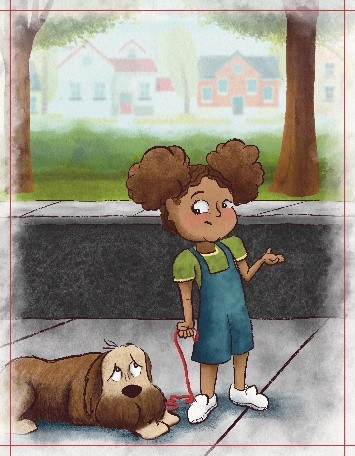
Image from Amica Helps Zoe

What path did you take to publish your book—traditional, self-publishing, or hybrid—and why?

SR: I have traditionally published a couple of books with very small publishers but found that to not be the path I wanted to take. I am now indie published through Solander Press. I find this to be an easier and more enjoyable path to publishing for me. I like the freedom to choose projects, illustrators, editors I work with, and basically a say in all the steps to publishing this allows me.

Image from Amica Helps Zoe

What do you hope young readers will take away from reading your book?

SR: With Amica Helps Zoe, I hope young readers learn that it is best to understand others before making a judgement and then to look for ways to help. For Amica, she became frustrated with Zoe because she wouldn’t walk. As Amica learned Zoe’s story, she better understands the reason Zoe doesn’t like to walk. Then Amica looked for a way to help Zoe learn to trust again.

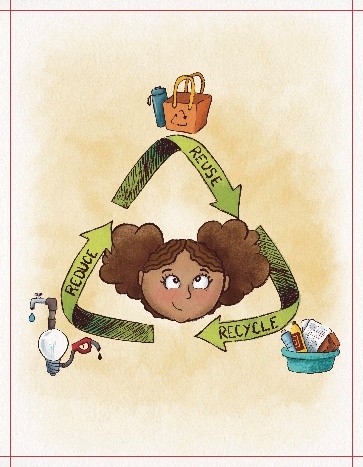
It’s also important that young readers take away an understanding that old does not always mean it cannot become something useful again. As Amica says, “Reduce, Reuse, Recycle.” Amica figures out a way to reuse something her neighbor, Mr. Brown, is throwing out. She works to fix it up to use with Zoe to help with walking in the neighborhood. Young readers will learn about the importance of patience, understanding, and a theme that occurs in many books, friendship.

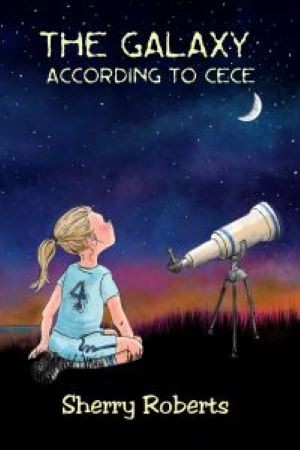
You also write chapter books and middle grade novels. Tell us about your The Galaxy According to CeCe series.

SR: Like many of my books, this is based on a time in my life. I’m the one who moved from North Carolina to Missouri right before the school year. I’m the one who moved into a house connected to an observatory. The feelings are very similar to ones I had but, from there, the story changes from my life to the story of Cece. This middle grade series is about change (book 1), friendships (book 2), and closure (book 3).

Book blurb for Book 1, The Galaxy According to Cece:

CeCe is having a ‘badventure’. What if her new school doesn’t have band tryouts? Or a soccer team? What if CeCe can’t make new friends? Moving across the country was hard enough, but the new house is an unusual house, and there definitely is something haunted about it.

Excited about her first year of middle school, CeCe and her friends anticipated all the fun they would have transitioning from elementary school to middle school. That was until the BIG announcement. Her family was moving across the country for her father’s job as an astronomer.

Starting the new school doesn’t go well, the class popular girl sets her sights on CeCe as she attends tryouts for the school soccer team and band. Making friends is difficult when the rumors swirl that the observatory is haunted. There are only so many “what ifs” for one eleven-year-old girl to think about. As CeCe balances her anxiety and comes to terms with her new situation, she starts to make forward strides in her new life embracing what the galaxy has given her.

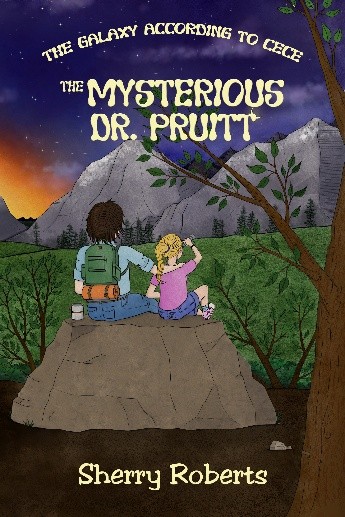
Book 2, The Galaxy According to Cece: The Mysterious Dr. Pruitt:

Cece thought she had finally begun to settle into her new home, school, and town. Until the unexpected happened. The ghost of Dr. Pruitt, the scientist who built the observatory, appears and turns her life upside down. Is he a friendly ghost or a vengeful one? And why can only she see him?

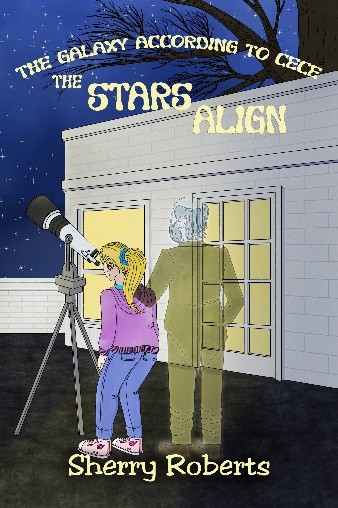
Book 3, The Galaxy According to Cece: The Stars Align:

Cece never expected her friendship with Dr. Pruitt to take a sudden turn, but when she and her friends discover a secret room in his domain, tensions rise. With their curiosity piqued and Dr. Pruitt’s disapproval looming, the friends must decide whether to push forward or back away. Will he allow them to use what they know, or will he continue to hide from them and create even more problems?

You’ve also written nonfiction picture books, which you photo-illustrated yourself. How do you decide which topics to write about?

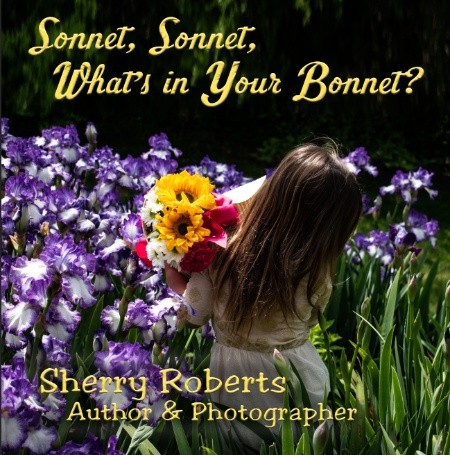
SR: My two non-fiction were fun to do. The first, Sonnet, Sonnet, What’s in Your Bonnet?, features a variety of flowers that I photographed from my own garden and public gardens around town. The story tells fun facts about each flower that readers, young and old, may not have known. For example, do you know what flower is the international flower of love? If you say the rose, that would not be correct. It is actually a red tulip. Why is the blanket flower called the blanket flower? Ever seen a leopard lily? Answers to all the questions and so many more may be found in this book.

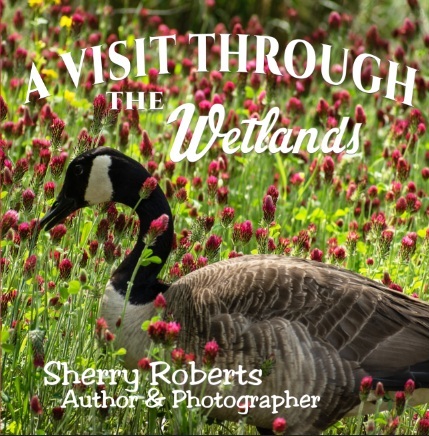
The second book, A Visit Through the Wetlands, takes the reader through a local wetlands to see the foliage, water fowl, amphibians, animals, and so much more that may be found when wandering through wetlands. This book was written to encourage families to not only visit this local wetlands but to find designated wetland areas when on vacation and take a tour to see all that may be found of nature in these beautiful reserves.

Where can people learn more about you and your books or connect with you online?

SR: My website features all my books, and talks more about me, and a blog that features many of my author friends, and educational resources for many of my books (more to be added). The address is www.sjrobertscreative.net.

People may also connect with me on the following social media channels:

Instagram: Instagram

Threads: @sjrobertscreative

Facebook: Facebook or Facebook

My email address is sjroberts@sjrobertscreative.net.

I look forward to hearing from you and others to talk about my books or just visiting. Look for a new chapter book series coming August 1, 2025, for readers ages 6-8.


Sherry Roberts is an award-winning children’s book author. She holds a Ph.D. in Curriculum and Instruction from the University of Louisville. She has written multiple award-winning picture books such as Hello, Can I Bug You?, Gabriel and the Special Memorial Day, What’s Wrong with Barnaby, and The Best Reading Buddy. Her newest, Amica Helps Zoe, was featured in Kirkus’ e-newsletter, June 2025, and received a Get It: Recommend review.

As a former middle school teacher, Dr. Roberts decided to write her first middle-grade novel. Her debut novel, The Galaxy According to CeCe, is the first book in a three-book series. It was officially released on February 24, 2024. Book two, The Galaxy According to Cece: The Mysterious Dr. Pruitt, was released August 2024. Book three, The Galaxy According to Cece: The Stars Align, released February 2025.

Interview Alert: Lauren Briére

Please welcome talented author and illustrator Lauren Briére, along with her whimsical robot pals, to Frog on a Blog! Lauren’s new picture book, Alphabot Adventures, which is part of her Robots In Rowboats series, is bursting with adorable, friendly, inquisitive, amusing, kind, and even pensive robots that kids will LOVE!

This fun and colorful concept book, published by Blue Star Press, features the alphabet, and it “will have your little one laughing and learning from A to Z!” Each of the 26 robots shares something very special about itself, its hobby or something it simply enjoys, with many of the things being animal or nature related, for example, D Bot delights in the company of dogs, and E Bot enjoys exploring everywhere among the evergreens. (I had a very difficult time choosing favorites to include in this interview. I had so many!)

This book is sure to be a hit with robot-loving children (and adults) everywhere! Let’s learn more from Lauren about Alphabot Adventures!

Congratulations on the publication of your new picture book Alphabot Adventures! What inspired you to create a concept book about robots? And where does your love for robots come from?

LB: Thanks so much! Well, I’ve been riding this wave of oil paintings of robots for about 11 years now, and I figured I’d keep it going in book format! After all, I got my art degree in children’s book illustration. Since there’s such a massive amount of choices of ABC books out there, I thought- Why not throw my own into the mix?! The idea of the robots initially started by randomly painting a robot in a rowboat because I simply liked the alliteration of it all. The wording ‘rolled off the tongue’ and onto a canvas, and a rabbit hole of quirky & sweet ideas opened up.

copyright © 2025 by Lauren Briére/accompanying text: J Bot just enjoys living among jellyfish.

Why did you decide to pair robots with nature and outdoor activities (which I love, btw!)?

LB: It just came so naturally! Admittedly, I wish I could claim there was more forethought, but, I guess, instinctually, I like unifying objects in juxtaposition and bonding them through empathy.

Your illustrations are so whimsical and detailed! Please tell us a little about your art process when you were working on your book and what media you used.

LB: I started with phrasing, sweet and silly to begin with, and the imagery just followed. My process is much like filling in a coloring book page. Once I’ve got a sketch I like, the oil painting just appears before me on gessoed wood-panel.

copyright © 2025 by Lauren Briére/accompanying text: N Bot navigates nature under the northern lights.

How are you able to give each robot its own personality?

LB: ? It’s all in the eyes and child-like poses & gestures, which we all can relate to: to some capacity, in heart, there’s a child within us all. I generally just paint stuff that I like… and I just love relatable, gentle, and sweet things that emanate humor and curiosity.

Why do you feel picture books are important for kids?

LB: I believe that imagery imprints itself in young minds. For example, I can’t recite the exact wording of my favorite book from when I was little, but I’ve got pictures and the mood that I perceived from it forever in the back of my mind, stirring a flavorful nostalgia soup. I’d like to think I’m able to do what I can now as an adult because I can frequently sample from it!

copyright © 2025 by Lauren Briére/accompanying text: Z Bot is a zany zoologist.

What do you hope children will take away from reading your book?

LB: I hope they absorb the overall curiosity of the Bots’ amusement in their letters. The alliteration I used when writing the book was utilized as a tool to pique their interest in language and the written word, while the imagery sets the tone and hopefully sparks memory.

Will there be more picture books starring your loveable robots in the future?

LB: ABSOLUTELY! I’m currently working on a concept where robots learn about a variety of sports. Through illustrations, viewers will see how these sweet robots experience competition, strategy, strength, and FUN. Eventually, there’ll be a similarly themed book about music & instruments.

Lauren Briére, a true product of the 80’s: watches too many movies and eats popcorn as a meal more often than not. She grew up in Wrentham, MA, and got her BFA in illustration from MassArt in Boston. She works in Austin, TX, now and works on the painting series, Robots In Rowboats. Her professional artist’s resume consists of work ranging from children’۪s book illustration, designer rain umbrellas “Over Our Heads”, animated music videos (two of which for the awesomely sweet band, The Weepies), and quirky paintings to amuse her young daughter.

To learn more about Lauren, her books, and her art, visit her website Robots In Rowboats or follow her on Instagram. Prints of some of her gorgeous robot art is available for purchase via her website. And her book Alphabot Adventures is available on Amazon as well as through several other vendors.

Interview Alert: Stenetta Anthony

Please welcome award winning author Stenetta Anthony to Frog on a Blog! Stenetta has published three lovely picture books and is working on publishing a fourth. She was an elementary school teacher for many years before becoming an author, and this is what she said about her new life’s path: “This change in career has taken me to places that I never envisioned as a teacher.”

I love how Stenetta’s books often include animals, and it’s through the animals’ stories that kids learn self-love as well as kindness and empathy for others. Her books clearly carry messages of hope and inspiration. We all need a little bit more hope and inspiration in our lives, don’t you think? Now, let’s hear from Stenetta about her books and her journey as a children’s book author!

Please share a little about each of your picture books and what inspired them.

SA: My first book, The Love Story, was inspired by a question asked by a young child who wanted to know who God is. Although I was familiar with children’s Bibles and other materials to educate children about God, I found it difficult finding a book which introduced a child or adult who was unfamiliar to God and why he was so important to our world.

(From The Love Story, copyright © 2015 by Stenetta Anthony)

A Home for Sally came from a place of concern for special needs animals and children. Using Sally’s story to promote empathy and understanding is an essential representation of a child with a disability, where they don’t feel alone and learn that being “perfectly imperfect” is okay, reinforcing the idea that everyone is beautiful.

(From A Home for Sally, copyright © 2018 by Stenetta Anthony)

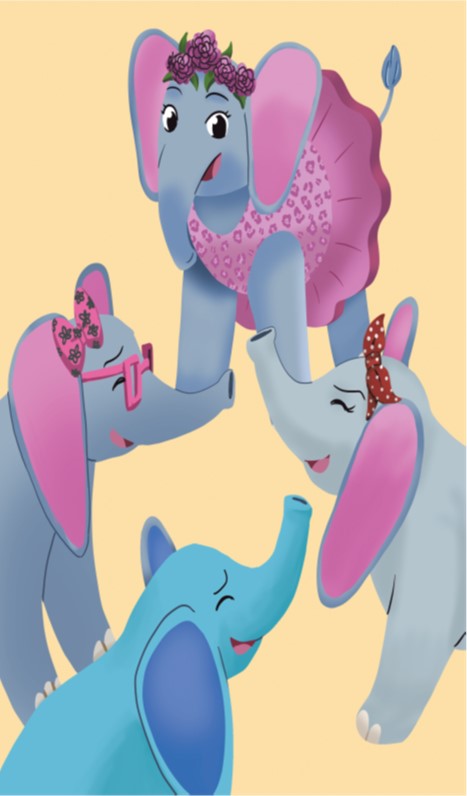
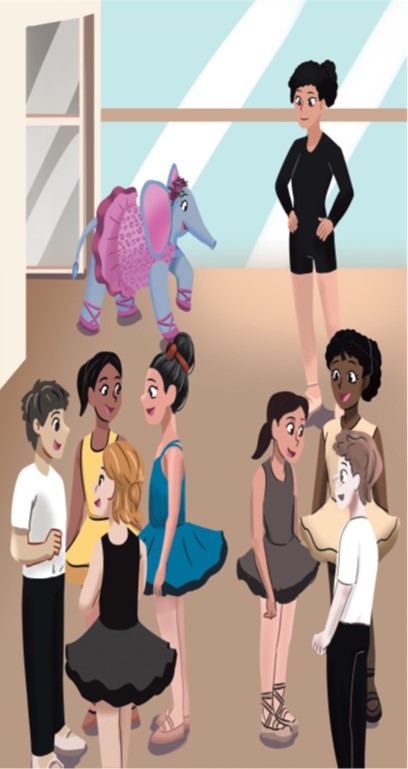
Ella Learns to Dance was written to demonstrate the misconceptions and stereotypes that sometimes surround a person who does not look like a ballerina, empowering a child to follow their dream regardless of what others may say.

(From Ella Learns to Dance, copyright © 2022 by Stenetta Anthony)

Each of these books was written to foster inclusivity, validation, and empathy on the importance of kindness, love, understanding and acceptance.

Why do you believe picture books are important for children?

SA: As a former educator, children are introduced to words at an early age either through watching television, social media or [other] avenues. Picture books introduce children to the world. Connecting the words with the pictures increases a child’s language skill, emotional literacy and visual thinking. Children can look at a picture and sometimes create their own story, developing creativity in the mind of a child.

What route did you take to publish your books—traditional, self-published, or hybrid—and why?

SA: The route I have taken to publish most of my books is hybrid; however, I have had the opportunity to self-publish one of my books, which was valuable to my learning more about the steps necessary to publishing.

Tell us a bit about your journey from being a teacher to becoming a children’s author.

SA: Many people dream about becoming an author; however, this is not my story. I was an educator for 22 years teaching pre-kindergarten – 3rd graders. During the years spent in the classroom as a teacher, I often looked for books that reflected my students, especially those with a disability; however, this was often difficult. This desire had me creating stories of my own. One day, while reading one of my creative stories to a friend, they asked, “Where did you get that book? I love it.” Telling them I had written it myself, they quickly asked, “Have you ever thought about publishing your own books?” 

After this conversation, thought and time, along with encouragement from my husband and children, I wrote and published my first children’s book entitled The Love Story, with three more books to follow and presently working on publishing my fourth children’s book, taking this teacher on a journey that took me from the classroom to becoming a published, multi award-winning children’s book author.

How would you encourage others who dream about being a published author?

SA: Following your dream can sometimes be intimidating. Since writing my first book, I have been told on multiple occasions, “I want to write a book.” The simple answer always given is to just start writing. Carry a pen, paper, digital recorder or other material and begin the writing process. Remember to never give up regardless of how long the process may take. Never give up on your dream to become a published author.

Multi award-winning author, Stenetta Anthony, was an elementary school educator for 22 years before becoming a published author, after reading hundreds, possibly thousands of books to her students and writing her own books. Stenetta has a passion for creating books that engage, enhance, elevate, motivate and evoke a love for reading in children. She is a graduate of Grand Canyon University. When Stenetta is not writing, she enjoys time speaking and reading with children in educational settings and other venues. Stenetta’s goal is to inspire people through her books.

To learn more about Stenetta and her books, visit her Website: www.stenettaanthony.weebly.com

Or connect with her on social media:

Facebook: https://www.facebook.com/public/stenetta-anthony

Twitter (X): https://twitter.com/StenettaA

Instagram: www.instagram.com/stenettaanthony/

LinkedIn: https://www.linkedin.com/in/stenetta-anthony-42b28544

Interview Alert: Jami Gigot (+ a Giveaway!)

Please welcome kidlit friend Jami Gigot to Frog on a Blog! Jami is an author, an illustrator, and a Texture Supervisor at LucasFilm’s Industrial Light & Magic. I recently featured a Happy Book Birthday post for Jami’s brand-new picture book The World In Our Backyard, which was published in May. I also interviewed Jami way back in 2015 when her book Mae and the Moon came out with Ripple Grove Press shortly after my book did.

I’m excited to welcome Jami back during the month of July, which happens to be Park and Recreation Month, to talk about The World In Our Backyard. This lovely and imaginative book is all about spending time and having fun in the great outdoors, especially our own backyards, and features a diverse group of kids from the city, the suburbs, and the country. It’s perfect for summer reading! Let’s hear more from Jami, and be sure to read to the end for details about how to win a copy of her book!

Congratulations on the publication of your beautiful new picture book The World In Our Backyard! Tell us the inspiration behind the story.

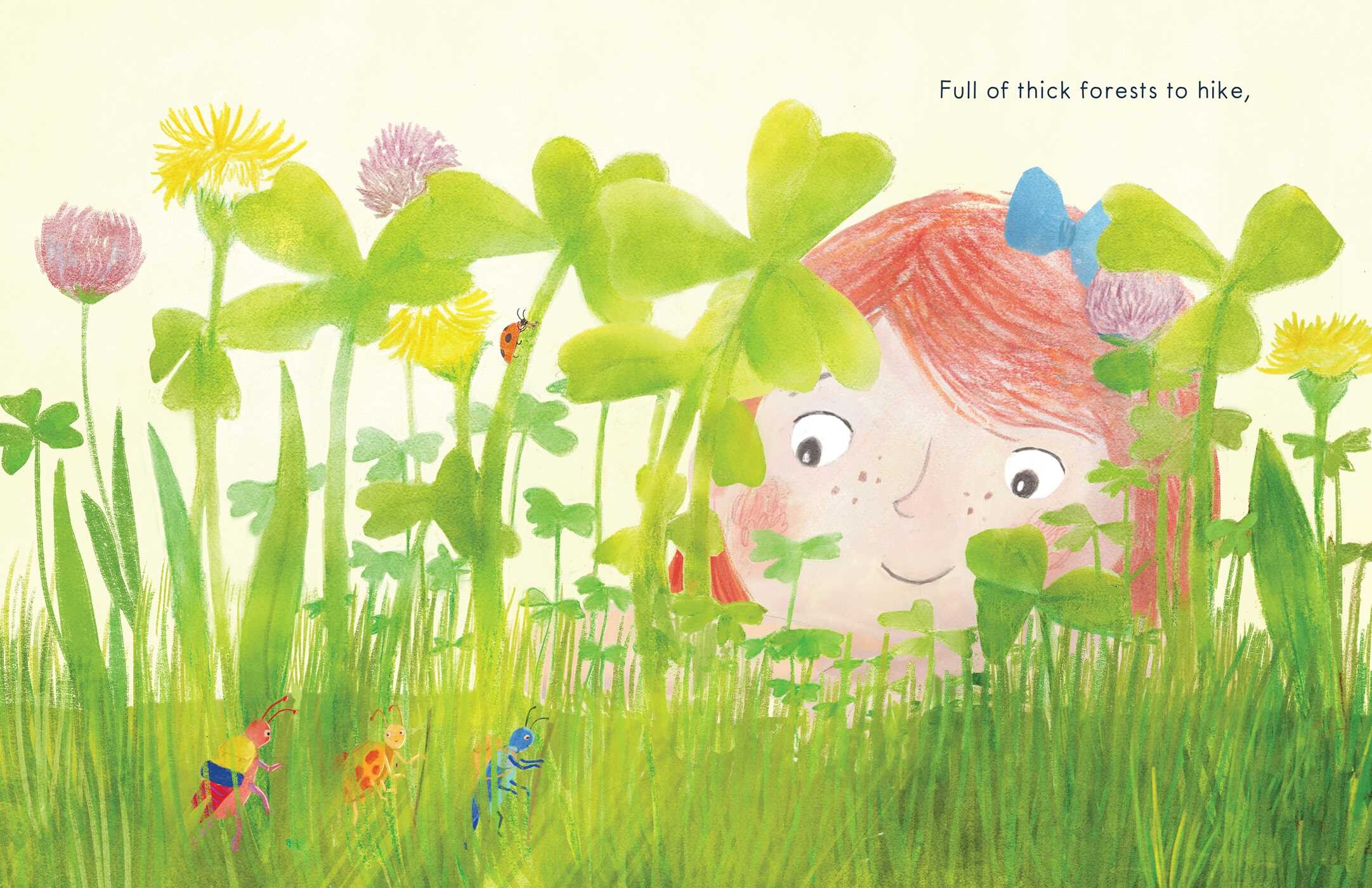
JG: Thank you so much! This book was inspired by my love of nature and my constant awe of our incredible world. One of my favorite things about writing for children is putting my mind back in the state where I try and think like I did as a child, and it was wonderful to revisit my own childhood memories and feelings of exploration and play. I had the thought, what would the world look like to a group of insects? It dawned on me that a clover patch would seem like a forest to them, and I made a sketch, which eventually became the first spread of the book. From that initial image, the rest of the story began to unfold. I thought, well, if there is a forest in a backyard, maybe there is a mountain, or a desert, or an ocean and so on. It was important to me to also explore the idea of backyards themselves and expanded the definition to include not only suburban households, but balconies, city parks, community gardens, or wherever we find joy exploring outside. 

copyright © 2024 by Jami Gigot

What was your process like when creating the illustrations for the book? And what’s your favorite spread?

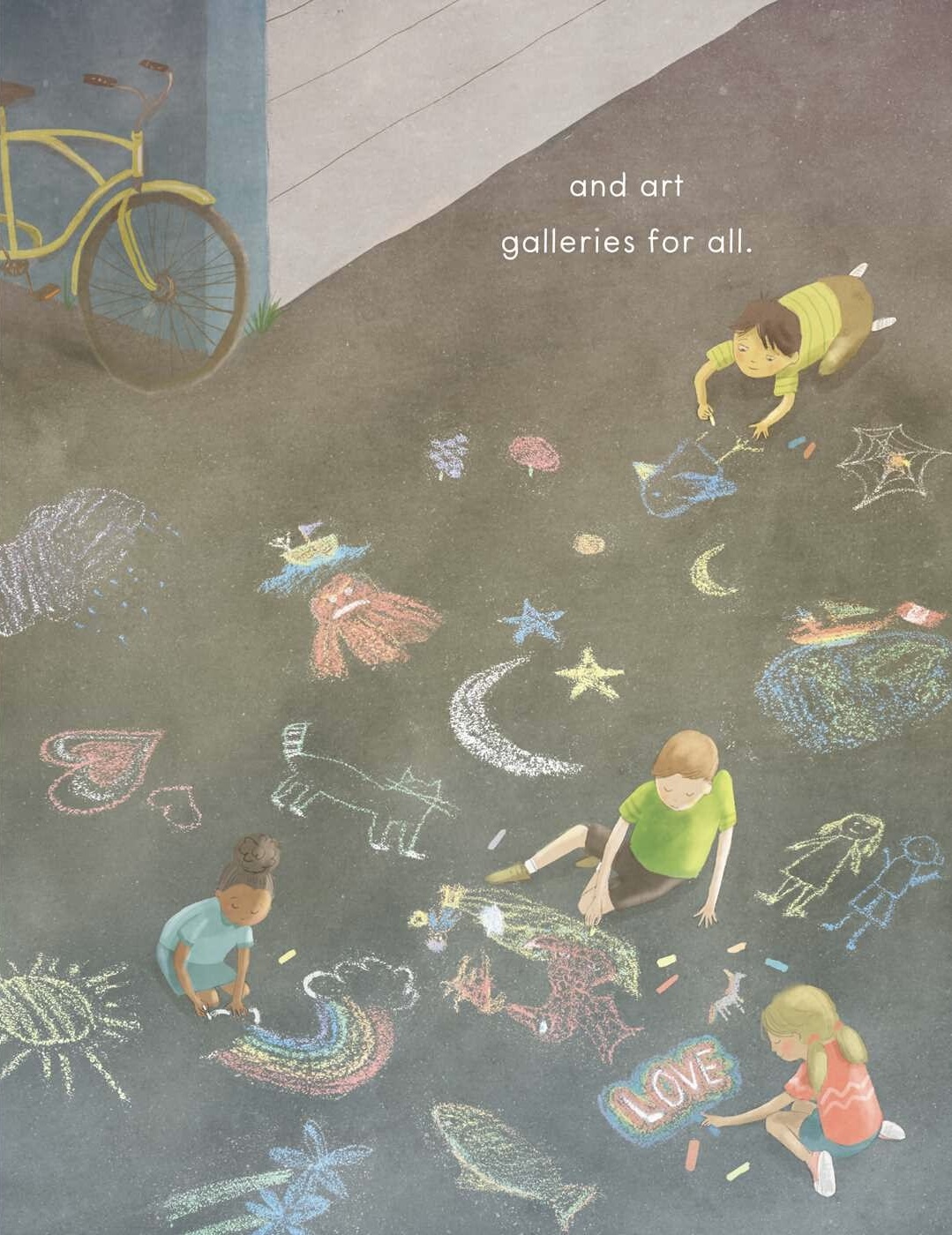
JG: Whenever I start illustrating a book, I first sketch out a very rough version of the book in its entirety in pencil or on my tablet, blocking out the layout and text on every page. This helps me feel the pacing and overall balance of the book. In terms of final art, I never know exactly how it will work, but it usually ends up being a collage of traditional and digital mediums. Often I will use watercolor or colored pencil and then mix that with digital painting and do the final layout in photoshop. For the spread with the kids making chalk drawings, I incorporated some photos of the chalk art my children and I drew on the street behind our home. 

copyright © 2024 by Jami Gigot

What do you hope kids will take away from reading the book?

JG: Kids already have incredible imaginations, and I hope this book reminds them of all the joys and wonders around us in our natural environments and encourages them to explore creatively. In a time when we have so much stimulation from screens and electronic devices, I think it’s more important than ever to get outside and play. 

copyright © 2024 by Jami Gigot

What outdoor activities do you and your kids enjoy doing together?

JG: I have always been very active with the kids, and we spend a lot of time exploring outside. We have done things like making a bed for a fairy out of a chestnut shell, or making art from leaves we collected. When they were very small, I would plop them in a baby carrier to go snowshoeing or push the double stroller around on my rollerblades through the city. Now that my kids are a little older (12 and 14), we do a lot of activities like playing lawn games, hiking, and stand-up paddle boarding, but we are still very curious and love spotting slugs or collecting shells and rocks. 

Can you give us a sneak peek of any projects you’re working on right now?

JG: I’d be delighted to show a little sneak peek of my next project! I am currently working on a humorous picture book called A BIGFOOT FIELDGUIDE TO CAMPERS (and other mysterious creatures), which will be published by Kids Can Press next Spring 2025. It is a story about not being afraid of the unknown and listening to your heart and is written in a guidebook format where the words and pictures completely contradict each other, so makes for a very fun read aloud! 

Image from A BIGFOOT FIELDGUIDE TO CAMPERS/copyright © 2025 by Jami Gigot

Giveaway

Jami has generously offered a copy of her beautiful book The World In Our Backyard to one lucky person who comments on this blog post! For your chance to win, just leave a comment on this post by July 15th. I will choose a winner at random and connect them with Jami. This giveaway is limited to residents of the US and Canada only.


Jami Gigot is the author-illustrator of many books for children, including Starboy: Inspired by the Life and Lyrics of David BowieImagination VacationSeb and the SunMae and the Moon, and The World in Our Backyard and the illustrator of My Daddy Can Fly!. She is also a Texture Supervisor at LucasFilm’s Industrial Light & Magic, and has worked on many award-winning films. In her free time, she can be found in a hammock in her small and lovely backyard, bird-watching and listening to the buzzing of bees. She lives in Vancouver, BC, with her husband, two children, and a big orange cat.

 Visit her at www.jamigigot.com or on Instagram @jamigigot. 

Interview Alert: Jackie Morera

Please welcome debut picture book author Jackie Morera to Frog on a Blog! You may know that today is Memorial Day, the perfect day to talk to Jackie about Abuelo’s Flower Shop because her lovely book, which officially comes out on June 4, 2024, from Beaming Books, highlights grief and sadness and how people remember loved ones they have lost. Abuelo’s Flower Shop is also multigenerational, starring a young girl and her grandfather, and bilingual, featuring a mix of English and Spanish text.

Abuelo’s Flower Shop is especially touching to me because I worked as a floral designer in my father-in-law’s flower shop for 10 years, and I know firsthand how special flowers are and how comforting they can be. Let’s hear more from Jackie about her writing life and her book!

Congratulations on the publication of your debut picture book Abuelo’s Flower Shop! Tell us a little about the story and what inspired it.

JM: Thank you! Abuelo’s Flower Shop is a story about a young girl who, while working alongside her abuelo in his flower shop, discovers the heartbreaking truth about the garden across the way and learns how their flowers help send a very special message to those in need.

The book is loosely inspired by my own experience. Like Elena’s abuelo, my grandparents sold flowers from the street in front of their Miami home, which sat catty-cornered from a cemetery. However, the heart of Abuelo’s Flower Shop—discovering the truth about the garden across the street—is entirely Elena’s story. That came from asking myself “what if?” What if I had paid closer attention when I was younger? What if my grandfather and I had that conversation? How might that have played out? And so, a story was born.

Jackie Morera’s grandfather with some of his flowers

What message do you hope kids will take away from the story?

JM: I hope they’ll walk away from the story with the confidence to ask questions, even (and maybe especially) when it may be uncomfortable to do so. Elena’s story is largely one about understanding loss and empathizing with those who are grieving, but, at its core, it’s about a little girl who asks “why?”

How long have you wanted to be a writer, and what influenced your love for books and writing?

JM: For as long as I can remember, I have always loved storytelling. I was fortunate to grow up in a home filled with books and with parents who encouraged reading, writing, and creativity. Some of my earliest memories are of my dad folding sheets of paper down into little booklets for me to write my own stories in, which he would pair with his illustrations. Later on, when we bought our first video camera, I would spend entire weekends writing and recording plays in my room. I carried that passion with me through the rest of my schooling and even into college where I briefly studied English Literature and Creative Writing. Of course, life takes you a roundabout way to accomplishing your goals sometimes, and ambitions change, but I’m happy I found my way back to my first true love.

You also write young adult novels. How do you switch your writer’s brain between writing for teens and writing picture books?

JM: It’s funny you ask because writing picture books happened sort of by accident for me. Young adult novels were my first love, as far as writing is concerned, so those are what I wrote almost exclusively for many years. Until, one day, I found myself sleep-deprived, nursing my (at the time) infant son, and suffering from the worst case of writer’s block I’d ever experienced. I was desperate to get back to writing and, in taking stock of what sparked inspiration, dove into studying the newest additions to our bookshelves—picture books! My first attempt at writing a picture book manuscript of my own was meant to be a creative exercise and nothing more, so switching my writer’s brain from writing for teens to writing picture books was a welcome change. Now, it does take a little more effort to toggle between the two, but I find I still turn to my picture book manuscripts as an escape. I would say the easy answer is that I’m able to switch my writer’s brain between writing for an older audience and writing for kids by letting my inner child run free on the page.

What were your first impressions of artist Deise Lino’s illustrations for Abuelo’s Flower Shop?

JM: Complete adoration! My immediate thought (well, once the crying subsided) was that she did a wonderful job of capturing the story exactly as I pictured it in my mind. Deise was quite far along in her illustration process when our publishing team shared her work with me, so it was almost like reading the entire story with the art at once. It was very special!

What are you working on now? More picture books?

JM: I’m currently in the editorial phase of a third (still unannounced) picture book that’s set to release in the Fall of 2026. I’m also tinkering with a few other picture book manuscripts, slowly drafting a second young adult novel, and outlining my first middle grade novel.

Thank you so much for having me on Frog on a Blog. It’s been a joy!

Jackie Morera is a Cuban-American author of books for young readers of all ages. Born and raised in Miami, Jackie lives in Central Florida with her husband, son, and goofy pup. She enjoys telling stories, savoring pastelitos, and cozying up for a good nap.

Her debut picture book, Abuelo’s Flower Shop, illustrated by Deise Lino and published by Beaming Books, hits shelves on June 4, 2024. Jackie’s sophomore picture book, Together We Remember, illustrated by Violeta Encarnacíon, is scheduled for a Summer 2025 release by publisher Make Me a World.

Connect with Jackie Morera online by visiting TikTok, Instagram, Threads, and Twitter/X @jmorerabooks, Goodreads or her website jmorerabooks.com.

Interview Alert: Jana Locke

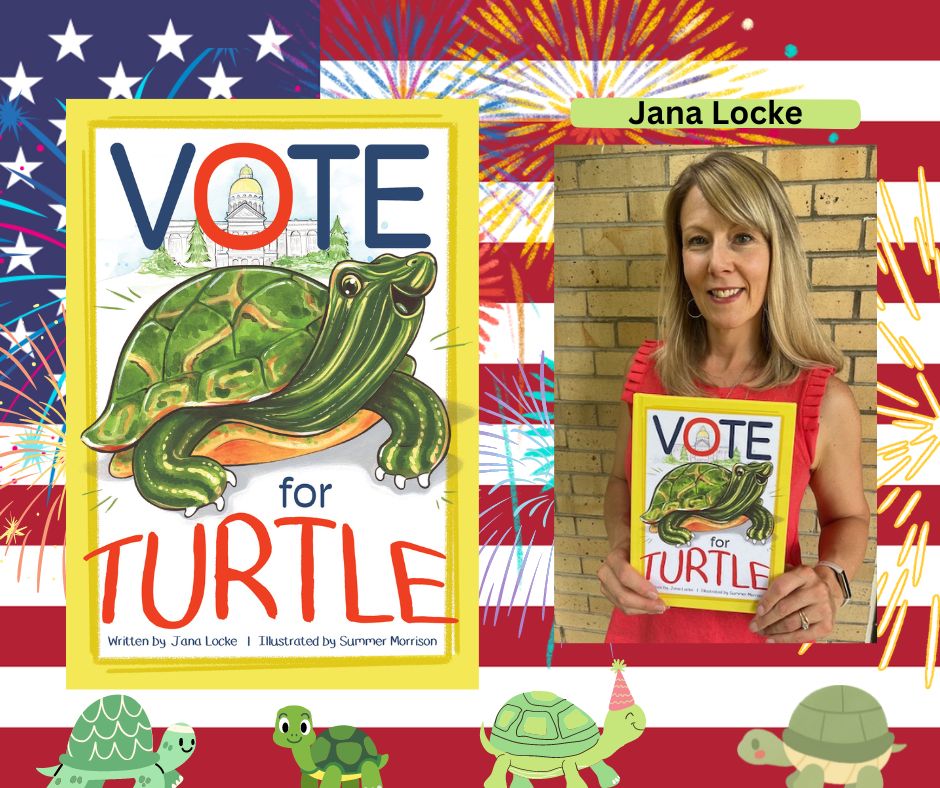
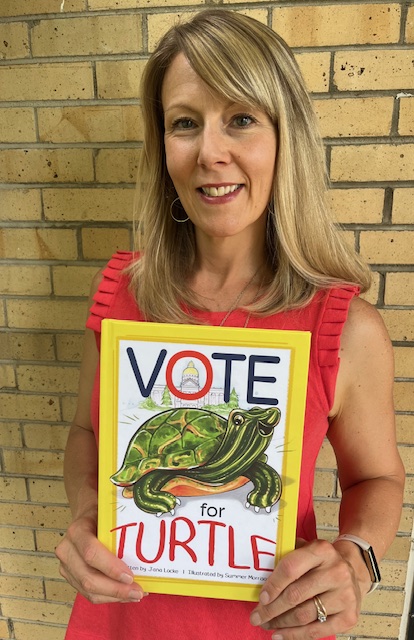
Happy World Turtle Day! It’s the perfect day to welcome Jana Locke, a picture book author and self-proclaimed passionate public servant, to Frog on a Blog to share her book Vote for Turtle. It might be a presidential election year, but Jana’s adorable book features something a whole lot more fun, especially for kids: voting for state symbols (and, of course, turtles). Vote for Turtle is a great first introduction to civic participation, democracy, and politics, as well as to how kids can make a difference by raising awareness of things that are important to them. Let’s hear more from Jana!

Congratulations on the publication of your timely picture book Vote for Turtle! Tell us about the story and what inspired it.

JL: Thank you, Lauri! I am really honored to be here. I loved reading your past reviews and interviews, and I created a long to-read list based on your featured authors and books.

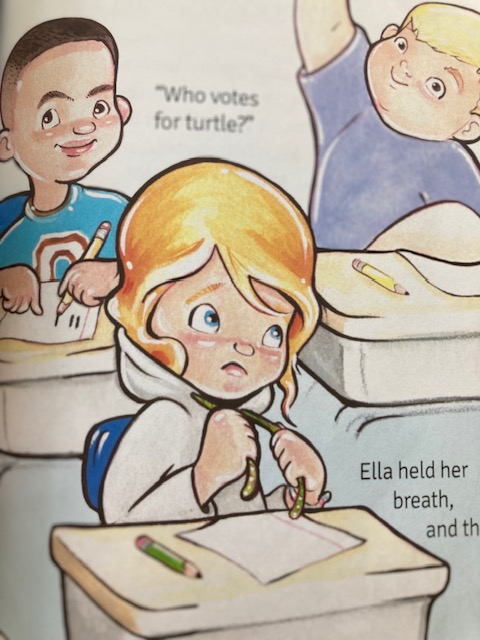
Vote for Turtle is a story about a shy student named Ella who loves turtles more than anything. While her class is learning about the different symbols of their state, Ella notices that her state doesn’t have a state reptile. Normally content to stay quiet in class, Ella is drawn out of her shell (ha ha) as she advocates for her beloved turtle, first, among her classmates, and then, ultimately, at the state capitol. Vote for Turtle is a picture book about civic engagement and kids making a difference. I hope that the story shows that young people have the power and ability to influence elected officials and participate in democracy, even if they can’t vote yet.

This book is inspired by and based on true stories of kids creating state symbols in many states. All states have symbols, from flags to flowers and mottos to minerals, that represent their natural, cultural, and social heritage. Students across the country have been responsible for proposing and passing laws to create new state symbols in multiple states, and my story is a fictional account of their efforts. When I was doing research for this story, I found many compelling examples of groups of kids seeing the need for a new symbol, speaking up, and successfully initiating and passing a bill through the legislature. I thought the creation of a new symbol was a really tangible, accessible, and powerful way of teaching kids about the lawmaking process through a picture book. It took me many years and many drafts to figure out how to tell the story in a succinct but meaningful way, and I hope I accomplished that! My goal is to write books that befriend kids for life and inspire them to impact the world around them.

Why do you feel it’s important for kids to learn about democracy and the process of creating laws?

JL: Civics is really about co-creating the world we live in; it’s about a shared investment in protecting the social fabric that binds us together. Theodore Roosevelt said, “The government is us; we are the government, you and I.” Like anything, being a civically engaged citizen takes exposure and practice. Paying attention to current events, knowing who your local representatives are, and voting are all habits to develop. If kids (and adults for that matter) understand that they can make a difference, they are more likely to participate in democratic processes. I think it is sometimes easy for everyone, kids and adults, to feel like we are powerless to affect anything around us, that our vote or our voice doesn’t matter, and to sort of opt out as a result. I hope this book shows that we can all make a difference if we take the time to participate in the process.

Where can readers go to learn more about their own state’s symbols?

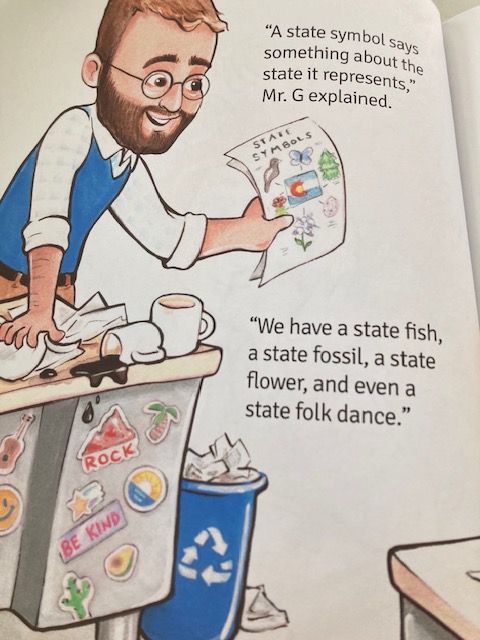
JL: There are a lot of great resources for this, but the most comprehensive one I’ve found is a website I’ve included in the back matter of my book called statesymbolsusa.org. Each state’s government also usually has a site that lists the symbols. There are some standard symbols that every state has, like a flag and a flower, but what I find really interesting is what unique symbols states choose. For example, Alaska’s state fossil is a wooly mammoth, California’s state fabric is denim, Maryland’s state sport is jousting, and Mississippi’s state toy is a teddy bear! As far as I know, each of these items was created by law, and school children or specific groups of citizens are often behind the efforts to pass these types of laws. Some have very interesting stories about how they came to be. I’m from Colorado, so the illustrator showcased some Colorado symbols to show what Ella’s class was studying in the book.

How was Summer Morrison chosen to illustrate Vote for Turtle, and were the two of you able to collaborate at all on the art for your book?

JL: I love Summer’s art; it is so inviting and engaging. Summer was one of a few illustrators that my publisher offered, and we met a couple of times via Zoom during the process. I tried to leave a lot of room for the illustrator in the manuscript and to not be overly prescriptive of the pictures. It was amazing to me how Summer caught on to certain parts of the text and was able to enhance the words with her drawings. She added layers to the story through the illustrations, like showing Ella, the main character, wearing a hoodie as a way for her to hide, kind of like wearing a shell. As Ella gathers courage, her hood drops. I thought this was a beautiful way to show a character trait without adding to the story’s word count.

Can you share an interesting fact about turtles?

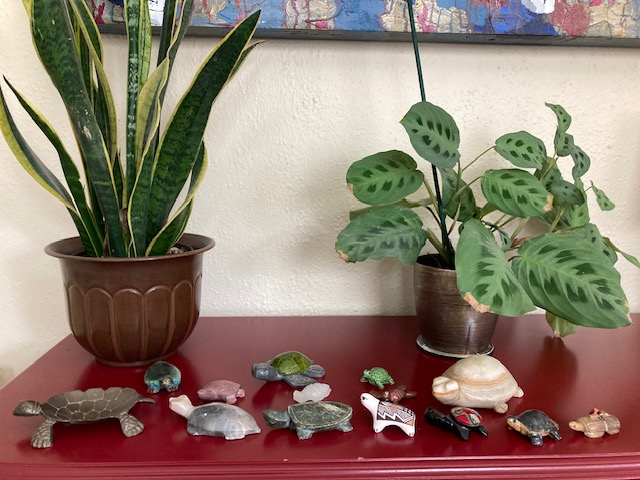
JL: I really love turtles! This is part of my collection of little turtles that my dad started many years ago and that I inherited and have continued to add to over the years.

They are fascinating creatures, in my view. My favorite fact about turtles is that they are found on every continent except Antarctica. They are nearly universal creatures, which is rare.

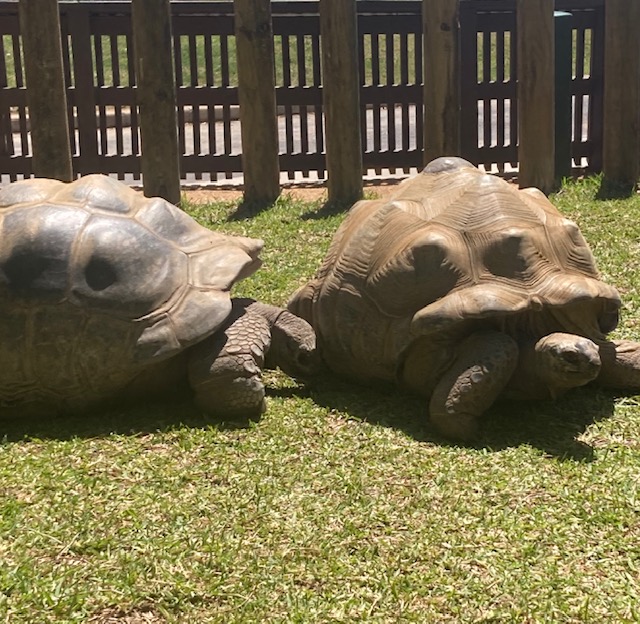
Turtles are known for being pretty stoic, and are not what you think of as cuddly. But, I had a recent experience that has me researching whether turtles show affection. My family and I were at Sea World last month and we were watching the giant tortoises. Two were parked right in front of us, and one was off to the side a bit. The one on the side slowly lifted its head and set out very purposefully but very slowly toward its friends. This was a tortoise on a mission! It took a minute or two, but this tortoise crossed the 15 feet to the others. My daughter and I were wondering what it was going to do – was it going to collide with the others? Was it being aggressive? It stopped directly perpendicular to another tortoise, and very slowly put its head right against the other. It was very sweet and made me wonder if even the hardest shelled creatures have soft feelings.

Vote for Turtle received a Firebird Book Award. Congratulations! Please tell us a little about that achievement!

JL: Thank you! I was very honored to receive this award. As an independently published author, I am thankful for awards like this that highlight the work of small presses that might not otherwise be recognized. I love that the entry fees for this award go to supporting people, including children, who are experiencing homelessness, and the children’s books, once reviewed and scored, are distributed at shelters. So I was delighted to win, and also delighted to help support a great cause.

Alaska-born and Colorado-raised, Jana Locke is a passionate public servant who has worked in state and federal government for over 20 years, including time as a Presidential Management Fellow. Bitten by the political bug early in life, Jana is excited to share the power of civic participation with kids. Her parents showed her how persistent and persuasive individuals can make an impact in the world, and she hopes this story passes that lesson on. Jana lives with her husband, two children, two cats, and a dog in Denver. Oh, and she loves turtles!

Visit Jana’s website, https://www.janalocke.com, for more information about her and her book Vote for Turtle, which was published in 2023 by Orange Hat Publishing.

Interview Alert: Wendy Goldstein

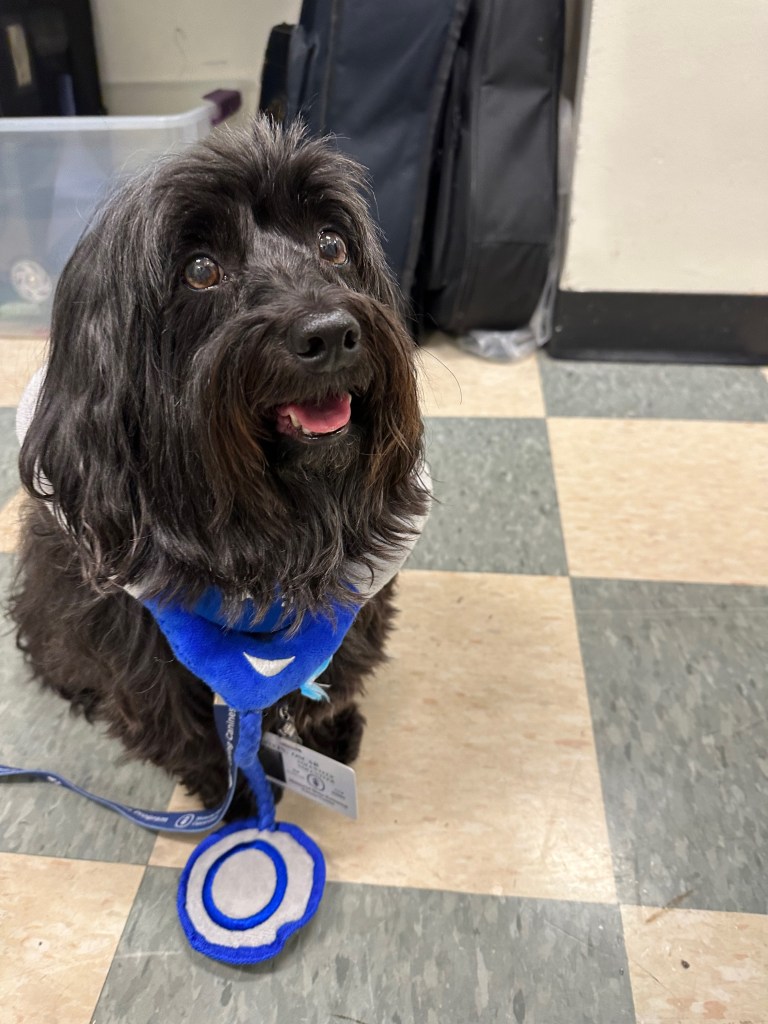
Calling all dog lovers! Happy Dog Therapy Appreciation Day! Please welcome Wendy Goldstein to Frog on a Blog! It’s a real treat to have Wendy here today to talk about her picture book Oscar’s Blue Bandana, which she both wrote and illustrated. The book stars her very own adorable dog Oscar, a Havanese, who is a real-life therapy dog. Wendy and Oscar visit kids at a cancer treatment center in New York City and a home for children and their families who receive care at New York City hospitals. Oscar’s story melts my heart, and I know it will warm yours as well. Let’s hear more from Wendy!

Congratulations on the publication of your adorable picture book Oscar’s Blue Bandana! Tell us a bit about the story and what inspired it.

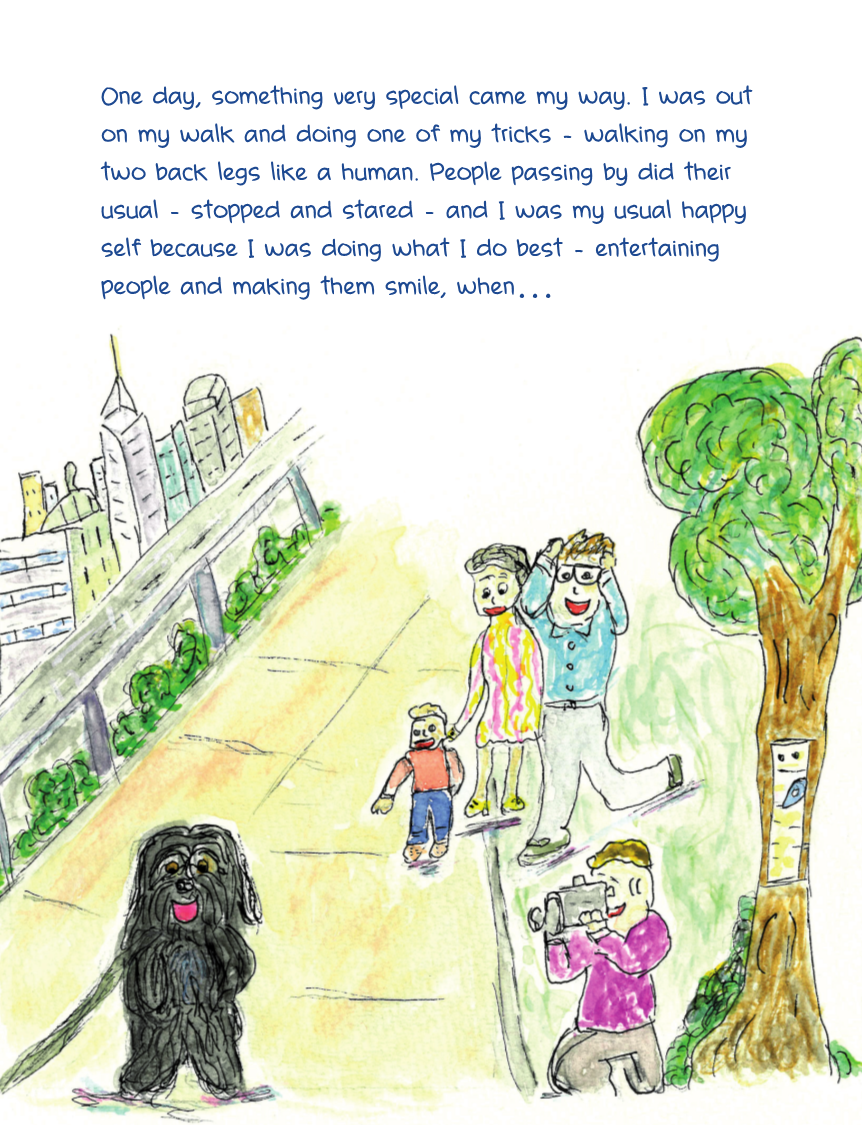
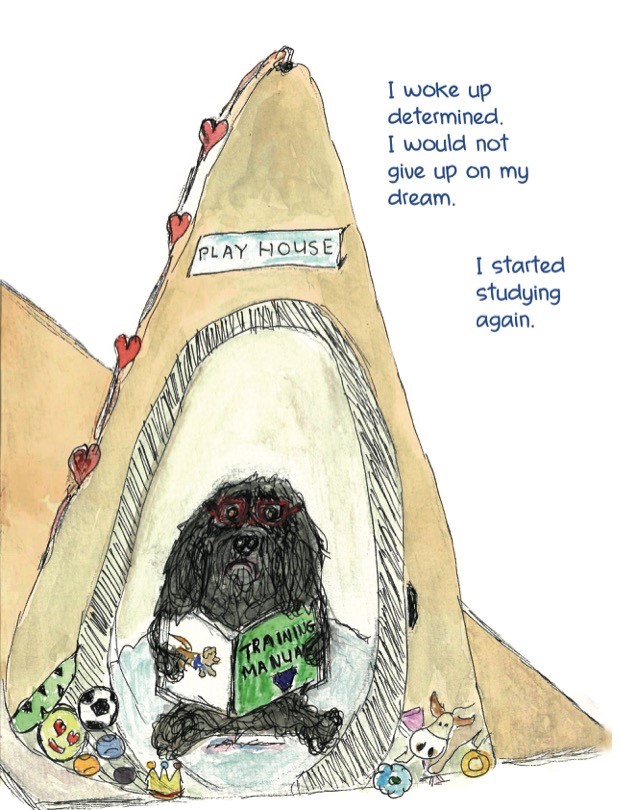
WG: Oscar is a playful and talented Havanese dog. He loves to make people smile by showing off his many tricks. When Oscar and I were given the chance to become a therapy dog team, we were so excited. After all, Oscar proved he would be a great therapy dog during his visits to my father when he was in the hospital. But on therapy dog test day, Oscar froze! You will need to read Oscar’s Blue Bandana to find out what happened next.

Oscar’s Blue Bandana was inspired by Oscar’s journey to become a therapy dog. Although the book is fiction, it is based on fact. I became inspired to write the book after realizing that once you tell a story over and over, it should be written down and shared widely.

Meet the real Oscar! And view more pictures of this cute and talented dog on Wendy’s website, Oscar Tales (click the photo).

Why do you believe Havanese dogs make great therapy dogs?

WG: Any breed can be a therapy dog, but the dog must be well-trained, calm, friendly, and comfortable with new places and people. The Havanese traits tend to match these requirements. The breed is often described as happy, loving, playful, and social. They are also known to be highly intelligent, easy to train, and eager to please. Oscar fits this description. I also believe that Havanese likely have a genetic disposition to being therapy dogs as, historically, they were used as circus dogs who entertained Cuban royalty.

What route did you take to publish your book—traditional, self-published, hybrid—and why?

WG: I chose to self-publish Oscar’s Blue Bandana for two main reasons. First, it was very important to me that I was able to write and illustrate the story. Second, I wanted to control the timeline. My goal was to publish the story now while Oscar is fully engaged as a therapy dog.

How did you decide to illustrate the book yourself?

WG: As I was writing and editing the manuscript, it became clear that I would need to illustrate the book to ensure that the pictures depicted the actual events. I did not want the illustrations to fictionalize Oscar’s true journey. Oscar’s Blue Bandana is narrated in the first person by Oscar. The colorful, whimsical art reflects Oscar’s playful, childlike voice and is designed to bring joy to the reader.

What do you hope kids will take away from reading Oscar’s Blue Bandana?

WG: My hope is that this book will encourage kids to follow their dreams, act from the heart, and never give up.

Are you working on any more books? Will we see Oscar again in future picture books?

WG: My intent is that Oscar’s Blue Bandana is the first book in a series known as The Oscar Tales.

Where can people go to connect with you online or learn more about your books, about Oscar, and about therapy dogs?

WG: People can connect with me through my author website at www.Oscartales.com. The website includes fun information about Oscar, his habits, and personal favorites. The website also has activities for readers, such as coloring pages, word scrambles, word searches, and bookmarks. It also includes great videos of Oscar performing some of his tricks. Information about therapy dogs and how to register with a local therapy dog organization also is provided on Oscartales.com.

You can also follow Oscar’s adventures and his work as a therapy dog on Instagram at Oscar_myhavanese.

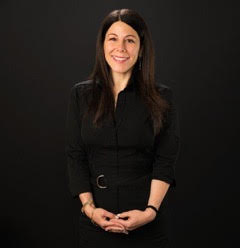
Wendy Goldstein never owned a dog before Oscar. Oscar quickly showed her that dogs are better than people. Wendy got the idea to write and illustrate books about Oscar when a crowd gathered and began cheering for him as he started dancing on his hind legs in the streets of New York City.

When Wendy is not volunteering at healthcare facilities with Oscar, or writing and illustrating books about him, she is an attorney in New York City representing clients in healthcare and life sciences. Wendy always tells Oscar that he is the best birthday gift she ever got from his dad, her wonderful husband.

Interview Alert: Leslie Eva Tayloe (+ a Giveaway!)

Please welcome picture book author Leslie Eva Tayloe to Frog on a Blog! When Leslie first reached out to me about her upcoming book Save the Trees, I knew I wanted to hear more because I love trees and I know she does too. And when I learned her story was about invasive vines overtaking trees, which is something that’s happened here in my town, too, I was more than happy to feature an interview with Leslie on my blog.

Let’s hear more from Leslie about Save the Trees, which has received a lot of advance praise! (Be sure to read to the end for a chance to win either a 30-minute Zoom book read and Q&A with a classroom OR a picture book manuscript critique from Leslie!)

Congratulations on the publication of your upcoming picture book Save the Trees, which officially publishes April 11, 2024, not long before Earth Day! Tell us about the story and what inspired it.

L.E.T.: I’m so glad to be here. Thank you so much.

Save the Trees is about a little boy named Ronnie. He loves trees. So when strange vines appear all over town on the trees, strangling them and making them fall over, he and his friend Leona pick, pull, and pluck the vines from the trees. But they need help, so Ronnie rallies community support to help save the trees!

This story was inspired by my partner, Michael, and I moving to a 74+ acre property. On our small farm, we have over 25 species of trees. We discovered invasive vines posed a threat to our native trees and plants. We conducted a lot of research and reached out to the local county’s agricultural office, inviting them to look at the invasive plants and vines on our property. To help solve our invasive plant problem, we picked, pulled, and plucked the vines and plants both from the trees and the ground. This is an ongoing effort every year, and can be very overwhelming, but we’ve saved many of our native trees and plants. Last year we planted over 200 native trees on our property.

Image from Save the Trees

Why do you feel this story was important to tell?

L.E.T.: This story is important to tell to educate kids and adults about the problem with invasive plant species and their impact on native plants and trees. The green vines climbing trees may be pretty to some people, but the vines will actually bring down a tree. Teachers can use this book as a starting point for hands-on activities like tree planting, gardening, or organizing a community project to combat invasive species. It’s important to instill a sense of environmental stewardship by encouraging kids and adults to take actions to protect and preserve trees in their communities. Also, it’s important to note that people should research the type of plants they are purchasing for their gardens, as many garden shops sell invasive plants, and if not taken care of, can spread to other gardens and open fields.

What route did you take to publish your book—traditional, hybrid, or self-publishing—and why?

L.E.T.: My first book, I’m Fishing with Pop-Pop Today (Austin Macauley Publishers, 2022), and Save the Trees (Brandylane, April 11, 2024), are both published by traditional publishers with a hybrid imprint. I heard from Austin Macauley Publishers fairly quickly after submitting in 2020. I did my research on the company, and I could afford the small hybrid cost, so I went for it. And it was the same with Brandylane Publishers. I wanted my story to be published, and I definitely wasn’t interested in self-publishing, so I signed. Both publishing companies are so different to work with that it was a huge learning experience. I have enjoyed working with both companies. I think some people get confused over hybrid vs. vanity. A legit hybrid publisher has a vested interest in the author and the book, and they are selective in what they publish. Whereas a vanity press publishes anything. I believe that both of my publishers have a vested interest in me as an author and my books.

My third book, Eduardo’s Attic Door, was written in 2021, and after two years of submitting it to publishers, Doodle and Peck Publishing picked up the story in 2023. Doodle and Peck Publishing is a straight traditional publisher—no hybrid. This was a dream of mine to have one of my stories traditionally published where I didn’t have to shell out any money! I’m very excited. Eduardo’s Attic Door releases this winter, 2024.

Advance praise (on back cover) for Save the Trees

How well do artist Lintang Pandu Pratiwi’s illustrations capture the message you express in your text?

L.E.T.: As part of the process of working with Brandylane Publishers, I selected Lintang as my illustrator. I reviewed other artists’ work and thought Lintang would do a great job. I wanted to make sure the illustrations captured invasives harming the trees and the struggle that the main character had with saving them. I’m very pleased with Lintang’s work. She did a beautiful job in capturing the message.

Please share tips on how people can get started helping trees in their own communities.

L.E.T.: There are many things that people can do to help save the trees:

  • Look in their own backyards and pick off the invasive vines that are growing on them, so they don’t spread.
  • Check out their local tree-planting events.
  • Join environmental organizations. Several of the endorsements I received for Save the Trees are from people who work for and enjoy nature.
  • Raise awareness of what invasive plants can do to native plants and trees.

Where can people go to connect with you or learn more about your books?

L.E.T.: You can learn more about me and my books at leslieevatayloe.com. Follow me on X: @LeslieTayloe and Instagram: @LeslieEvaTayloe.

Book trailer for Save the Trees:

My book is available through https://www.brandylanepublishers.com/product/save-the-trees/. And online at Barnes and Noble, Bookshop, and Amazon.

During the months of March and April, I will have many ways for people to help promote my new book. I hope they can join me in celebrating!

Each month, I interview an author on my website/blog and do a free book giveaway. If anyone is interested in a free book giveaway, they should subscribe to my newsletter.

GIVEAWAY!

Leslie is generously offering one lucky commenter a choice of either a free 30-minute Zoom book read and Q&A with a classroom OR a picture book manuscript critique (fictional story not over 800 words, no rhymes or poems). I will randomly choose a winner from those who comment on Leslie’s blog interview by March 15th and connect them with Leslie. Good luck!

Leslie Eva Tayloe is a children’s picture book author. Her inspiration for writing I’m Fishing with Pop-Pop Today (Austin Macauley Publishers, 2022), Save the Trees (Brandylane Publishers, April 11, 2024), and Eduardo’s Attic Door (Doodle and Peck Publishing, Winter 2024) came from her personal life experiences. Leslie also wrote an article for Children’s Book Insider, April 2023 Issue, titled, Marketing Group Helps Writers Collaborate for Success.

She’s a former analyst with the federal government and worked as a substitute teacher for elementary school-aged children. She holds a Master’s degree in Human Resource Management from the University of Maryland. Leslie lives in Virginia with her partner, Michael, two cats, and a dog. She loves to fish on the Rappahannock River, read, take long walks with her black lab Frankie, and craft anything.

Interview Alert: Laura Roettiger (+ a Giveaway!)

Please welcome author Laura Roettiger back to Frog on a Blog! Laura’s been here several times. She reviewed a few picture books here in 2018, she wrote a guest post in 2019 about her debut picture book Aliana Reaches for the Moon, and I reviewed her debut that same year.

Today, it’s my extreme pleasure to feature an interview with Laura about her brand-new picture book An Accidental Hero: A Mostly True Wombat Story, which just published on February 12th by Eifrig Publishing. This adorable book, told in a “news report” style, stars a loveable and humble little wombat, a creature we don’t often see in picture books, along with a cast of other cute animals. Another great feature of the book are all of the factual elements that Laura expertly weaved into the story and included in the back matter about forest fires and about several of Australia’s unusual animals, many of which can’t be found any place else on Earth, like wombats, which, like their well-known koala cousins, are also marsupials!

Let’s hear more from Laura about An Accidental Hero: A Mostly True Wombat Story. And be sure to read to the end for information about how to win either a picture book manuscript critique or a 30-minute Ask Me Anything session from Laura!

Congratulations on the publication of your amazing new picture book An Accidental Hero: A Mostly True Wombat Story! Tell us about the story and what inspired it.

LR: Lauri, thank you so much for having me on your blog! Four years ago, one of the biggest international news stories was the devastating bushfires in New South Wales, Australia. Day after day, the news felt overwhelming, until I saw a story that showed rescuers found other animal species sheltering in wombat burrows. It was early 2020, before the global pandemic, and resulting shutdowns took front and center on everyone’s minds.

Why was this story important to tell?

LR: The bushfires were scary to see, and children were seeing daily reports of animals dying. As a teacher and now an author, my goal is finding a way to take a scary subject and make it manageable. How do we allow children to process the reality of bad things happening?

The cover of An Accidental Hero is really eye catching! How do you feel about Debbie Palen’s incredible illustrations?

LR: The cover, the color palette, and the illustrations are all fantastic. I know it’s unusual in publishing, but the editor wanted my input, so he set up Zoom meetings for the three of us. I had ideas, of course, so I made a few suggestions and some input early on in the process. You mentioned the cover, at one point, Debbie and I shared covers we liked based on color, layout, or other factors to get a sense of what she would create. It was fun to see how those ideas became the eye-catching cover of An Accidental Hero: A Mostly True Wombat Story. It was collaborative in the planning stages, and Debbie definitely brought her own ideas and talent to make the book what you see.

I enjoy seeing the photographs you post on social media of sunrises, the moon, and the outdoors. Tell us about your love of nature and how that translates to your picture book writing.

LR: Thank you, Lauri! I am fortunate to live in Colorado where it is beautiful, and I don’t have to go far to take great pictures. But, truthfully, I have a collection of photographs of roses that people love from my last visit to Evanston, IL. And, of course, people can see the moon or a sunrise wherever they are. I think it’s about stopping to admire the beauty, and I’ve been told I have “an eye” for photography. It’s my art. Just as Debbie creates art through illustration, I create art through photography. I think spending time outdoors is part of my writing process. Nature is always changing if you look closely.

Why do you feel picture books are important for children?

LR: Picture books are an excellent way for anyone, not just children, to be entertained, to learn, to have their imagination and curiosity sparked, and to have their world expanded.

How does your experience as a reading specialist help you as you write, and what are you working on now? More STEM picture books?

LR: My background as a reading specialist allows me to consider different audiences for my writing, and it helps me add different layers and themes in one story. It’s always fun when someone notices another layer I’ve woven in that’s subtle, but important, because I know it spoke to them as a reader. I’m currently working on a middle grade novel, and I always have picture books in the works. I have one picture book that’s newer. It’s a lyrical intergenerational story that I’m revising, and I hope the world loves it as much as I do.

GIVEAWAY!

Laura is generously giving away, to one person who comments on this blog post, their choice of either a picture book manuscript critique or a 30-minute Ask Me Anything session. Just comment on this post by Thursday, March 7th, for your chance to win. I’ll choose the winner at random and connect them with Laura. Good luck!

Laura Roettiger is a reading specialist and award-winning elementary teacher from Chicago, IL, who weaves her passion for STEM learning and fostering kindness into stories for children. Her roots in Chicago remain deep, but now her home and heart are firmly settled in the Rocky Mountains of Colorado with her Goldendoodle Charlie.

After moving to Colorado, Laura focused on writing for children, working in environmental education, and mentoring new teachers at a STEM school. She focuses her writing on characters demonstrating creativity and kindness. 

Her debut, Aliana Reaches for the Moon (Eifrig Publishing, 2019) combines science information with the story of a girl whose curiosity and patience pays off with the light of the full moon.

Her book, An Accidental Hero: A Mostly True Wombat Story (Eifrig Publishing, 2024), is based on events during the aftermath of Australian bushfires in 2019-2020. When Wombat sees the bushfires raging out of control, she learns that helping those in need of sanctuary in a time of crisis provides unexpected rewards.

Laura combines her enthusiasm for helping others with the knowledge and experience she’s gained along the way. This is most recently evidenced in her co-creating the promotion group https://picturebookgold.wixsite.com/website.

To connect with Laura or learn more about her books, please go to her website LauraRoettigerBooks.com or visit her on social media:

Facebook: https://www.facebook.com/laura.roettiger

Twitter: https://twitter.com/ljrwritenow

Goodreads: https://www.goodreads.com/author/show/18549873.Laura_Roettiger

Blog: https://lauraroettigerbooks.com/blog/

Bluesky: https://bsky.app/profile/ljrwritenow.bsky.social

Interview Alert: Colleen Olle

Sophia and Sinclair first appeared in Sophia and Sinclair Go on an Adventure!, which I coauthored with my husband. I enjoyed this project so much, I wanted to accompany Sophia and Sinclair on a new adventure.

Your story features some real behaviors that wild animals exhibit. Why was it important to you to include realistic animal actions in your story?

CO: First, I’m drawn to realistic details. In all my writing—picture book and literary fiction, I gravitate toward imagining and bringing to life on the page what I, or my characters, experience in our everyday world. Second, nature amazes and fascinates me. Did you know that moles eat 25 to 40 percent or more of their weight in food each day? Moles eat mostly earthworms and keep them alive and immobile by biting their heads and storing them in the kitchen part of their underground tunnels. I love learning facts like this and incorporate them into stories whenever possible and appropriate. While readers don’t see Olympia, the mole, decapitate her worms, Sinclair does help himself to a mound of earthworms he discovers in her kitchen chamber.

Third, what is imaginary or magical or fantastical in any story often becomes so or feels so because it’s placed or happens within a realistic framework. If I’m grounded in my own reality, like Lewis Carroll’s Alice feeling hot and bored while sitting beside her sister on a riverbank, then I’m more apt to believe that the white rabbit who scurries past me is muttering to himself while taking a watch out of his coat pocket, and why wouldn’t I, consumed by curiosity, chase after him? After all, I’m safe in my own world, at least at the start. I’ve merely discovered what I’ve always hoped possible: other lives and worlds that exist close to but not the same as my own. Finally, given our climate crisis and the probability that our activity is causing the sixth mass extinction on our planet, I’d like to show readers the wonder of the flora and fauna currently around us and to celebrate and enjoy its beauty.

What route did you take to publish your book—traditional, hybrid, self-publishing—and why?

CO: When my husband and I wrote the first picture book, we’d planned on sharing it only with our families, especially our nieces and nephews. Once our illustrator, Marcy Tippmann, started sending us sketches of the characters, we began to think more people might enjoy this book. Around the same time, the pandemic was lasting longer than anyone first predicted. As fear and anxiety took hold and life darkened for many, Jeff and I wanted to share the hope and good cheer of two best friends enjoying the beauty of the world around them. Consequently, in December 2020, we self-published Sophia and Sinclair Go on an Adventure! Since Sophia and Sinclair are in the new book, I of course wanted Marcy to illustrate them again.

How do you feel about artist Marcy Tippmann’s delightful illustrations in Sophia and Sinclair Get Lost?

CO: I love them! We hired Marcy based on her portfolio and her initial character sketches of Sophia and Sinclair. She loves illustrating animals who act like people. As it does me, nature inspires and informs her work.

What do you like most about writing picture books?

CO: Writing picture books engages a different part of my brain, at least it feels that way, than when I write literary fiction. As in a poem, in a picture book, each word matters in sound and sense and simultaneously serves the story. So I love the challenge of shaping the language in a way that will entertain readers. I also enjoy thinking about each scene and imagining what will appear in illustration, at least broadly, on each page.

Are you working on more picture books? Will we see Sophia and Sinclair again in the future?

CO: Yes, Sophia and Sinclair will return! If all goes well, they will next enjoy a wintertime adventure.


Colleen Olle writes incisive and quietly funny literary fiction and charming, naturalistic children’s picture books. She earned an MFA in fiction from the Bennington College Writing Seminars and is a member of 12 x 12, the California Writers Club–San Francisco Peninsula Branch, and the Society of Children’s Book Writers and Illustrators (SCBWI).

The oldest of five, she grew up in southeast Michigan and currently resides in the San Francisco Bay Area with her talented husband, co-author of the children’s picture book Sophia and Sinclair Go on an Adventure!

To learn more about Colleen and her books, please visit her website https://colleenolle.com/ or connect with her on Twitter X and Goodreads.

Interview Alert: Gina Soldano-Herrle

Please welcome author and professional ghostwriter Gina Soldano-Herrle to Frog on a Blog! Gina’s beautiful new picture book Nia’s Rescue Box is available now. With Christmas just a couple of weeks away, I’m sure many of you are in the giving spirit. Maybe you’re even feeling charitable and wondering about ways you can help out in your community. Or maybe you or someone you know is going through a tough time right now and could use a little assistance. Nia’s Rescue Box features a food rescue, which is something I hadn’t heard of before.

Food rescues are nonprofits that partner with grocery stores, restaurants, and farms to reduce wasted food. The story follows a little girl as she visits a local food rescue and learns, not only how it can benefit her and her family, but also, how she can help reduce food waste in her community. Let’s hear more from Gina!

Congratulations on the publication of your new picture book Nia’s Rescue Box! Please tell us a little about the story.

GS: I came up with the idea while working as a service participant at Vindeket Foods, a food rescue in Fort Collins, CO. I’ve been writing children’s books for years and couldn’t think of any that touched on food rescues, which differ from pantries in that there are no requirements/qualifications to shop/rescue there.

Here’s the blurb: Ashamed of her newfound food insecurity, Nia leaves the local food rescue with an empty box. Afterward, when confronted with the reality of food waste, she reconsiders accepting help and becoming a part of something greater.

Why do you feel this story was important to tell?

GS: It’s important for two big reasons—people and our food cycle. According to recent statistics from Feeding America, there are around 119 billion pounds of food waste every year in the United States. That’s roughly 40% of all food in our country every single year.

The concept of a food rescue embraces solving the environmental crisis caused by food waste while also making a huge impact on food insecurity. Vindeket’s core mission is to revalue food and people. It’s a symbiotic relationship that could bring about large-scale change to waste and hunger problems, and that’s just in the United States.

What route did you take to publish your book and why?

GS: I self-published it. At first, I queried agents and editors, but, after some interest, they all passed because they lacked the passion for it. This book is about solving environmental and social issues that affect people right now on a huge systemic level. People need to know about food rescues, and we need to stop being afraid to talk about being hungry.

Also, half of all profits from book sales go back to Vindeket, which is growing rapidly within the Fort Collins community.

The art in Nia’s Rescue Box is quite unique. How did you connect with your illustrator, Abi Joy Eaton?

GS: She’s a fellow patron/shopper at Vindeket! Vindeket founder, Nathan Shaw, and I put out a call for artists to submit sample art for the book, and Abi was the winning submission. When I saw her first piece of art for Nia, I was speechless and couldn’t imagine a better person to help tell Nia’s story.

Winning illustration by Abi Joy Eaton

You’re a professional ghostwriter and freelance writer and have written many articles and short stories. How does writing children’s picture books differ from the other types of writing that you do? And which type of writing is your favorite?

GS: I like to write all the things! I’ve always had a hard time narrowing down genres and I enjoy everything from picture books to adult nonfiction and all that goes in between.

The children’s book writing is quite a bit different because usually there isn’t as much research involved. Also, I usually write it without an outline. That’s for the picture books at least. I’ll write a draft or three of a new picture book idea then iron it out before sharing it with a critique group. I don’t have any critique partners for my articles. When it comes to books though, I do have some middle grade, adult contemporary fiction, and adult memoir that I work on as well and usually run past critique partners. Those also all need outlines…usually. If I don’t have some kind of outline I usually get lost in the murky middle.

How important do you believe it is to volunteer in your community, and how would you encourage others to do the same?

GS: I think it unlocks something different within every one of us. All of us have unique strengths that make us who we are, and through volunteering our time to help others, we often realize we are capable of greater things than we anticipated.

If you’re still in school, definitely check out your local Key Club (run by Kiwanis, an adult organization) or other service-oriented organizations to find nonprofits and other charities you can help. If you’re an adult, do an online search. There are some platforms you can check out that list different organizations in your area. But I’ve had the best luck with just asking around. Ask your friends. Ask their friends. I found Vindeket through a friend of a friend and can’t imagine being where I am today without them.

Gina Soldano-Herrle has been a professional ghostwriter and author since 2019. As a member of SCBWI and The 12×12 Picture Book Challenge, she’s very active in the writing community. You can find her debut picture book, Nia’s Rescue Box, at most online booksellers and read her interviews with other authors on her website.

Connect with Gina by visiting her website ginasoldano.com or follow her on Instagram @gina.soldano or TikTok @ginasoldanoherrle.

Interview Alert: Ronni Diamondstein

Headshot photo credit: Randi Childs

Please welcome author Ronni Diamondstein to Frog on a Blog! Ronni’s debut picture book is a biography about the life of iconic public figure Jacqueline Bouvier Kennedy Onassis, entitled Jackie and the Books She Loved. Ronni’s book is due out on November 7th by Sky Pony Press, but you can preorder it now. The art, by the talented Bats Langley, is gorgeous and so colorful, but what I think I like best about the book is getting a glimpse into the life of a young Jackie Bouvier, a little girl who loved reading, collecting books, writing and illustrating stories and poems, and animals. There’s so much I can relate to here! And I’m sure kids will too!

Ronni’s answered a few questions for us today about her special book and her writing life. Let’s hear from Ronni!

Congratulations on your fantastic debut picture book Jackie and the Books She Loved, which was beautifully illustrated by Bats Langley! Tell us a bit about the book and what inspired you to write it.

RD: First, I’d like to thank you, Lauri, for having me on Frog On A Blog.

JACKIE AND THE BOOKS SHE LOVED is my debut picture book biography and it truly was a labor of love. Having researched Jacqueline Kennedy Onassis for nearly thirty years, I was fascinated by her love of books and her career as an editor and was inspired to tell her story. The book introduces young readers to an independent and confident Jackie and the idea of how books guided her life. The story paints the portrait of a child captivated by reading and a love of literature and writing—from five-year-old Jackie reading Chekhov stories to a seasoned and confident Jackie at her desk as an editor in the last two decades of her life. Jackie never wrote a memoir but revealed herself in the nearly one hundred books she brought into print. Jackie and the Books She Loved is about the real woman behind this American icon of style and grace brought to life by the lovely artwork of Bats Langley.

Can you reveal one interesting fact you uncovered about Jacqueline Kennedy Onassis while doing research for your book?

RD: I knew a lot about Jacqueline Kennedy Onassis, but I was not surprised to learn that she preferred that the author be the star and insisted on staying in the background. Most readers had no idea that Jackie had acquired and shaped the book they were reading.

How does your experience as a school library media specialist and teacher influence how you write for children?

RD: Because I have read so many books in my more than three decades as a teacher and school library media specialist, I know what good writing looks like, and that can be a little daunting and intimidating. I also realize how important it is to read your work aloud as you write. I want to write something that will spark a child’s imagination. I always had this Einstein quote in my school libraries, “Imagination is more important than knowledge.”

How would you encourage children who aspire to be writers one day?

RD: I have done this as a school library media specialist. I ran writers workshops for students. Now that I am retired, I hope JACKIE AND THE BOOKS SHE LOVED will encourage children to be writers. I am doing an online launch with the Chappaqua Library on November 9th at 7PM. I am working with the children’s librarians to develop a craft kit that will include writing prompts for kids to write poems and stories and make their own little booklet of their writing with strings and ribbons just like Jackie! I will also have activities on my EXTRA page on my website.

Please share one of your favorite classic picture books and one of your favorite recent picture books.

RD: This is the hardest question for a librarian! I will say there are classics like Make Way for Ducklings by Robert McCloskey and Mr. Rabbit and the Lovely Present by Charlotte Zolotow that I think should be read to every child. Dominic by William Steig is one of my very favorite children’s books that I recommend to adults as well as children. It’s a brilliant book about life that I’ve read many times.  The Boy Who Loved Words by Roni Schotter is a more recent beautifully written picture book. And for a recent picture book biography, a mentor text of mine is On the Wings of Words: The Extraordinary Life of Emily Dickinson by Jennifer Berne. I’m also loving the brand new pb bio by Lisa Rogers Beautiful Noise: The Music of John Cage.

What are you working on now, another biography perhaps?

RD: I have always loved interviewing people as a journalist, so it should come as no surprise to you that I am working on a biography even though people are always asking me to write about my dog, Maggie Mae!

Photo credit: Randi Childs

Ronni Diamondstein spent her life surrounded by books and immersed in the world of children’s literature. An avid reader since childhood, libraries, books, and writing are her life’s work. As a school library media specialist and teacher of gifted and talented students in the United States and abroad, Ronni nurtured her students’ creativity by sharing her love of reading with them.

Ronni is a graduate of Syracuse University. She attended Bread Loaf Writers Conference and led writing workshops and open mics to encourage people of all ages to tell their stories. Ronni served on the Board of the Chappaqua Children’s Book Festival and is a past President of the Chappaqua Library Board of Trustees. Jackie and the Books She Loved is her debut picture book. Ronni lives in Chappaqua, New York, with her toy poodle, Maggie Mae. 

To connect with Ronni and learn more about her book, visit her website and follow her on social media:

Website- www.ronnidiamondstein.com

Facebook- Ronni Diamondstein

Instagram @maggiemaepupreporter 

Twitter @MaggieMae10514

Threads @maggiemaepupreporter

Post @ronnidiamondstein

Bluesky @ronnidiamondstein.bsky.social

Interview Alert: Gayle C. Krause (+ a Giveaway!)

Please welcome multi-published children’s book author Gayle C. Krause to Frog on a Blog. Gayle’s new picture book, Zadie and the Witch’s Tea, was just released this past July from Trowbridge Books. The book stars an adorable little witch, and absolutely no prince, in this clever reimagining of the Cinderella story. Perfect for Halloween or anytime, Zadie and the Witch’s Tea will enchant kids with Gayle’s delightful rhyming text and Kate Talbot’s bold, colorful illustrations.

Gayle is definitely a fan of both fairy tales and holiday stories, as evidenced by a few of her published books, including the picture books Once Upon a Twisted Tale and Rock Star Santa. Let’s hear more about Zadie and the Witch’s Tea from Gayle in the interview below. Be sure to read to the end for information on how you can win your very own signed copy of Zadie and the Witch’s Tea along with some fun swag!

Congratulations on your fantastic new picture book Zadie and the Witch’s Tea, which was charmingly illustrated by the talented Kate Talbot! Tell us a little bit about the story and what inspired it.

GK: As a Pre-K Director in a Laboratory Program in an upstate New York Career/ Technical Center, I trained prospective Early Childhood Education teachers and incorporated Children’s Literature, most specifically fairy tales, into the secondary and preschoolers’ curriculums.

Since the Cinderella tale is well-known to children, and Halloween is a dress-up event they love, (it happens to be my favorite holiday), coupled with my own family fun time (Witchy Sisters Weekend), I couldn’t help but write Zadie’s story. Zadie and the Witch’s Tea is a retelling of Cinderella with a little witch, a Hairy Godspider, and no prince.

When a little witch’s two older sisters dash her hope of attending the biggest event of the Halloween season because she has no magic, her determination and a surprising spider enchantment sends her there. The adult witches compete to become the assistant to the most powerful witch in the land, The Grand Witch. But a kind gesture from Zadie wins the night and the title, proving kindness is stronger than magic!

As someone who’s authored picture books, middle grade novels, and young adult novels, which type of book is your favorite to write?

GK: That’s an interesting question, Lauri. When I met with my editor and the editorial director of Scholastic Books for my first picture book, Rock Star Santa, I distinctly remember telling them that I loved to write in rhyme, but thought I had a YA voice. They disagreed with me.

Truth be told, as the years have passed, I’ve been attracted to writing MG novels as well as picture books. So, I guess they were right.  At this point I switch back and forth. After completing a picture book (which is usually in rhyme), I write a MG novel (a whole different mindset).

How does your experience as a teacher influence how you write for children?

GK: Another great question. Yes. My students, both high school and preschool, have played significant parts in my writing. I had a little boy in the nursery who was so shy he wouldn’t talk to anyone, but a junior girl, who was also painfully shy. (She went on to become an actress in Hollywood.) Go figure! 😊

I had another boy who, at the time, was not diagnosed as neurodivergent, but, looking back, was clearly on the spectrum. Brilliant! And an expert on dinosaurs. He could identify a dinosaur by its footprint cast. (I do have a picture book about him, but it was never published.)

I also had a little girl who was adopted from China and shared her favorite Chinese holiday and folktale with the class. I have a picture book about her life story, as well, but unless I get her to co-author it with me, it won’t be published.

And, of course, the high school kids will recognize their personalities in the attitudes of my novels’ characters.

How important were books to you as a child?

GK: I loved to read. I still have my favorite Little Golden Book from, let’s just say, a very long time ago, Uncle Mistletoe. A few years ago, one of the department stores in NYC came out with an Uncle Mistletoe stuffed doll and a Christopher Radko ornament of both Uncle Mistletoe and Aunt Holly. They are on my tree every year.

I also read every Grimm’s fairy tale, and it wasn’t until I studied Children’s Literature in college, that I was introduced to the other creators of fairy tales like Carlo Collidi (Pinocchio), Hans Christian Andersen (The Snow Queen, Little Mermaid), and Charles Perrault (Little Red Riding Hood, Puss in Boots, Cinderella, and Sleeping Beauty) to name a few. I could go on forever about fairy tales. 😊

What do you believe makes picture books so magical?

GK: I believe it starts with the author’s vision. For me, I see the pictures as I write. It’s important to leave room for the illustrator, but it’s equally important to make sure the story stays true to your vision. I couldn’t see Zadie as a black-outlined graphic or an abstract illustration. Kate had the exact style and vision that coincided with mine. We were a perfect fit. I especially love how she portrayed the magic of the Hairy Godspider transforming Zadie’s dress into a spooktacular spidery sensation.

Please share some words of advice for aspiring children’s book authors.

GK: This business is so much harder than it looks, but don’t give up on your dream. Here is a mantra to follow:

Persevere! Persist! Proceed!

And even when you get frustrated and you think your dream will not happen, just take a break. The drive and creativity never leave you. It always comes back stronger and better. And, this time, it might be the manuscript that delivers your dream!

Thank you for having me, Lauri, and letting me share Zadie’s story with your readers.

Named the 2022 MG first-place winner of the Kid’s Choice KIDLIT Writing Contest, Gayle C. Krause is a PAL SCBWI member and a past member of The Historical Novel Society, and The Poets’ Garage. She served on the National Rhyme Revolution Committee, choosing the best rhyming picture book from 2015-2018. She teaches writing seminars to published kid-lit creatives and new children’s writers. She’s a former Education Academy Chair in an upstate NY Career and Technical school, where she taught prospective Early Childhood educators and directed a Laboratory Pre-K in conjunction with her program.

She writes PB, MG, and YA and has six published books. Her picture book Rock Star Santa (Scholastic – 2008) was performed as a play in Australia and presented at Storytime in Montserrat, British West Indies with a real British Rock Star. Her picture book Daddy, Can You See the Moon? (Clear Fork/SPORK – 2019) shares royalties with Our Military Child, an organization that helps veteran’s children deal with their parent’s war injuries. And her new picture book, Zadie and the Witch’s Tea, a retelling of the Cinderella tale with a little witch and no prince, emphasizes kindness and has an international following.

Discover more about Gayle and her books on her website https://www.gayleckrause.com.

And follow her on social media:

Facebook

Twitter (X)

Instagram

Interview Alert: Alex Willan

Please join me in wishing a very Merry Christmas, er, I mean a very Happy Book Birthday to the hilarious, multi-published author/illustrator Alex Willan for his brand-new picture book Elves Are the Worst! This book is sure to be a holiday (or anytime) favorite with kids. It’s the latest in his The Worst! series and should prove to be just as popular as the other three: Unicorns Are the Worst!, Dragons Are the Worst!, and Yetis Are the Worst! All of these books are filled with humor, color, and lovable characters. And they are so much fun to read. Just like the others, Elves Are the Worst! stars the adorable, ever persistent Gilbert the Goblin, but, this time, he must prove himself to be just as good as, if not better than, any elf at the North Pole. What will he learn this time? You’ll have to read the book to find out.

Alex has stopped by today to share more about his new book, the series, and Gilbert. And, as a special treat, he’s included a few in-progress illustrations. Let’s hear from Alex!

Congratulations on the newest picture book in your hilarious The Worst! series, Elves Are the Worst! Please tell us a little bit about the book and the inspiration behind the series.

AW: Thank you so much! In Elves Are the Worst!, Gilbert the Goblin is back with a fresh set of complaints, this time about elves. He decides to go undercover to Santa’s Workshop, disguised as an elf, to prove that goblins are just as hard working as any elf.

The first book in the The Worst! series, Unicorns Are the Worst!, was about how sometimes our feelings lead us to false conclusions. Gilbert says that his unicorn neighbors are the worst, but really he is just jealous that they get all of the attention. (And he’d really enjoy an invitation to their tea parties.) The fun challenge with each new book in the series is to figure out what Gilbert is trying to prove and what he learns along the way, both about his neighbors and about himself.

Gilbert the Goblin and his pals are so adorable. Which came first, the characters or the stories, and how does Gilbert feel about starring in his own book series?

AW: I’ve had ideas for books come to me in both ways. Sometimes it starts with a character in my sketchbook and the story grows from there, and sometimes it starts with the story. This series started with the story. In fact, when I first wrote Unicorns Are the Worst! The main character was actually a gnome named Gnelson. My wonderful agent, Lori Kilkelly, liked the idea, but wasn’t completely sold on my initial designs for Gnelson. I played around with mythical protagonists and, when I landed on goblin, I suddenly had such a better understanding of his motivations. Gilbert always has a bit of a chip on his shoulder and that made so much more sense given that people generally have a negative opinion of goblins.

I must tell you, Gilbert would very much appreciate you acknowledging that he is, in fact, the star of these books, as opposed to the unicorns, elves, etc. I think that Gilbert had grown quite used to living alone, tucked away in his corner of the forest, but, for a character that claims to want to be left alone, he sure seems to enjoy talking at length with the reader. One of the biggest joys for me in working on this series is seeing his world continue to expand. Finding his place in the larger world has been good for him, although I doubt that he would ever admit it.

What is your art process like when creating your books, and what media do you use?

AW: I create my illustrations digitally using the Procreate App on my iPad Pro. When I was in school, I learned to create art traditionally and I was very hesitant to switch to digital. Eventually though, the technology became so advanced that working on the iPad felt as natural as drawing in my sketchbook. I’m still grateful that I learned to draw and paint by hand, but I now find working digitally to be quite freeing. I can take risks and try new things without the risk of ruining several hours of work. The undo option has truly been a gift.

What do goblins like Gilbert do in their free time?

AW: Gilbert takes his work as a goblin very seriously, but I like that with each installment in the series, we get to see more and more of his interests outside of his important magical pursuits. In Elves Are the Worst! we see that he enjoys gardening, baking, and organizing events for his sock slugs. I also really like how much his friendship with Chicken continues to develop with each new installment.

Can you give us a sneak peek of any upcoming books you may have? Will we be seeing Gilbert again?

AW: I am happy to say that I am working on two new Gilbert books (not yet announced), as well as a brand new title. I’ll be able to share more about these projects soon, and I’d encourage people to follow me on Instagram at @alexwillan for news. I am so grateful to have the opportunity to make these books, to work on them with so many incredible people, and to be able to share them with readers of all ages.

If it was ALEX WILLAN, and not Gilbert the Goblin, who was in charge of writing the stories, he’d make a book called Anchovies Are the Worst!. Alex is the author-illustrator of Unicorns Are the Worst!, Dragons Are the Worst!, Yetis Are the Worst!, and the Jasper & Ollie series, as well as the illustrator of Got Your Nose, written by Alan Katz. Alex lives in Chicago with his dog, Harley, who is the absolute best. Visit him online at AlexWillan.com.

Interview Alert: Sue Heavenrich

I’m thrilled that Frog on a Blog is a stop on multi-published author Sue Heavenrich’s book blog tour today! Sue is one of the nicest people you’ll ever meet. And she just happens to be a member of the West/Central Upstate NY Chapter of the SCBWI, just like me, and our paths have crossed a few times at local conferences. She may have even given me a writing tip or two.

Sue is also a former science teacher, a nature lover, an avid gardener, and an insect enthusiast, so it’s no wonder that she likes to write children’s books and magazine articles that highlight science and nature subjects. Sue has combined those interests with another one. Baking! And the result is her brand-new picture book and star of this blog tour The Pie That Molly Grew, which released August 15th from Sleeping Bear Press and features charming illustrations by Chamisa Kellogg. I jumped at the chance to ask Sue some questions about herself and her lovely book, which, by the way, cleverly uses the cumulative rhyme pattern of the familiar tale The House That Jack Built! Let’s hear from Sue!

Congratulations on your fabulous new picture book The Pie That Molly Grew, which was beautifully illustrated by Chamisa Kellogg! Please tell us a bit about it and what inspired you to write it.

SH: The Pie That Molly Grew begins with the planting of a single seed and shows the vine growing and flowering and finally producing a pumpkin. At the end, Molly’s pumpkin is turned into a delicious pie for the community to share in a celebration of gratitude.

I’m pretty sure that the idea germinated in my brain one year while I was planting seeds and dreaming about the salads and pies those fruits would become. Then I came across a post by Susanna Leonard Hill. It was National Pie Day and she challenged us to write a story …. about the biggest pie; the smallest pie; pies stacked sky high. I started thinking about apple pie and blueberry pie, pecan and key lime, and pumpkin pie. A line came to mind and got stuck, like an earworm, until I finally wrote it down: This is the seed that Molly sowed.

Where do you think your love of nature comes from?

SH: My parents took us kids camping and hiking. I loved the ranger talks at National parks and filled a notebook with lists of animals and plants I met. My dad loved geology, and, when he found an interesting rock, he’d tell the story about where it came from. My mom loved to watch the night sky and once woke us up in the middle of the night to drive up a mountain so we could see a comet. Being outside, in nature, was where adventures happened. And then I discovered … field guides! And Euell Gibbons’s books about eating wild plants.

Why do you feel it’s important to share science and nature with children through books?

SH: Children are curious about the world around them, so let’s make sure they have the tools and inspiration to explore that world. My kids asked questions about everything. Why do ants walk in a line? What happens if you roll a toy car down a board? How can we launch a cork to fly over the garage? As a writer, I want to create books that can nurture curiosity and help children (and maybe some adults, too) discover answers to their questions. 

Your book Diet for a Changing Climate: Food for Thought, which you cowrote with Christy Mihaly, talks about edible weeds, amongst other unexpected and unusual foods. What weed, in your opinion, is the tastiest? Please share a simple recipe.

SH: Thanks for a shout out for our book. Christy and I had a lot of fun tasting recipes and writing the book. As for eating wild plants, I have a soft spot for dandelions. They are pretty, and a great pollen source for early pollinators. Plus they are easy to grow – all you do is … nothing! Dandelions were the first wild plant I tried when I was a kid. My friend and I collected leaves from her yard and boiled them. They were so stringy and bitter! I learned my lesson: pick young leaves.

I have a recipe for dandelion quiche in my book. But here are some very simple ways to add dandelions to your menu: sprinkle dandelion flowers on the top of your salad (pull individual flowers from the head); mix individual flowers into pancake batter and tortilla dough; pick very young leaves and toss into a stir-fry. Just make sure that the dandelion plants haven’t been sprayed by chemicals. I source my dandelions from my organic garden, where I have a continuous supply season after season.

You also love to write about insects. Which insect do you find to be the most fascinating and why?

SH: Oh, man! That’s like asking which of my kids is my favorite. I love bees – big, bumbly, bumble bees and tiny, shiny, metallic green bees. But then there’s flies, which look like bees (and one I found just the other day that looks like a huge yellowjacket!), and beetles (who doesn’t love beetles?). Oh! And pseudoscorpions. They’re not insects – they have eight legs – but they are related. They’re not scorpions either, even though they wave their big* pincers just like a real scorpion. (*Big is a relative term. Pseudoscorpions are often only a quarter of an inch long.)

What book projects are you working on right now?

SH: I’m working on a couple ideas, but I’m still at the stage of throwing words on the page to see what sticks. Meanwhile, I continue to learn more about the insects and spiders that inhabit my garden and share those discoveries on my blog, Archimedes Notebook.

Sue Heavenrich used to teach science. Now she writes magazine articles and books for children and their families. When the ground is warm and the sun is shining, Sue plants pumpkin seeds in her garden. She mulches and weeds and waters her plants. She watches—and counts—the many kinds of bees that visit her flowers. And when it’s time, she slices and dices and mixes and spices . . . and bakes up her favorite kind of pie!

Visit Sue at the following sites:

Website: http://www.sueheavenrich.com

Archimedes Notebook blog: https://archimedesnotebook.blogspot.com

Facebook: https://www.facebook.com/SueHeavenrichWriter


BLOG TOUR STOPS

Click the links below to visit the other stops on the blog tour:

Aug 15 – at Vivian Kirkfield’s blog for a Book Birthday & giveaway

Aug. 16 – we’ll join the STEAMTeam at Maria Marshall’s blog, The Picture Book Buzz


Aug. 18 – at Carol Baldwin’s blog 


Aug. 23 – with Kathy Halsey on the GROG blog


Aug. 25 – over at Beth Anderson’s blog


Aug 28 – with Lauri Fortino at Frog on a Blog

Interview Alert: Heather Pierce Stigall

Hooray! Please join me in wishing Heather Pierce Stigall’s debut picture book, Paisley’s Big Birthday, a very Happy Book Birthday today! This book, released by Clavis Publishing and illustrated by Natallia Nushuyeva, is Adorable, with a capital A, in both text and art and will ultimately be published in four additional languages besides English.

Heather is an active member of the kidlit community, especially in the Eastern Pennsylvania Chapter of the SCBWI where she is the Critique Group/Meet & Greet Coordinator. I’m so glad our paths crossed over on Julie Hedlund’s 12 x 12 Picture Book Challenge membership forum. With experience as a counselor for children and families, Heather loves to write stories that truly resonate with kids. Let’s learn more about Heather and Paisley’s Big Birthday!

Congratulations on your adorable debut picture book Paisley’s Big Birthday! Please tell us a bit about the story and who or what inspired it.    

HS: Thank you so much, Lauri! The origins of PAISLEY’S BIG BIRTHDAY began nine years ago when I picked up my youngest child from preschool on his birthday. He climbed into his car seat, wearing a glittery birthday crown and a slight frown. The conversation began something like this:

Birthday Boy:               “When is my birthday?”

Me:                              “Today!”

Birthday Boy:               (shakes his head) “No. When is my real birthday?”

Me:                              “Today is your real birthday!”

Birthday Boy:               “It doesn’t feel like it.”

Heather Stigall’s son Regan donning his birthday crown

My mind began to spin. Why didn’t he feel like it was his birthday? Did something happen or not happen at school? What would it take for him to feel like it was his “real” birthday? A few questions later, I realized that he believed that on his birthday he would instantly “feel” older; he would magically be able to do things he wasn’t able to do the day before. But I kept the conversation going during the ride home, through lunch, and for some time after that. I asked lots of questions and listened as he shared evidence for why it was most definitely not his birthday. I was enamored with his reasoning and determination, while underneath it all, I felt his disappointment that this day, one that was supposed to be special, didn’t meet his expectations. Not long after, I wrote a draft of a story about a bunny who hops out of bed the morning of her birthday, expecting to be all things “big bunny.”

Illustrator Natallia Bushuyeva’s artwork is so sweet and complements your text so perfectly. Were you able to offer input into what the illustrations would look like? Did Natallia’s work exceed your expectations?

HS: I really hit the jackpot when Clavis chose Natallia to illustrate Paisley’s Big Birthday, didn’t I? Clavis always produces beautifully illustrated picture books, so I knew I would be in good hands, but seeing the way Natallia brought our characters to life was really special—she absolutely exceeded my expectations! I just love her art style and think she was the perfect choice for Paisley. Unlike most U.S. publishers, Clavis (who is based in Belgium) makes it a practice to connect author and illustrator so they may collaborate if they wish. But I have no business telling an illustrator what to do, so I put my full trust in Natallia, and I think that worked out beautifully.

How have your degrees in Child Development, Psychology-based Human Relations, and Social Work influenced how you write for children?

HS: I have always felt a connection with children, so I pursued my degrees because I wanted to learn more about the “why” and “how” behind the way people, particularly children, behave and think. I used that education and training as a counselor for children and families, and it came in handy when raising my own children. Now, as a writer, I think that background and experience inform me about how children relate to others and the world, and I hope to have that come across when I create stories about and for them.

Please share one of your favorite classic picture books and one of your favorite recent picture books.

HS: That is such a difficult question to answer! I have fond memories of many classic picture books, and I read SO many picture books regularly, that it’s hard to choose just one of each. But, if I must answer, I’m going to cheat a little. What comes to mind as a childhood favorite “classic” is the Frances series by Russell and Lillian Hoban. I love them all, but I particularly like Bread and Jam for Frances and A Bargain for Frances in that series. I think they capture the mind and antics of a child so well, they have the perfect balance of humor and heart, and they bring back memories of me being read to as a child.

As for more recent favorites, I’ll narrow it down to two as well: I love Swashby and the Sea by Beth Ferry and Juana Martinez-Neal (Houghton Mifflin Harcourt/2020) for its gorgeous art, clever plot, giggle-inducing humor, and heartfelt theme—all around brilliance! I also love Off-Limits by Helen Yoon (Candlewick Press/2021) because it so perfectly captures the curiosity, imagination, creativity, and antics of a child, and because it makes me laugh out loud—more brilliance!

How involved are you in the writing community?

HS: I would say very! I have been a member of SCBWI (The Society of Children’s Book Writers & Illustrators) since 2012, and that started me on a path deeper and deeper into the woods of children’s literature. I have attended numerous conferences and webinars over the years and found my first critique group through our local chapter. Our group still meets regularly, and I wouldn’t be the writer I am today without them. Currently, I am the Critique Group/Meet & Greet Coordinator for the Eastern PA Chapter of SCBWI, where I have organized webinars and workshops as well as matched and mentored children’s writers and illustrators in peer critique groups, have contributed to our Chapter’s blog by conducting faculty interviews and writing articles, have acted as group facilitator in Chapter run events, and have spoken at conferences.

Outside of SCBWI, I am also a long-time member of the 12×12 Picture Book Challenge, I have attended webinars and courses through The Writing Barn and the Highlights Foundation, I have been a member of Storyteller Academy and Children’s Book Insider, I am a member of the Picture Book Pals promotion group, I am active on social media where I connect with other kid-lit creatives, and I am a regular visitor to my local library where I read tons and tons of children’s books.

Why do you believe picture books are important?

HS: Oh, for so many reasons! Picture books are often a child’s first introduction to reading (a “gateway” book, if you will) that will hopefully open the floodgates to the wonderful world of books. They not only introduce kids to the mechanics of books, but show them how reading can entertain, inform, and teach them something about themselves, others, and the world, all wrapped up in a beautiful piece of art. Plus, picture books are meant to be shared, so they foster a connection between reader and listener. I know some of my fondest memories of picture books are not just about the stories themselves, but of the time spent on the lap of a loved one or with a loved one on my lap.

I know you have another picture book set to be released next year. Can you share a little bit about it?

HS: Absolutely! My next under-contract project is another picture book called Gilbert and the Ghost. It’s about a boy who believes a ghost lives in his neighborhood, even though no one else believes. But Gilbert knows how hard it is to make friends, especially when you feel invisible, so he tries every gesture he can think of to befriend the ghost. This sweet tale of overcoming obstacles and finding friendship in mysterious places, for kids who often feel unseen, will be illustrated by Jess Mason and published by Beaming Books. The original publication date was set for fall 2024, but I recently found out that it will be delayed until fall 2026. I’m disappointed I won’t be able to share Gilbert with everyone for another three years, but these things happen in publishing!

Heather Stigall uses her experience with children and her degrees in Child Development, Psychology-based Human Relations, and Social Work to create stories that speak to kids. She is the Critique Group/Meet & Greet Coordinator for the Eastern PA SCBWI Chapter, a member of the 12×12 Picture Book Challenge, and a parent to five children and one pup.

When she’s not writing, you can find Heather hanging out with her kids (hopefully at the beach), reading, eating chocolate, baking, or creating all sorts of treasures.

Her debut picture book, PAISLEY’S BIG BIRTHDAY (Clavis Publishing) will be released in August 2023 and is/will be published in four additional languages. Her second picture book, GILBERT AND THE GHOST, (Beaming Books) is due out fall 2026.

You can connect with Heather through her website, HeatherPierceStigall.com, and her social media links at https://linktr.ee/HeatherStigall.

Interview Alert: Dr. Artika Tyner

It’s my pleasure to welcome author, educator, attorney, and motivational speaker Dr. Artika Tyner to Frog on a Blog. Artika designs programs to drive Diversity, Equity, and Inclusion (DEI) initiatives for companies and organizations of all sizes from Fortune 500s to startups and grassroots groups.

Artika is passionate about inspiring social change, which includes closing the literacy gap, and one of the many ways that she does that is through writing children’s books. Artika has published more than 30 children’s books, both fiction and nonfiction. Since we’ll only be mentioning a few today, I encourage you to seek out Artika’s other wonderful books. Let’s get to know Artika!

Tell us a bit about your picture book Justice Makes a Difference: The Story of Miss Freedom Fighter, Esquire. Why was this story important for you to tell?

A.T.: Justice Makes a Difference was a story important for me to tell since it allowed me to reflect on my childhood and inspiration for becoming a civil rights attorney. I chose my grandmother as the central character since she taught me about leadership and challenged me to lift my voice for justice. She exemplified the best of servant leadership by ministering to the needs of the sick, poor, and those with unmet needs. She was not concerned about position or title. She simply expressed a willingness to be a blessing in the lives of others. Her example guides my daily work as an author, educator, lawyer, and community advocate.

You have written over 30 books for children from nonfiction and biographies to fiction and readers. Which type of book do you most enjoy writing? Please share two or three of your favorites.

A.T.: I enjoy writing nonfiction books related to Black history, culture, and heritage. My education was missing many chapters of Black history. Therefore, I never had the opportunity to fully immerse myself in the richness of American history. Each day, I am discovering new dimensions of the impact of Black innovators, creatives, and disruptors.

My recent books are two favorites. I wrote my first graphic novel, The Courageous Six Triple Eight. It celebrates the legacy of the all-Black female battalion that served an instrumental role in World War II. They organized millions of pieces of mail. They were guided by the mantra: “No mail, low morale.” Their efforts served as a vitally important connection between soldiers abroad and their families.

The Untold Story of Annie Turnbo Malone: Hair Care Millionaire is another favorite. While writing this book, I was inspired to continue my work as an entrepreneur. Ms. Malone created jobs for the community and empowered women around the world to be their own bosses. She also modeled excellence in philanthropy by investing in education and supporting children in need.

How does your experience as a civil rights attorney influence you as a children’s book author?

A.T.: My experience as a civil rights attorney influenced my work as a children’s book author. I decided to write for justice and inspire youth to discover joy in reading. This is personal and important to me because as a civil rights attorney, many of my clients learned how to read in prison. This is unacceptable but somehow we created a RULE OF 4:

    1 in 4 American children are not reading at grade level by 4th grade.

    If you are not reading at grade level by 4th grade, you are 4 times more likely to drop out of school.

    And here’s the connection, you are also three and a half times more likely to be arrested during your lifetime.

    This is UNACCEPTABLE. This is an opportunity for change. Where we can create new pipelines for the future and work to end mass incarceration.

    Tell us about Planting People Growing Justice Press and its mission.

    A.T.: Planting People Growing Justice Leadership Institute (PPGJLI) was founded in 2017 to address the community’s concerns regarding the school-to-prison pipeline and mass incarceration. I witnessed these concerns firsthand as far too many of my clients learned to read while in prison. Characterizing this as a miscarriage of justice, I brought the community into my living room to create a solution to the tangled web of mass incarceration which has far too many entry points and very few exit points. Together we designed a literacy campaign to strategically bridge the literacy gap by promoting diversity in books. Those of us involved in the solution remain actively involved today sharing the gift of reading and learning with children of color who live at the margins of society as we did.

    MISSION: With a mission to plant seeds of social change through education, training, and community outreach, we work to disrupt the school-to-prison pipeline and end mass incarceration by bridging the literacy gap through intergenerational reading circles. We do that by helping Black children discover joy in reading by promoting literacy and diversity in books, supporting leadership development at the grassroots level, and building intergenerational circles with a focus on advocacy. Reading is leveraged as a direct intervention to our community’s concerns regarding the school-to-prison pipeline and mass incarceration since there’s a direct connection between reading failure and future incarceration according to the Department of Justice.

    Please share some words of inspiration for aspiring children’s book authors.

    A.T.: For aspiring children’s book authors, I encourage you to keep writing, exploring, and leading change in our global community.  Here are a few pearls of wisdom:

    • Join a writing circle
    • Perfect your craft by participating in writing workshops like the ones sponsored by the Highlights Foundation
    • Connect with children since they are the best beta readers
    • Discover your inner child by unleashing your natural curiosity and imagination

    Dr. Artika Tyner is committed to creating a world of inclusive leaders who will meet the pressing needs of today and work towards a better future where racial justice and economic justice reign supreme.  As a motivational speaker, author, and educator, Dr. Tyner helps people of all ages connect with their gifts and develop tangible tools for bringing forth sustainable, durable change in the family, workplace, community or school.  By building and leveraging the tools in The Inclusive Leader she has inspired thousands of people to lead with their own gifts and plant a seed of social change.

    Dr. Tyner’s work is grounded in extensive experience as a law and leadership professor, lawyer, social change agent, researcher, and nonprofit founder and leader.  She is well-known as a thought leader, author, and designer of high-profile programs to drive organizational DEI initiatives and create inclusive leaders.  Her impact spans Fortune 500 companies, start up tech companies, healthcare providers, government services and agencies, higher education institutions and grassroots organizations.  

    Dr. Tyner is deftly able to ask the big questions, strategically innovate real solutions and then lead the way. She intentionally invests her time and energy in inspiring change and welcomes opportunities to present, collaborate and innovate with key stakeholders seeking to impact social change and do what no one has done before.

    To connect with Dr. Artika Tyner, follow these links:

    @dr.artikatyner (Facebook)

    @artikatyner (Instagram)

    @drartikatyner (Twitter)

    Interview Alert: Leejone Wong

    Please welcome author and illustrator Leejone Wong to Frog on a Blog! The third book in her Momma Comma and Friends picture book series, Queenie Question Finds a Key, came out last month. This series features adorable punctuation mark characters, cute animal characters, and bright colors. And the charming stories introduce kids to the concept of punctuation in a way that is entertaining and fun. Kids won’t even realize they’re learning!

    These books would make great additions to an elementary school teacher’s classroom library. In fact, Leejone got feedback from teachers as she was writing the first book in the series, Momma Comma and the Soup Drama. She speaks about this below. I also asked Leejone about how the Momma Comma and Friends series got started as well as about her illustration process, something I always find fascinating when interviewing illustrators. Let’s hear from Leejone!

    I love your MOMMA COMMA AND FRIENDS picture book series! Please tell my blog readers about the books.

    LW: Thank you so much! The books are lighthearted mystery or adventure stories that introduce children, ages 4 to 8, to the concept of punctuation. Throughout the series, Momma Comma helps Queenie Question to find a missing pet and return a lost key to its owner or encourages Papa Period to save the neighborhood school. These aren’t (boring) grammar books, and some kids may not even realize that they’re educational!

    At the same time, the stories do encourage children, even those who aren’t reading on their own yet, to notice and talk about punctuation. What are they called? Where do you find them in sentences? What role do they play in understanding what’s being said? The series is perfect for parents and teachers who are looking for vividly imagined picture books that make learning effortless and fun.

    What inspired you to write the series, and which came first, the story concept or the characters?

    LW: The concept for the series came first! Years ago, I tutored international graduate students at New York University who struggled to understand grammar rules. I discovered, over time, that it was helpful to them if I drew diagrams, used visuals, or read short stories aloud; they were then able to better see and hear how to use punctuation, if that makes sense. I guess there’s a similar concept at work in the Momma Comma and Friends picture books—but I didn’t think about creating the series until I became a mom!

    My daughter inspired me when she was four years old! One afternoon, she pointed at a comma and asked me what it was; she wasn’t even reading or writing yet. I suppose ideas are born when they’re ready to be—and that’s when the Momma Comma and Friends characters popped into my imagination. I could actually see a picture book in my mind—and that book eventually became Momma Comma and the Soup Drama! That said, I sat on the idea until the COVID-19 pandemic required so many of us to isolate and stay at home.

    How did feedback from elementary school teachers help shape the stories in your MOMMA COMMA AND FRIENDS series?

    LW: When the idea for the books first got into my head, I brushed it aside because I assumed I’d find something similar to what I was envisioning in bookstores and libraries. Then when I didn’t find anything, I thought maybe it was because nobody cared or wanted books like these. Still, I really loved and believed in my idea, so I went ahead and put together a version of the first book, Momma Comma and the Soup Drama. I thought it was important to test the concept, and I was fortunate that a dozen or so elementary school teachers invited me into their classrooms to read it to their students.

    I left a survey with the teachers, asking them for feedback. I wanted to know if the book was useful to them, how their students had responded to it, and if they all liked the story. Thankfully, there was only positive feedback and a lot of support—which was significant because it gave me the greenlight to move forward and told me that there was an audience and desire for my books.

    Getting to read the book to kids was also helpful, and I made some small edits based on their reactions—for example, I changed the title to something a little more silly and intriguing, and in one scene, I felt that Nathan Exclamation’s teeth were a little scary, so I took them out. Overall, though, the published book is very similar to that early version!

    Your characters are adorable! Can you share a little about your illustration process when working on the art for the series?

    LW: I’ve always thought that each punctuation mark has its own personality. For example, in my mind, of course Nathan Exclamation is going to express strong emotions, and he’s going to love eating spicy food and engaging in exciting activities like bungee jumping! And Papa Period will naturally be more serious because he’s the Stopper of All Things, and Momma Comma will be the kind of person that likes to make lists and take meandering walks. In fact, the reason that Momma Comma is yellow is because, on a traffic signal light, yellow means “slow down.”  Papa Period is red because that means “stop.”  

    When I designed each character, I wanted to make sure that their personality came through. That’s also why I include an “About the Characters” page in each book, which shares a character’s favorite thing to say or do. I’ll share a few development notes from my sketchbook so that you can get a glimpse into the process. When I’m just trying out ideas, the characters look more like doodles. After I settle on a direction, I sketch their outlines in pencil on Bristol paper.  The last step is to scan them into my computer, and then I use digital tools to refine them. In general, I work fairly intuitively on the computer and make a lot of decisions about color, texture, and composition at that point in time.

    Currently, there are three books in the MOMMA COMMA AND FRIENDS series. Do you have plans to write more?

    LW: Yes. I’m currently working on a book for Nathan Exclamation, and then I’ll write one about Aly Apostrophe. After that, I’ll see if my readers want any more! If you, blog readers, end up reading and liking my books, kindly let me know by writing a review. Momma Comma and the Soup Drama, Papa Period Versus Mega Rock, and Queenie Question Finds a Key—are the ones that are available now. Thank you!

    Find more information about Leejone Wong and her books:

    Website: https://www.mommacomma.com/

    Facebook: https://www.facebook.com/mommacomma

    Instagram: https://www.instagram.com/leejonewong/

    Leejone Wong is the creator of the Momma Comma and Friends picture book series; her third book, Queenie Question Finds a Key, was released through Immortal Jelly Publishing in May (2023). Before her life as an author and illustrator living in Los Angeles, Leejone previously taught writing at New York University, wrote film and art reviews, and created online content and games for television networks.

    Interview Alert: Jennifer Raudenbush (+ a Giveaway!)

    Please welcome children’s author and poet Jennifer Raudenbush to Frog on a Blog. Jennifer and I first crossed paths during a critique session on the online writing platform Inked Voices. I’m thrilled to have her with us today to talk about her beautiful debut picture book In the Palm of My Hand, which just released in March by Running Press Kids. Jennifer and I are both nature lovers, and clearly the natural world was a huge inspiration for her when she wrote the text of this expressive book. Let’s hear more from Jennifer about the book and what inspires her creativity. Be sure to read to the end to find out how you can win a signed copy of In the Palm of My Hand!

    Congratulations on your lovely and poetic debut picture book In the Palm of My Hand! Please tell us a little bit about it and why this story was important for you to tell.

    Thank you so much for having me on your blog today, Lauri!

    In the Palm of My Hand, released by Running Press Kids, is about a child who takes a nature walk and discovers tiny things—like an acorn or a wildflower—hold big possibilities, big potential, just like he does. Ultimately, it delves into the big picture ideas of connection and self-esteem.

    I hope it encourages little (and big) people to go outside and explore their corners of the world. To stop and notice. To savor. The book is a bit meditative and invites taking a rest from all the doing to just “be” for a while. When my son was younger, he was rambunctious, to say the least. Time in nature always calmed and focused him.

    My goal with In the Palm of My Hand, a lyrical love letter to the natural world, is for readers to fall in love with both the beauty of words and the beauty of nature.

    How did you feel when you held your new picture book for the very first time? Did Isabella Conti’s beautiful artwork blow you away?

    It was a thrill to hold my debut for the first time! I call it “the heart of my heart,” and it reminded me of what it feels like for a new mom to have her child, her heart, walking around outside her body.

    I’d gotten to see Isabella’s sketches along the way, but it did not prepare me for seeing the entire, amazing colorized version.  Especially in her landscapes, she captures nature’s wonder and awe. I love the way the text and pictures pair together to tell a stronger story and create depth of feeling.

    Isabella also had a professionally produced video made showing how she painted the illustrations. Your readers can watch her 2 ½ minute video HERE (scroll down the page).

    As a picture book and middle grade novel writer as well as a poet, what most inspires your creativity?

    This is an easy one to answer! Nature. My husband, teenage son, and I are surrounded by eastern Pennsylvania woods, and I walk my Westie pup Mazy every day. But whenever we travel, all of nature inspires me.

    Another big source of creativity for me is reading. I try to begin every morning by reading poetry. Later in the day, I’ll read both fiction (mostly middle grade) and writing craft books. I tend to binge picture books after a trip to the library or while browsing in a bookstore.

    How does your experience as a Pediatric Speech-Language Pathologist influence your picture book writing?

    You’ve really done your homework, Lauri! While a Speech-Language Pathologist, I specialized in pediatrics because I loved children.  I definitely bring that love of children into my picture book writing. Also, I’ve always been smitten by words and language, which I both studied and used every day in that profession.

    Why do you feel picture books are important?

    For so many reasons! First, reading picture books forges a bond between parent, relative, teacher, or librarian and the child or children. This bond is special, meaningful, and deep. Reading together helps children learn vocabulary, story, and the sounds of words. It helps teach them to read, as they follow the words on the page. It develops in them a love of literacy. Finally, picture books, like all books, encourage compassion and understanding of other human beings through inhabiting other perspectives and understanding other viewpoints.

    Please share some of your favorite picture book authors.

    In the picture book space, my favorites include Beth Ferry, Carter Higgins, Joyce Sidman, Dianne White, and Pat Zietlow Miller. I tend to gravitate toward lyrical, poetic texts, because that’s my strength, but I also really enjoy humorous picture books.

    What’s next for Jen Raudenbush? What projects are you working on right now?

    I’m continuing to work on picture books, but I spend the bulk of my time writing middle grade novels. I’m currently revising my fourth (my third is on submission with editors). What I’m really excited about is taking my first verse novel class with Laura Shovan in May. I’ll be able to meld poetry with middle grade novels, and I can’t wait to tackle this new challenge!

    Where can fans connect with you online?

    Thanks for asking! I love connecting with people. The easiest way to reach me is through my Linktree HERE, where I have a fun newsletter your readers can sign up for. I’ll also list my links separately:

    Website: jenraudenbush.com , Twitter, Instagram, and Goodreads.

    GIVEAWAY!

    Jennifer is generously giving away a signed copy of In the Palm of My Hand to one lucky person who comments on this post! Just leave a comment by May 31st for your chance to win. I’ll choose a winner at random and connect them with Jennifer. This Giveaway is open to US residents only. Good luck!

    Jennifer Raudenbush feels most alive when she’s creating stories, especially picture books, poetry, and middle grade novels. Jen lives with her husband and teenage son in eastern Pennsylvania, where its natural beauty provides endless inspiration. She has been published in Cricket children’s magazine, the 10.10 Poetry Anthology and Two Truths and a Fib Poetry Anthology. She is represented by Natascha Morris at The Tobias Literary Agency. IN THE PALM OF MY HAND, illustrated by Isabella Conti, Running Press Kids (Hachette), is Jen’s first published picture book.

    Interview Alert: Sarah Kurpiel

    It is my extreme pleasure to welcome multi-published author/illustrator Sarah Kurpiel to Frog on a Blog. You may be familiar with Sarah’s other books, including her debut Lone Wolf, which received a starred review from School Library Journal and was a Summer 2020 Kids’ Indie Next Pick.

    Today, we get to celebrate the birthday of her brand-new book Snake’s Big Mistake! Sarah has a knack for creating adorable animal characters and kid-relatable stories with lots of heart. She’s shared a lot in this interview, and I know you’re all going to love learning more about her, her new book, and her art process. You may even be inspired!

    Congratulations on your new picture book Snake’s Big Mistake! What inspired the story?

    Thanks so much for welcoming me on Frog on a Blog to talk about my latest picture book, Snake’s Big Mistake! The story is about a young snake determined to make the best, most spectacular, positively greatest clay pot in art class. But when disaster befalls his clay creation, he makes a terrible decision that just might ruin his friendship with Turtle forever. The story was loosely inspired by true events—sort of. Way back when I was in kindergarten, my class made little clay pots (nothing like the grand sculptures created by the kids in Snake’s class!). I don’t remember much about my kindergarten days, but I distinctly remember this project—how excited I was to sculpt and paint my clay pot, how impatient I felt waiting for it to be fired in the kiln so I could take it home and show my parents, and how disappointed and embarrassed I felt when I saw my finished clay pot sitting alongside all the much better ones. At the end of the day, we each went up to the table at the front of the classroom to find the clay pot marked with our initials on the bottom. I remember thinking: “Mine is so bad. Maybe I should take someone else’s instead.” Now, in the end, I did not. But what if I had? That’s how the story got its start. This small event in my life—making a little clay pot—was the source of so many big emotions for me as a kid—both good and bad. No wonder this project has stayed with me when most of my memories of kindergarten have not. The ups and downs of the experience felt like something plenty of kids could relate to, so I ran with the idea, and the result was Snake’s Big Mistake.

    The characters in Snake’s Big Mistake are adorable! Tell us a little bit about your art process when creating the illustrations for the book.

    Thank you! I love drawing cute animal characters. A few years ago, for no reason at all (which is the best reason to draw, in my opinion), I drew a “portrait” of a very serious snake sitting in a chair with perfect posture. It made me laugh. I knew right then that I wanted to draw more snakes in the future. So, I included an argyle sweater-sporting snake in my picture book Elephant’s Big Solo, which was published last year. When it came time to make a follow-up book, who better to take the lead this time around than Snake? I had a blast doodling him. I already knew what he looked like, so I focused on experimenting with creative ways a snake might express emotions through body language. Then, I thumbnailed the story, which is my favorite part of the picture book making process. I draw digitally in Photoshop using a Wacom tablet, so it’s easy to make adjustments and move things around as I change my mind. From there, I worked with my agents and editor to finalize the story. For the final art, I mostly used digital dry media brushes, and I applied overlays I created to give the characters added texture. While I needed to stay stylistically consistent with Elephant’s Big Solo, I also knew this book called for a brighter, bolder color palette to match Snake’s bright, bold personality. I’m pleased with the way the colors pop on the page.

    As both an author and an illustrator, which comes easier to you, writing or illustrating, and which usually comes first when you get an idea for a story, the words or the art?

    Illustrating comes much easier for me—not because I’m particularly confident in my drawing skills (I’m not), but rather because I enjoy it so much. If I wasn’t drawing for publication, I’d be drawing anyway. I tend to think about picture books wholistically from the start—including the cover, endpapers, title page, and so on. If I can’t envision the whole thing, then that’s usually a good sign I’m not ready to make the book. Writing the words, on the other hand, is a slow process for me. So, when I have a story idea, I usually start with a loose outline and maybe a few key lines, doodle the characters and thumbnail the story (which leads to new ideas), and then work out the precise words. My process isn’t always so straightforward as that, but it’s generally what happens.

    Since you’re a librarian, you obviously love books. What are some of your favorite picture books? Or who are some of your favorite picture book authors or illustrators?

    Oh, this is a tough question. There are too many to name! A few of my favorite picture books are Birdsong by Julie Flett, Extra Yarn by Mac Barnett and illustrated by Jon Klassen, A Sick Day for Amos McGee by Philip Stead and illustrated by Erin Stead, Small in the City by Sydney Smith, and Truman by Jean Reidy and illustrated by Lucy Ruth Cummins. A few of my favorite picture book creators are Julie Flett, Rebecca Green, Lucy Ruth Cummins, Christian Robinson, Sydney Smith, Ebony Glenn, and Kate Berube.

    Why do you feel picture books are important?

    The books we love as kids have a way of staying with us all our lives. That’s a powerful thing. Picture books can help kids see themselves in the world, learn about people different from themselves, face complicated emotions, grow their imaginations, learn something fascinating, descend into a fit of giggles—or, in many cases, some combination of these things. I think no matter what age we are when we read them, picture books can have a lasting impact on us. When I come across a picture book with that just-right combination of words and pictures needed to express something authentic, it reminds me all over again why I love picture books so very much.

    You’re not shy about sharing that you have a disability and use a power wheelchair. In what ways do you hope to inspire other authors and artists who may be struggling with disabilities too?

    Every disabled person experiences disability differently, so I can only ever speak from my own lived experience. In my case, I’ve always loved to draw, but for most of my life, I considered it just a hobby because my disability significantly limits my arm strength and range of motion. But about seven years ago, I realized something important that changed everything for me: my limitations are my style (or, at least a big part of it). I can’t use most traditional media, so I work digitally; I can’t naturally draw a straight line, so I embrace the wobbly line; I don’t have the stamina to do study after study or draw all day, so I lean into simplicity and only spend my energy drawing things I truly want to draw. Once I reframed my mindset on my style, that’s when things started happening for me. I wish I knew earlier in my life that you don’t need to go to art school or use certain media or draw certain subjects or follow certain rules or wait for permission from anyone in order to make art and share it with the world. As long as it’s authentically you who is making the work, there’s no right or wrong way to make art.

    Where can fans connect with you online?

    You can find me on Instagram (@sarah.kurpiel) and Twitter (@SarahKurpiel) or visit my website at sarahkurpiel.com.

    Sarah Kurpiel is a librarian by day and self-taught picture book author/illustrator by night and weekend. Her stories are inspired by animals, nature, and everyday life. Sarah’s debut picture book, Lone Wolf (Greenwillow Books, 2020), received a starred review from the School Library Journal and was a Summer 2020 Kids’ Indie Next Pick. Her latest book, Snake’s Big Mistake (Greenwillow Books, 2023), was a May/June 2023 Kids’ Indie Next Pick and a Junior Library Guild Gold Standard Selection. A few of Sarah’s favorite things include libraries, elephants, the ocean, drawing, flannel shirts, iced coffee, miniature books, summer, new pens, sci-fi stories, and the color green.

    Interview Alert: Nadia Ali (+ a Giveaway!)

    It is my pleasure to welcome freelance writer and children’s book author Nadia Ali to Frog on a Blog. Her brand-new picture book Humphrey the Egg-Splorer officially released today! Just look at that fabulous cover by illustrator Valentí Gubianas! Nadia has several published books, including the recently-released four-book series Animal Societies, which feature animal families, homes, communication, and jobs.

    I invited Nadia to share a little about the inspiration for Humphrey the Egg-Splorer and a bit about herself too. Read to the end for information on how you can win a copy of Humphrey the Egg-Splorer fromYeehoo Press. Let’s get to know Nadia!

    Congratulations on your upcoming picture book Humphrey the Egg-splorer! Please tell us what inspired you to write it and a little bit about it.

    Nadia: Thank you, Lauri. The inspiration came from Dan Santat’s After the Fall (How Humpty Dumpty Got Up Again), which got me thinking about Humpty in today’s world. I imagined Humpty to be a grandpa and his grandson Humphrey wanting to become a great egg-splorer like his grandpa. But with one big difference – he doesn’t want to have a great fall and so, discovers how to become stronger.

    Valentí Gubianas’s illustrations in Humphrey the Egg-splorer are so colorful and cheery! What did you think when you saw the completed book for the first time?

    Nadia: The completed book took my breath away! Valentí chose orange, red, and yellow, which made the illustrations vibrant and warm. Yeehoo Press utilized this by creating numerous double-paged spreads, creating a stunning visual impact.

    You are a freelance writer who not only writes children’s books, but also books, magazine articles, and online content for adults. How did you begin your career as a writer and which do you like best, writing for kids or adults?

    Nadia: I began writing as a greeting card writer in the days when that market was booming and have numerous cards to my name. From there, I branched out to writing for adults and found a niche in the travel and pet industry. I enjoy writing for both adults and kids as it challenges me in different ways. For adults, I learn about a topic in a structured informative way that transforms into an article. And, when writing for kids, they learn about a topic in an entertaining, fun way that evolves into a picture book story.

    Why do you think picture books are important?

    Nadia: Picture books encourage children’s literary, language, and vocabulary skills but also because they help with tough topics never discussed before, such as diversity, belonging, and anxiety.

    Who are your favorite authors or illustrators?

    Nadia: There are many that I admire. The legendary Beatrix Potter is a definite favorite, both an author and illustrator having created the much-loved character of Peter Rabbit. Hena Khan (author), Vashti Harrison (both), Raissa Figueroa (illustrator,) Hatem Aly (illustrator) and, of course, illustrator extraordinaire Valenti Gubianas for the wonderful job he did of bringing Humphrey to life!

    Where can fans connect with you or find out more about your books online?

    Nadia:

    Twitter: https://twitter.com/NadiaAwriter

    Facebook: https://www.facebook.com/NadiaAwriter/

    Instagram: https://www.instagram.com/nadiaawriter/

    Website: https://nadia-ali.weebly.com/

    Do you have any words of advice for aspiring picture book writers?

    Nadia: Publishing a picture book by a traditional publisher takes time…lots of time! From the moment you get a yes to your submission to signing a contract, writing revisions, and holding the completed book in your hands – the whole process could span two years! So my words of advice is patiently persevere and be in no rush.

    Giveaway!

    Nadia and Yeehoo Press are generously giving away a copy of Humphrey the Egg-Splorer to one lucky person who comments on this blog post! Just leave a comment by April 22nd. I will choose a winner at random and connect them with Nadia. The giveaway is open to US residents only. Good luck!


    Nadia Ali was born in London, UK, and currently resides in the Caribbean where she lives with her husband and has two married daughters. She enjoys writing features and articles which are published online and in magazines. As a children’s author, she writes fiction and nonfiction picture books. When she is not writing, she can be found in the kitchen whipping up a super sweet dessert.


    More about Humphrey the Egg-splorer from Yeehoo Press:

    A rollicking story that expands the famous tale of a fragile egg to a new story about bravery, creativity, and forging your own path.

    Summary:

    Eggs are fragile and bought specifically to be cracked. . . but what if they don’t want to be cracked and have their own ambitions and goals for life like becoming a great egg-splorer? Humphrey has long known the cautionary tale of his grandfather, Humpty Dumpty. Being an egg means he can easily slip and crack at any time . . . but what does that mean for his dreams of becoming an egg-splorer and going on grand adventures? But Humphrey is determined, and he’ll do whatever it takes to become a brave adventurer―even if that means putting himself through the fieriest trials to get there. Inspired by the beloved nursery rhyme, author Nadia Ali and artist Valentí Gubianas deliver a rollicking story that expands the famous tale of a fragile egg to a new story about bravery, creativity, and forging your own path.

    Interview Alert: Howard Pearlstein

    It’s my pleasure to welcome multi-published children’s author and advertising creative director Howard Pearlstein to Frog On A Blog. Howard has four picture books coming out this year, so this is the perfect time to learn more about him and his books. Howard enjoys collaborating with his daughter Amanda Pearlstein, and two of his upcoming books, Tribeca and The Liebrary, are coauthored with her. Let’s chat a bit with Howard.

    How did you begin you picture book writing career?

    My picture book career began in 2018. I was an advertising creative director at the time, and still am, but I was listening to a podcast on my way home from work, and the guest said something along the lines of, “We spend our best years giving our creativity away to other people.” I can’t remember the podcast or who the person was that said that, but it struck a chord with me. Advertising is literally just that – giving your creativity away to other people. I looked back at my career and was proud of the work I had done, but I had nothing personal to show for it. I started thinking about what I could do for myself and realized that ads are like little stories, where the words and pictures have to work together to communicate a message. I figured if I could do these little stories, I could write little stories for children.

    When I got home, I told my wife I was going to write picture books. She, of course, supported me, but I actually had no idea how to do it. So I Googled, “How to write a picture book.” That’s how my career began.

    Why do you like to write stories for children?

    I have precious memories of reading to my daughters when they were young. The thought that parents might be reading my stories to their children – and creating these memories – is pretty cool. If the stories teach children something along the way, entertain them, or make them feel some sort of emotion, even better. From a practical standpoint, I like writing stories for children because I can complete them quickly.

    Amanda Pearlstein, Howard’s daughter and picture book coauthor.

    How does your experience as an advertising creative director influence the way you write picture books?

    My advertising background has been the perfect experience for writing picture books. In many ways, the process is similar:

    • You have to come up with a concept on how you will communicate an idea.
    • You have to understand who your target audience is and what motivates them.
    • You need to know what goals you’re trying to achieve.
    • You then need to create words and visuals that go together to tell the story in the most creative way possible.
    • You also need to use the fewest words possible to get across your message.
    • You want the final product to be something that speaks to the audience on an emotional level since that’s what sells.

    I mentioned before that I write quickly, and that has everything to do with my advertising background. We work under extremely tight deadlines, and when there’s a due date, that’s when the project has to be complete. That structure forces you to be creative quickly.

    What do you love most about picture books?

    I love that picture books have limitless opportunities to tell any story in any way imaginable. The stories can be reality-based or complete fantasy. They can be wordless or rhyme or be told from any perspective. The possibilities for what a picture book can be are truly endless.

    Who are your favorite picture book authors and illustrators?

    My favorite picture book author and illustrator is Dr. Seuss. His work, both in the stories and the visuals, were groundbreaking, which is why they remain so popular today. Plus, he made rhyming seem effortless – something that is definitely not effortless.

    Congratulations on your four upcoming books! Please give us just a little taste of each one and tell us what inspired you to write them.

    My oldest daughter Amanda, a lawyer with the department of justice, called me one day and said I should write a picture book about the three-legged cat she and her girlfriend had fostered and that was eventually adopted by a family with a three-legged dog. I told her it was a great idea, but I’d only write it if she wrote it with me. She agreed, and we wrote the story from Tribeca’s perspective about the thoughts and fears a foster cat could have.

    I realized one day that the word “library” sounds the same if it’s spelled “liebrary.” This was around the time that the term “fake news” was in the news a lot, and people tended to believe whatever story aligned with their viewpoints – no matter how fantastical or unrealistic the stories might have been. I thought it would be interesting to tell a story about the consequences of believing everything you read without thinking critically about what is actually being said. I wrote a draft and thought it was okay, but knew it could be better. So I emailed it to Amanda and said, “Make this better.” Sure enough, she took my Corolla of a story and transformed it into a Lexus.

    My youngest daughter Emily has always been very empathetic. One of the things that upset her the most, from a young age, was seeing old men eating by themselves. I have no idea why. But I took this idea of an old man eating alone and thought about how I could transform this sad premise into something else. While the story has sadness and deals with dying, it gives the reader an opportunity to look at loss from a different perspective.

    My wife and I went out to breakfast one day, and it seemed like every parent was on his or her phone rather than paying attention to their children. When the kids started getting antsy, the parents gave them their phones to occupy them. I thought this was incredibly sad to see families barely interacting with each other. I remembered a story from when I was little about a boy who pushed vegetables onto his fork with his thumb, even though his parents told him not to. He kept doing it and one day vegetables started growing from his thumb. At first it was cool, but then the vegetables grew out of control. I thought a similar premise could work for a boy who’s addicted to his device and then realizes the consequences. I wanted this story to be a cautionary tale about the dangers of choosing devices over people.

    Where can fans connect with you or find your books online?

    howardpearlstein.com

    https://www.facebook.com/howard.pearlstein

    IG: howard.pearlstein

    Twitter: @HowPearlstein


    Howard Pearlstein is a picture book author and advertising creative director who has worked on some of the world’s most popular brands, including Toyota, Verizon, and Mitsubishi. A California native, Howard now lives in Birmingham, Alabama, with his wife Debi. Howard has three daughters, Amanda, Jacquie, and Emily, who live across the country, and one dog, Maeby, who still lives at home.