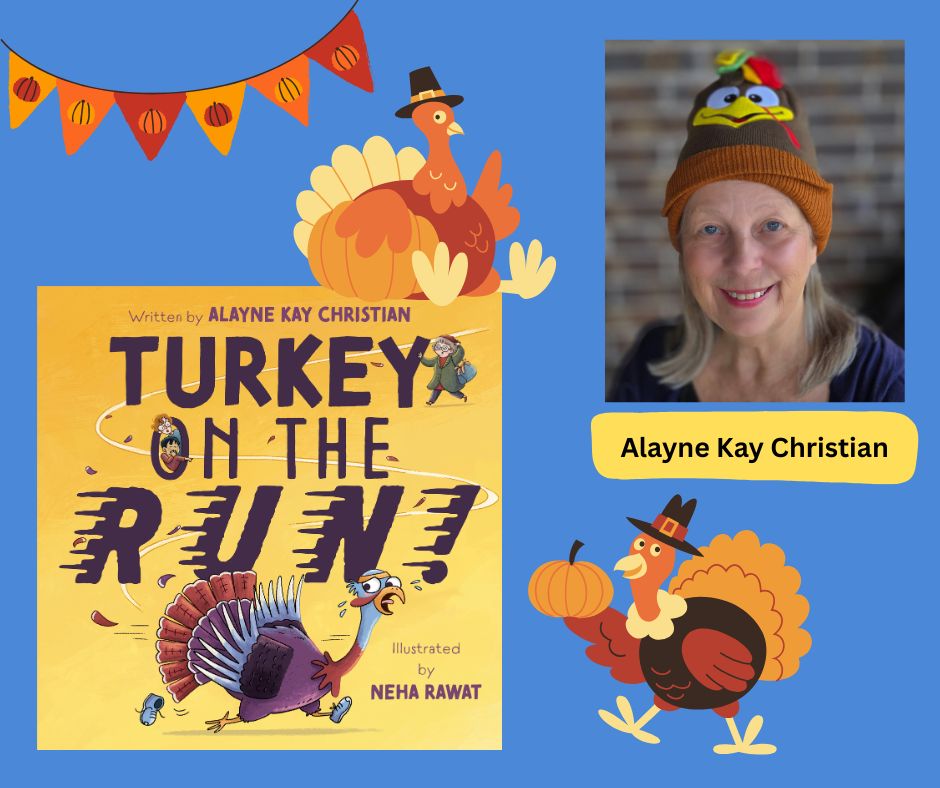
When award-winning author and teacher Alayne Kay Christian agreed to write a guest post for Frog on a Blog, I was so excited! Her latest picture book Turkey On the Run! will be officially released on September 29th, but you can preorder it now. This action-packed book is perfect for Thanksgiving, and should appeal especially to vegetarians, to people who’d prefer to dine on something a little different from the usual main dish of the holiday, and, of course, to kids who love animals.
Alayne specifically wanted to write about fun activities that teachers and librarians can use with their kids while sharing her book. But parents can take advantage of the activities as well, perhaps on Thanksgiving or in a party setting. Here she offers a cornucopia of ideas, including a simple “theatre” play and several bonus activities. Plus, she has even more to explore in the teacher’s guides on her website. Let’s hear from Alayne!
Thank you for having me as a guest on your blog. Today, I am offering some fun activity ideas for teachers and parents to go along with my latest picture book Turkey On the Run! Following is the Penguin Random House description to give you a sense of what the book is about and why these activities would work well.
“A feather-filled fiasco about a turkey determined to see the dawn of another Thanksgiving Day. As the whole town gives chase, this plucky bird dashes, dodges, and schemes his way towards freedom, only to discover that what waits at the end of the dining tale might not be as disastrous as he originally suspected. Told in bouncy, rhyming verse that fans of The Gingerbread Man will gobble right up, this spirited twist on the traditional holiday tale is stuffed with humor, heart, and holiday cheer.”
Here’s a little slideshow sneak peek of Turkey On the Run!:
(text and images copyright © 2026 by Alayne Kay Christian and Neha Rawat)
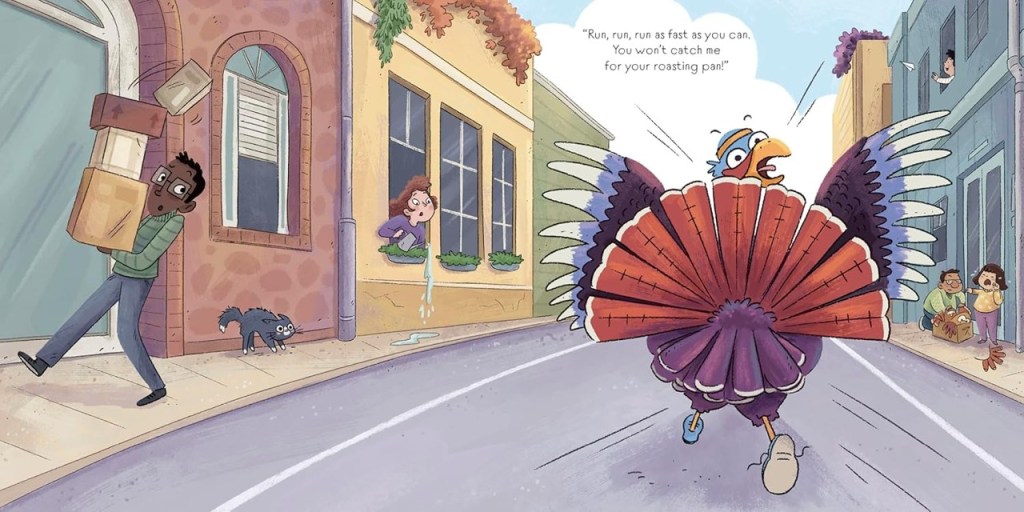
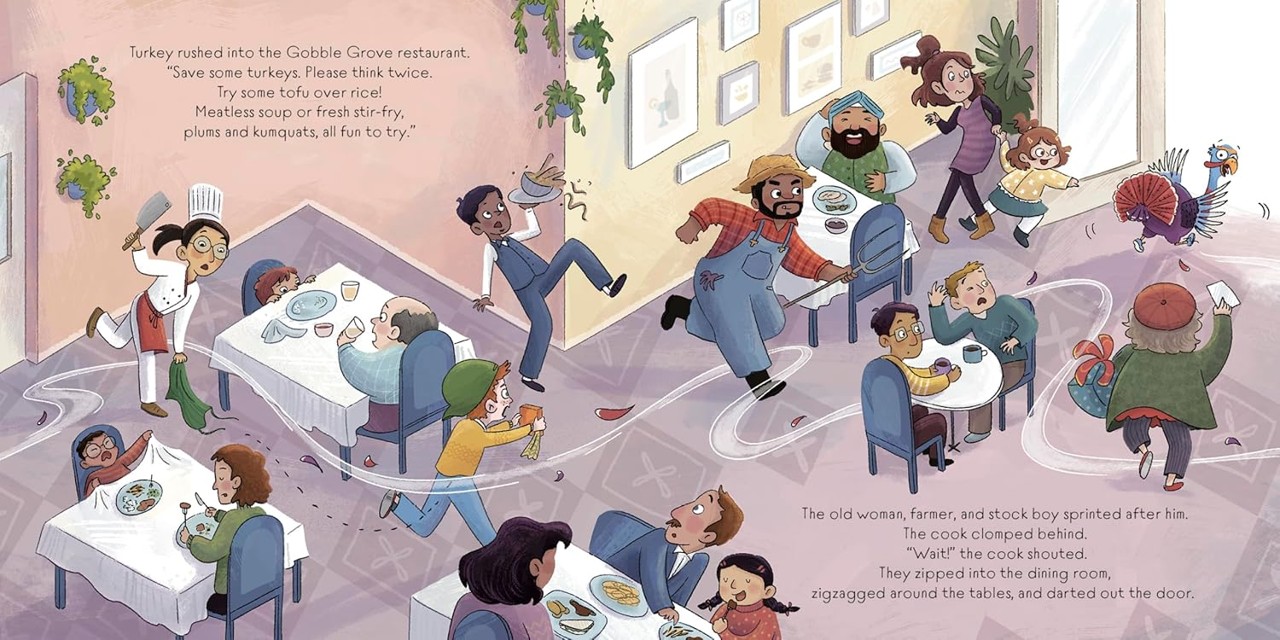
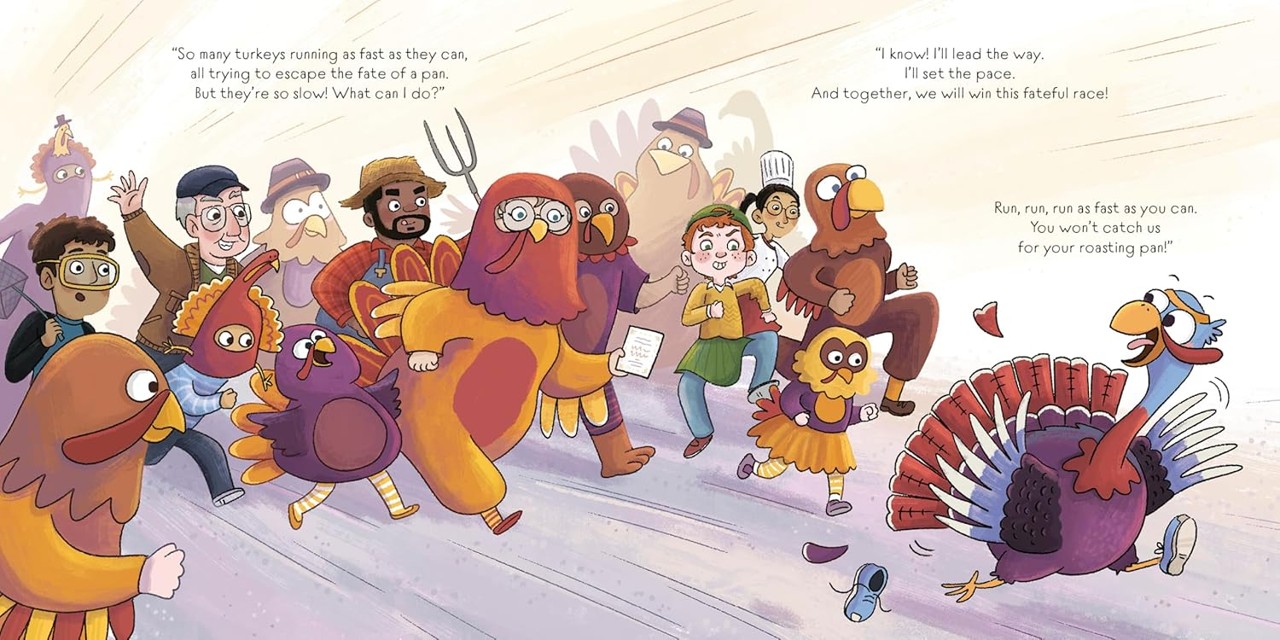
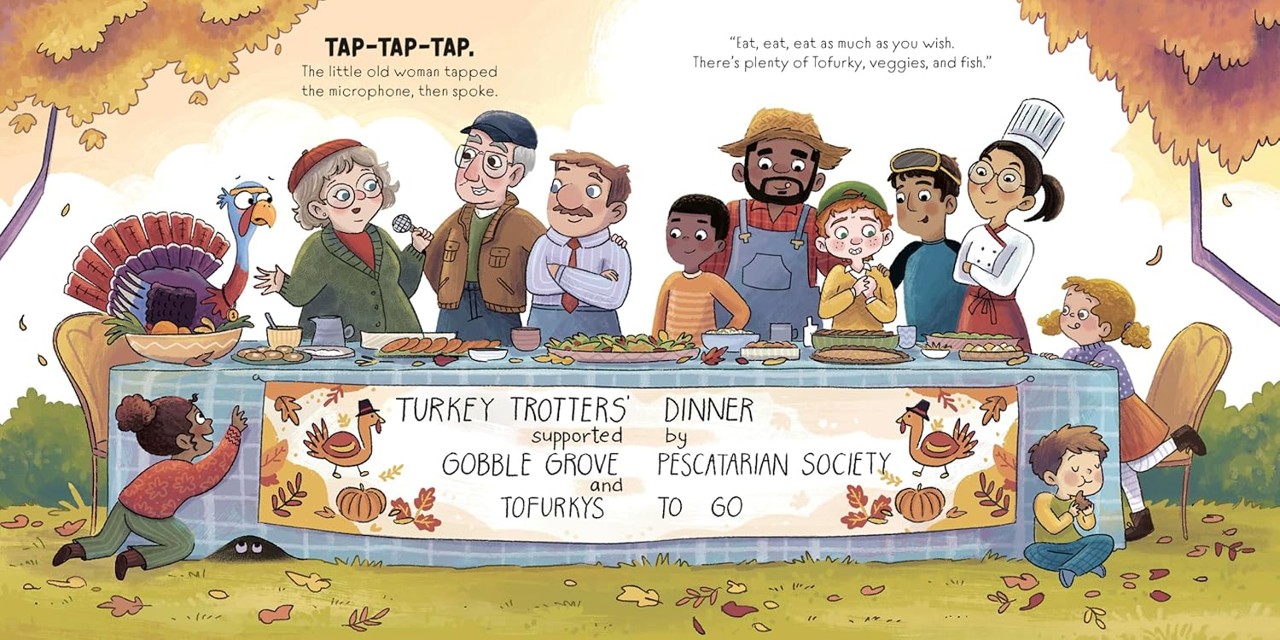
Turkey On the Run! is a perfect book to encourage fun and creative acting and playing for children. I hope some or all of the variations I offer below will encourage creativity, expression, listening, observing, and more from the children who participate. Also, I hope that this is just the beginning, and the ideas here spark additional ideas from your creative and teaching spirit.
The basic idea for most of the variations below is that children will either say, “Run, run, run as fast as you can. You won’t catch me for your roasting pan.” or shout “Wait!” If the situation allows, they can also act via motion and facial expressions, and so on.
1)Print out Turkey On the Run! character sheets (below).
2)Decide how students will display their character. On a paddle sign. On a headband. Clipped or pinned to clothing. As a hand puppet. Or simply hold it.
3)To make a simple hand puppet, roll the printout of the character into a tube and tape it together. Pinch the top of the tube and tape it closed. Slip the tube over child’s hand. (See the photo below.)
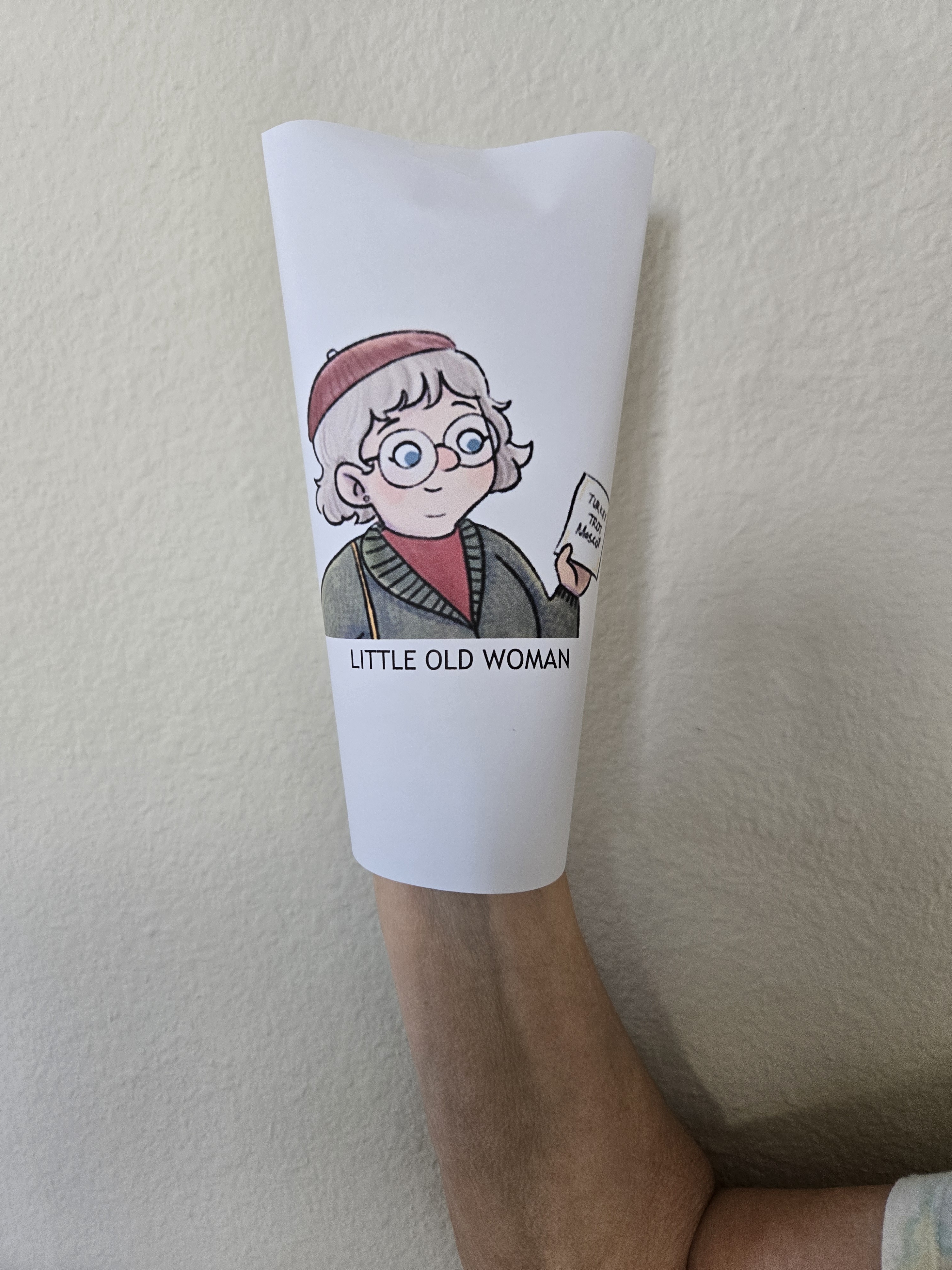
4)Assign children (or teams) a character role OR let children draw from a hat.
5)Reader will be the narrator that tells the story until it becomes the character’s chance to speak and act.
6)Determine how you want the children to present the play. Do you want them to actually chase Turkey around a defined area? Do you want the puppet holders to sit or stand in a circle and do a minimal chase with their arms, while maybe running in place with their feet? The actions will be up to you. Actions could include characters dropping an item and the next character picking the item up. The items dropped in the book are gloves, bandana, apron, and hat.
7)At the turning point of the story (the bakery scene), it will likely be easier if the narrator speaks for Turkey while the child acts. The child who plays the Turkey character might act out Turkey’s fear at the bakery, and his excitement at the race, and his concern on the final page.
8)You can take advantage of the “Run, run, run” sign and the “Wait!” sign that I have created by printing it out (perhaps making an easy grasp paddle to glue it to) and then hold each one up to prompt your different actors to speak. (See the signs below.)
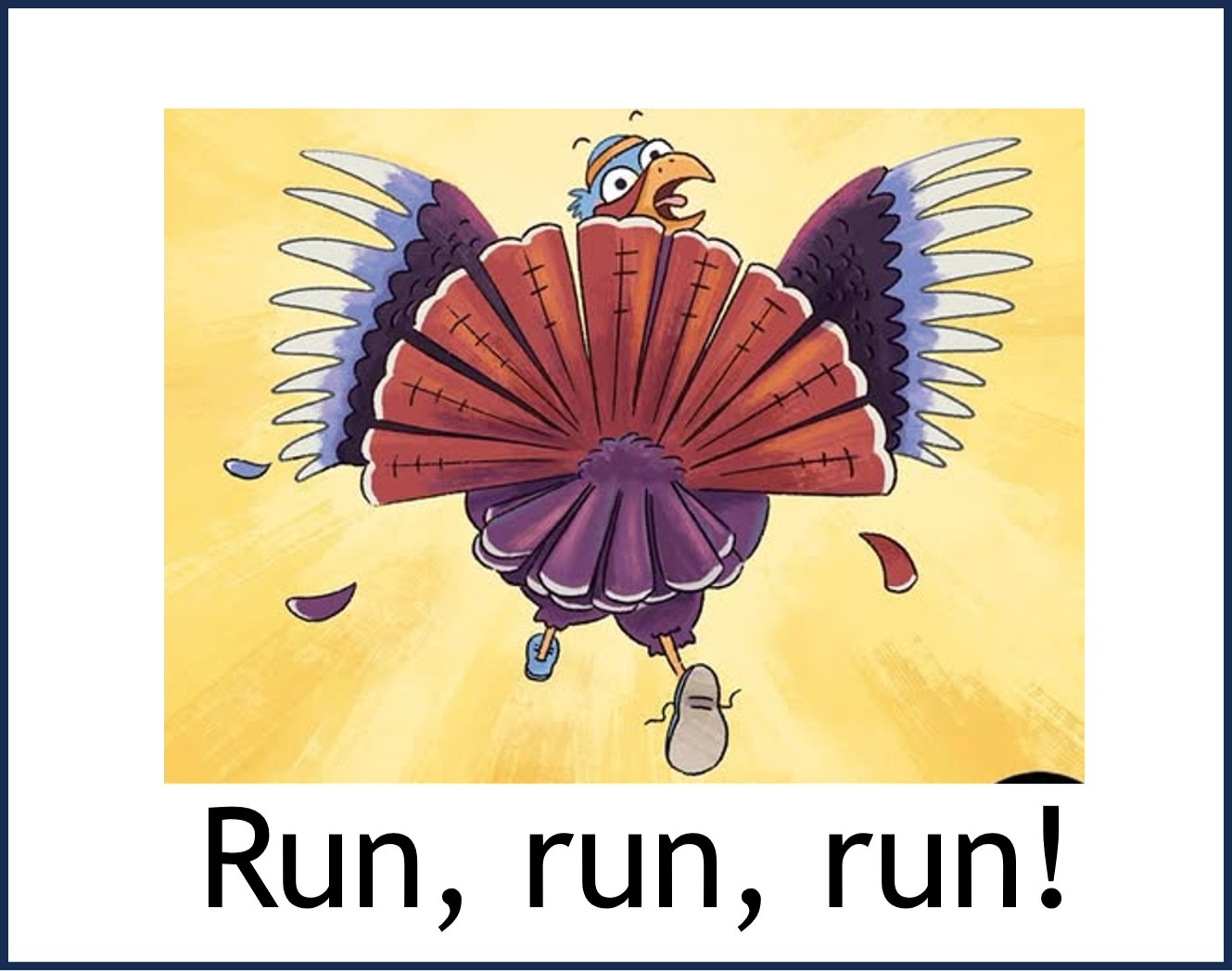

Signs
BONUS ONE: DISCUSS THE STORY
After the play, you may want to consider this list of questions (below) for comprehension, observation, inference to help discuss the story on a deeper level. Some of the questions will require a closer look at the illustrations to help the children discover through observation. This list is from my Turkey On the Run! Teacher’s Guide/Classroom Companion One, which you can find on my website.
PLAY VARIATIONS
TEAMS: Instead of individuals, you could have character teams, so each team would say their assigned character’s part together and do any actions decided upon ahead of time.
MUSICAL CHAIRS/TURKEY TROT CHAIR RACE: If it is a small group, and you don’t have space for a fun chase, you could do a musical chairs type thing. So, as the story advances, every time Turkey says, “Run, run, run as fast as you can. You won’t catch me for your roasting pan.” the characters start going around the chairs. You will always have one chair less than the number of characters. The last character seated is the winner of the Turkey Trot Chair Race.
You will most likely want to start the chase first with a warning such as “1, 2, 3!” Before you start the “Run, run, run as fast as you can. You won’t catch me for your roasting pan.” refrain. And you may want to end the chase by saying, “Wait!” or “Stop.”
FULL PARTICIPATION
You may want to use the Turkey “Run, run, run” sign along with the “Wait!” sign after you divide the children into two groups. As you read the book, one group will recite the “Run, run, run” lines when you hold up the Turkey sign. The other group will shout, “Wait!” when you hold up the wait sign.
BONUS TWO: TURKEY DAY
Have children wear something to represent a turkey. It could be a turkey hat or shirt. Fall colors like the colors in the book. A pin. A necklace. A sticker. A temporary tattoo. Anything that says “turkey.” Then make it a turkey day by reading the book and doing a turkey craft or doing some of the many activities in my teacher’s guides. You can find a list of links to Turkey and Fall crafts in my Turkey On the Run! Teacher’s Guide/Classroom Companion Two, which you can find on my website.
BONUS THREE: MODIFIED DUCK, DUCK, GOOSE
If you have the space, a great game for Turkey Day is a modified version of Duck, Duck, Goose. The child goes around the circle tapping heads and repeating “turkey” until they tap and say “Run!” And the chase begins.
BONUS FOUR: THANKSGIVING THANKFUL STORIES OR CARDS
The perfect way to end Turkey Day could be to talk about the times in the story that Turkey might be thankful. Then have children either write and illustrate a short story about something they are thankful for. Or you could have the children make a Thanksgiving card for someone to let them know why they are thankful for them. It doesn’t necessarily have to be someone close to them. It could be someone that impacts their lives like trash collectors, wait staff, mailperson, doctor, and so on.
TURKEY ON THE RUN TEACHER’S GUIDES/CLASSROOM COMPANIONS
Visit my website to find worksheets and activities for compare and contrast, character sequencing, cause and effect, vocabulary, crossword puzzles, word scramble, word search, creating, writing, drawing, alphabetizing, foods, thankful story, maze, crafts, bingo and more!
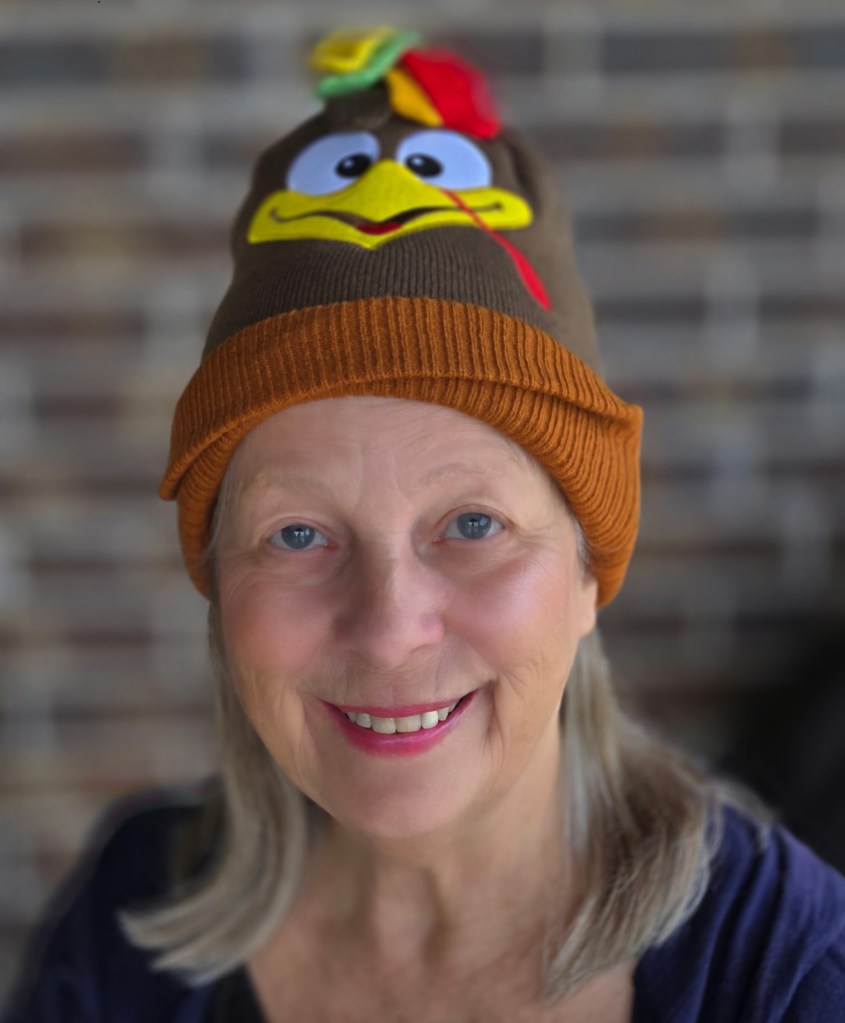
Alayne Kay Christian is an award-winning author, a former acquisitions editor, and a writing teacher. Her picture books include An Old Man and His Penguin: How Dindim Made João Pereira de Souza an Honorary Penguin; The Weed That Woke Christmas: The Mostly True Story of the Toledo Christmas Weed; and Turkey On the Run!
Born in the Rockies, raised in Chicago, and now a true-blue Texan, Alayne’s writing conveys her creative spirit, a bit of her funny bone, and the kinship to nature and humanity that lives within her heart. She is available for school visits both via Zoom or in-person and will work with teachers and or school to customize the visit to their needs.
To learn more about Alayne, visit her website and blog at . . .
Website: https://alaynekaychristianauthor.com
Blog: https://alaynekaychristian.wordpress.com/
You can find and follow Alayne on social media at . . .
X: @alayne_kay
Facebook: https://www.facebook.com/alaynekay.christian
Bluesky: @alaynekaychristian.bsky.social
Facebook Author’s Page: https://www.facebook.com/AlayneKayChristianAuthor/
Amazon Author’s Page: https://amazon.com/author/alayne_kay_christian
YouTube Channel: https://www.youtube.com/channel/UCY6yndWtpXwX6CIRoFi7X4g
Instagram: https://www.instagram.com/alaynekay/
Linkedin: http://www.linkedin.com/pub/alayne-kay-christian/12/168/525/