Favorite Line from the Book: “This will be better than bamboo bubble tea!” ~Red
What’s the first thing that pops into your head when you think about a panda? Probably the lovable, ever-popular black and white panda bear, right? That would be true for me, too, if my local zoo didn’t have red pandas. Red pandas are small, tree-dwelling mammals native to the forests of the Himalayas, Nepal, Tibet, Bhutan, and China. They have the fluffiest tails ever and are just so cute. They’re also endangered due to habitat loss and poaching, so I’m thankful that my zoo is dedicated to their conservation.
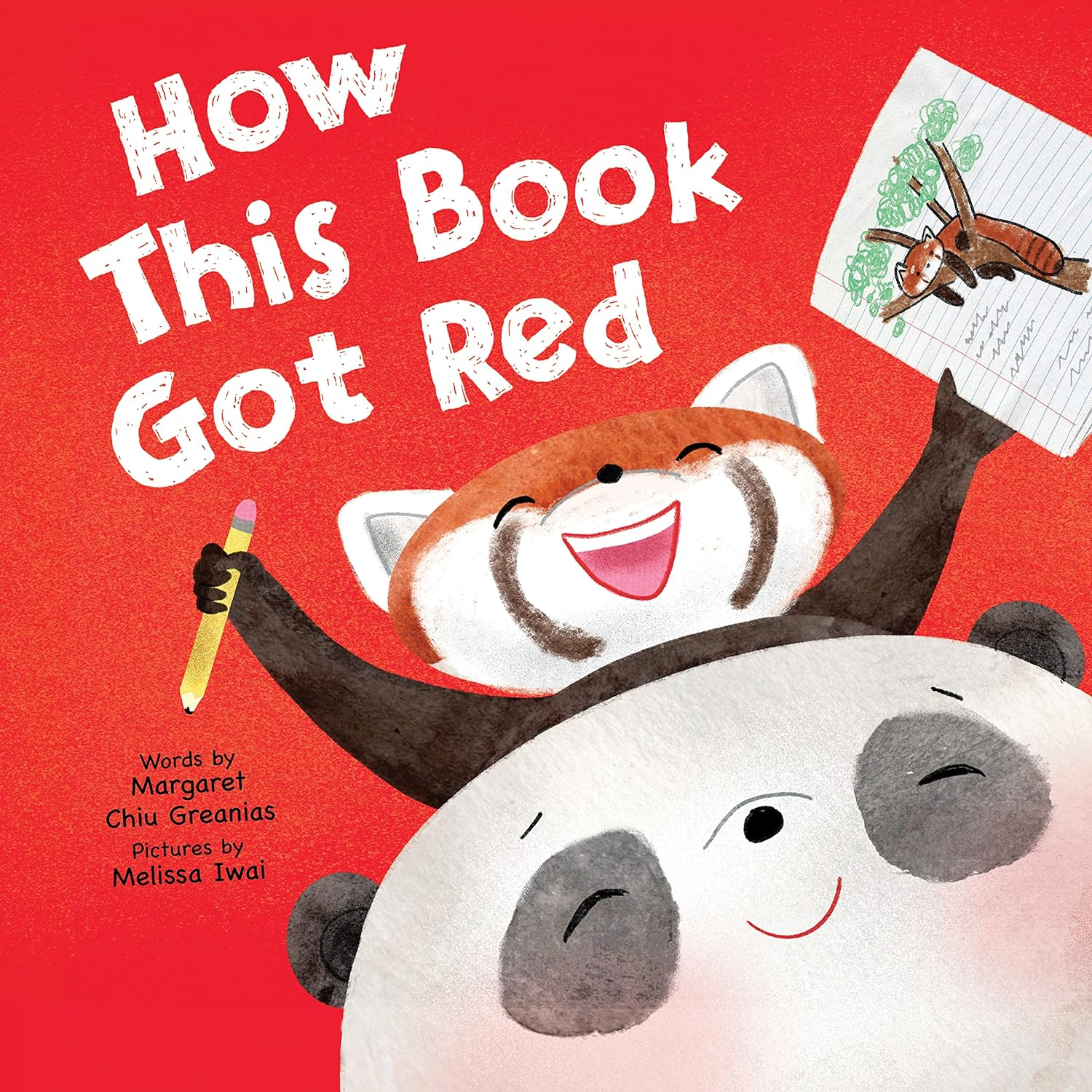
I was thrilled to hear about Margaret Chiu Greanias’s new picture book How This Book Got Red, which stars a red panda named Red and her best friend Gee, a giant panda. One day, Red and Gee settle down together to read a book about pandas, but the only pandas in the book, and in the books at the bookstore, are the black and white ones. Upset by this realization, Red endeavors to write her own book all about red pandas. But she struggles to get her words down on paper and complete her book. She thinks, if there are no books about red pandas, it must be because no one wants to read about them. But she soon learns that’s not the case at all. And with a little help from Gee, she finishes writing her book, and it becomes a great success.
On the surface, How This Book Got Red is a sweet picture book about a red panda who decides to write a book about red pandas. But there’s a deeper layer to this story. Representation. Margaret Chiu Greanias, the daughter of Taiwanese immigrants, says, “Like Red, the main character in How This Book Got Red, I didn’t see myself in books when I was growing up.” She goes on to say, “I grew up feeling less than others. When I looked in the mirror, I saw someone who didn’t match my idea of pretty and never would.” Margaret says she didn’t value who she was because people who looked like her were not represented in the books she read. She believes “that the more everyone understands how the lack of representation affects those rendered invisible, the less children will grow up feeling the way I did.” In a starred review, Kirkus Reviews said: “Greanias illustrates perfectly, in a way that children will intuitively understand, why it’s so crucial for everyone to see themselves depicted in media…”
A secondary layer in the book reflects a struggle that most writers will connect with: Trying to write when the words just won’t come. Believing you have nothing of value to say, nothing that anyone’s going to want to read. Taking a chance and pouring yourself onto the page and then sending your work out into the world with a deep breath in your lungs and hope in your heart. Yep, I certainly can relate to that.
The illustrations, by Melissa Iwai, created using watercolors, colored pencils, and digital tools, are charming, colorful, and clearly done by a talented artist who has the skills and experience to bring personality to Red, Gee, and all their panda pals.Red is just so endearing! ❤️ As a bonus, readers will find a few facts about real red pandas on the front and back endpapers.
Most people recognize the black and white panda, but I think there should totally be more books about red pandas. If you’ve ever seen one in person, like I have, you know I’m right. They are Adorable with a capital A, just like this book. And something tells me that How This Book Got Red will inspire kids to be writers, hopefully, writing the kinds of stories they want to see, ones that represent them!
Publisher/Year: Simon & Schuster Books for Young Readers/2023
Favorite Line from the Book: There on their doorstep was a very soft, very waggy, very lick-your-face-play-fetch-roll-over-rub-its-belly-and-chase-its-tail sort of a thing.
This silly and heartwarming book, written and illustrated by Amy June Bates, is for animal lovers (like me) and anyone who wishes they could fill their home with lots of pets, big ones, small ones, ordinary ones, and rather unusual ones. Aardvark anyone? How about a buffalo? Or maybe a whale?
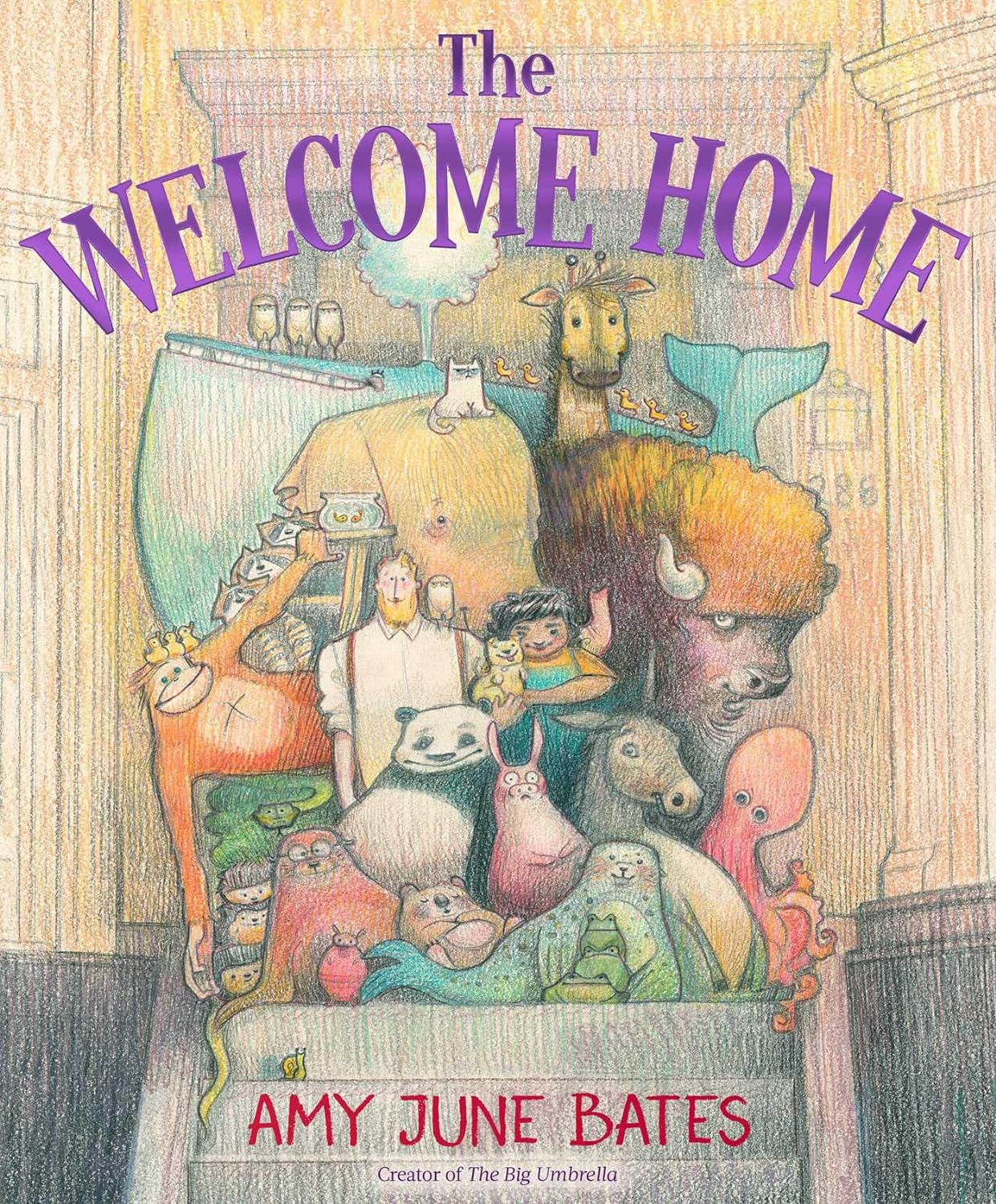
The Welcome Home is about a couple, Mr. and Ms. Gargleson-Bittle, who live together in a big house and feel that something is missing. So they get a pet and then another and then another and begin to fill the empty space in their home. They love all of their animals, from the snail to the panda to the orangutan to the octopus (and many more), but something is still missing, something very soft, very waggy, and very lick-your-face-play-fetch-roll-over-rub-its-belly-and-chase-its-tail-y. It’s a good thing they have room in their hearts for just one more to make their family complete.
The text of The Welcome Homeis simple, but children will get a kick out of meeting each new animal as it’s introduced, names and all. The cover is colorful and eye catching, but I’m not as enthusiastic about the interior art. Some of the pages are a bit dark and cluttered, making the illustrations, which are done in colored pencil, hard to “read.” That said, I think kids will still find the pictures of happy, playful animals appealingand laugh-out-loud funnyin this book that Kirkus Reviews called, in a starred review, an instant classic.After all, who wouldn’t like a donkey howling at the moonor a flock of ducklings nesting in their hair?
Yep, I’m an animal lover to the core. I adore spending time with my dog. I enjoy watching nature programs on TV. Visiting the zoo is one of my favorite pastimes, and I want to bring all of the animals home with me. I’d love to put an elephant in my backyard. But, alas, I’m pretty sure my town has restrictions against it. I wonder how they’d feel about a giraffe? Hmm…🤔
I guess most of us will have to settle for reading picture books about animals. And that’s great news because those are some of my favorite books! And kids love them too!
Picture Book Month is an international literacy initiative founded by Dianne de Las Casas that celebrates the print picture book during the month of November. Many people in the kid lit community were fortunate to have known Dianne and considered her a friend. I didn’t know her personally, but what I knew of her, I admired. She was a multi-published author with a passion for picture books, so much so that she established Picture Book Month in 2011 along with fellow children’s book authors and illustrators Katie Davis, Elizabeth Dulemba, Tara Lazar, and Wendy Martin. Dianne continued to champion picture books until her untimely death in 2017.
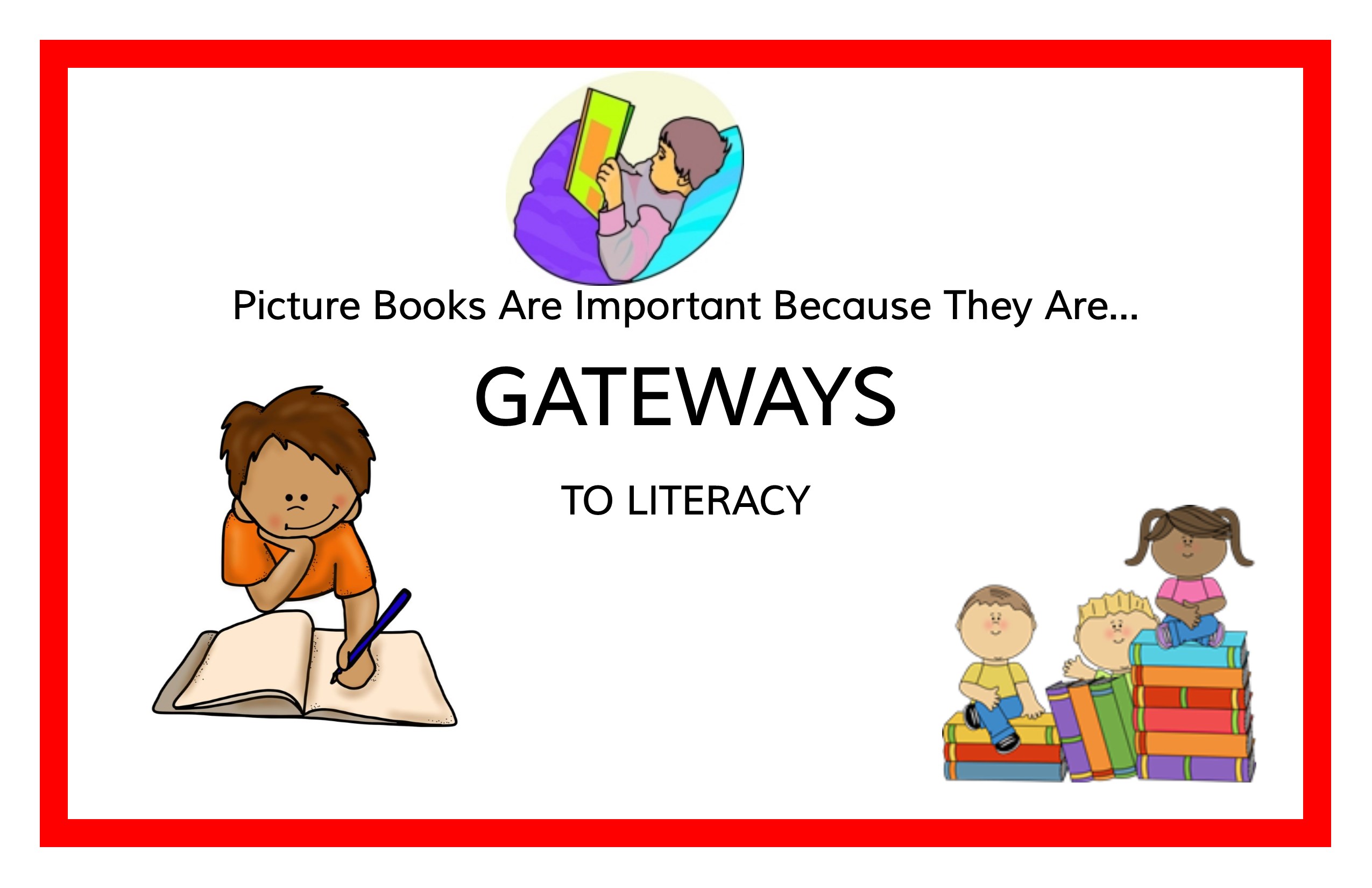
When I first discovered the Picture Book Month celebration in 2012 (I think), I promptly subscribed to receive the daily posts and displayed the Picture Book Month Ambassador badge here on Frog on a Blog, not only in support of the initiative, but also, just like the authors and illustrators that were featured on the PBM site, I wanted to be an advocate of picture books and the many incredible things they represent. I wanted to answer the question “Why are picture books important?” (See the slideshow below for just a few of the answers.)
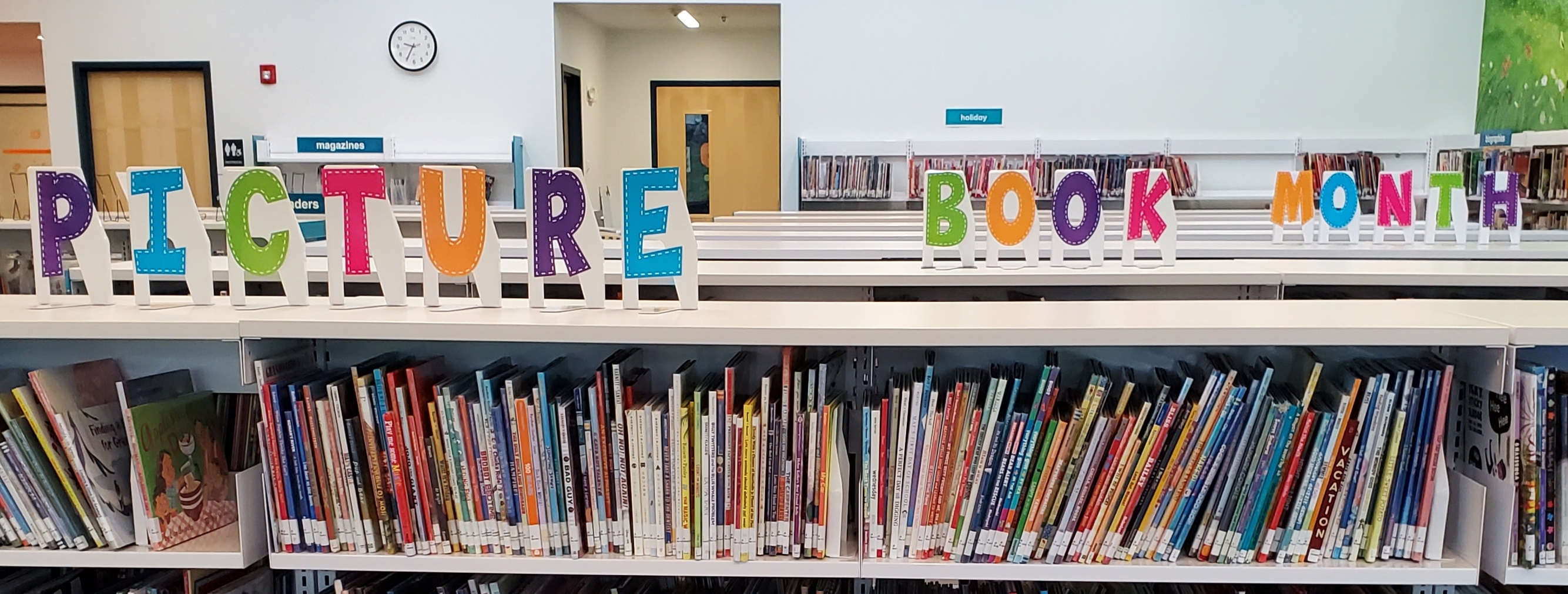
When I worked at my local public library, one of my favorite things to do was to create book displays, posters, and decorations for the children’s room during Picture Book Month. I put out bookmarks and coloring sheets for kids to take home. And each day of November, I put new picture books on display. I’ve since retired from my library assistant job, but my blog still serves as a place to share and celebrate picture books, which is why I still proudly display the Picture Book Month Ambassador badge to this day.
I post actual book reviews very seldom, preferring to share interviews and guest posts, but, in honor of Picture Book Month, I’m going to attempt to review several picture books throughout November. Keep an eye out for the posts. You may just find your next favorite book!
Since the world tragically lost Dianne de Las Casas, it has no doubt been difficult for another to pick up where she left off, and the Picture Book Month website was taken down. But it’s heartening to see libraries across the country (and, hopefully, the world) still celebrating PBM with programs, activities, and displays, both digital and physical. I’m sure other organizations, authors, bloggers, and more are promoting it too.
All of you reading this right now, join me in celebrating picture books this month. Check picture books out from your libraries. Read them with your kids. Share picture books you’ve read on social media.Leave reviews on Amazon and Goodreads. And buy your favorite author’s and illustrator’s books.
I love what school librarian Cynthia Zervos said about Picture Book Month on the ALSC (Association for Library Service to Children) blog in 2021: “Honestly, I celebrate picture books all year long, but November is a great time of year to reflect on all the beautiful picture books that were introduced to us this year.” So true!
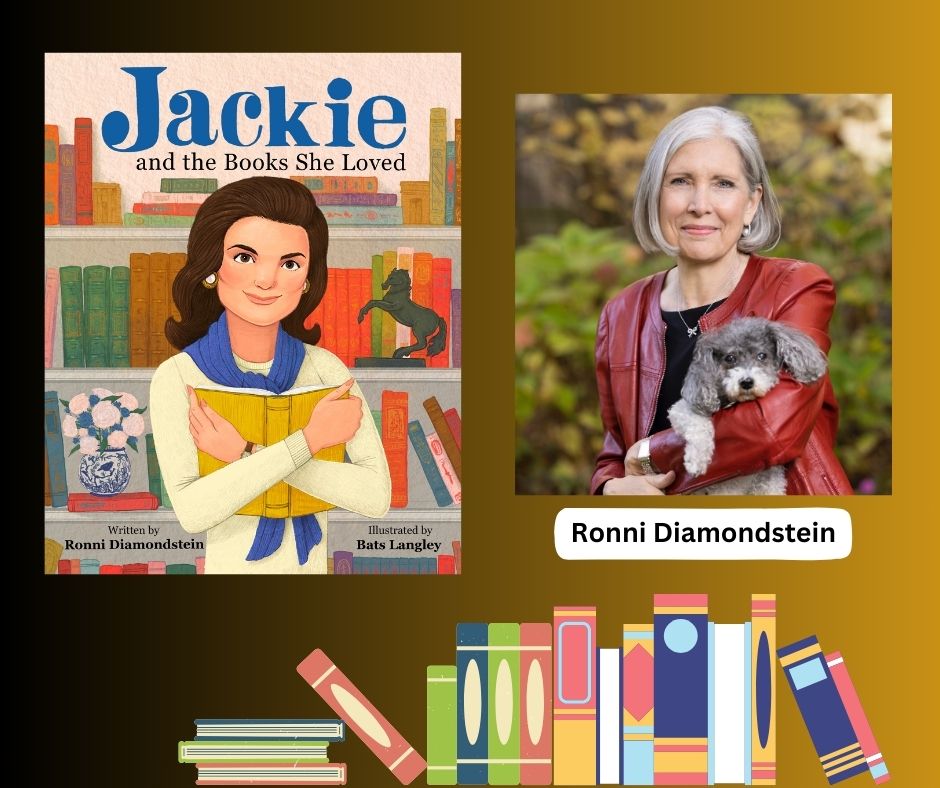
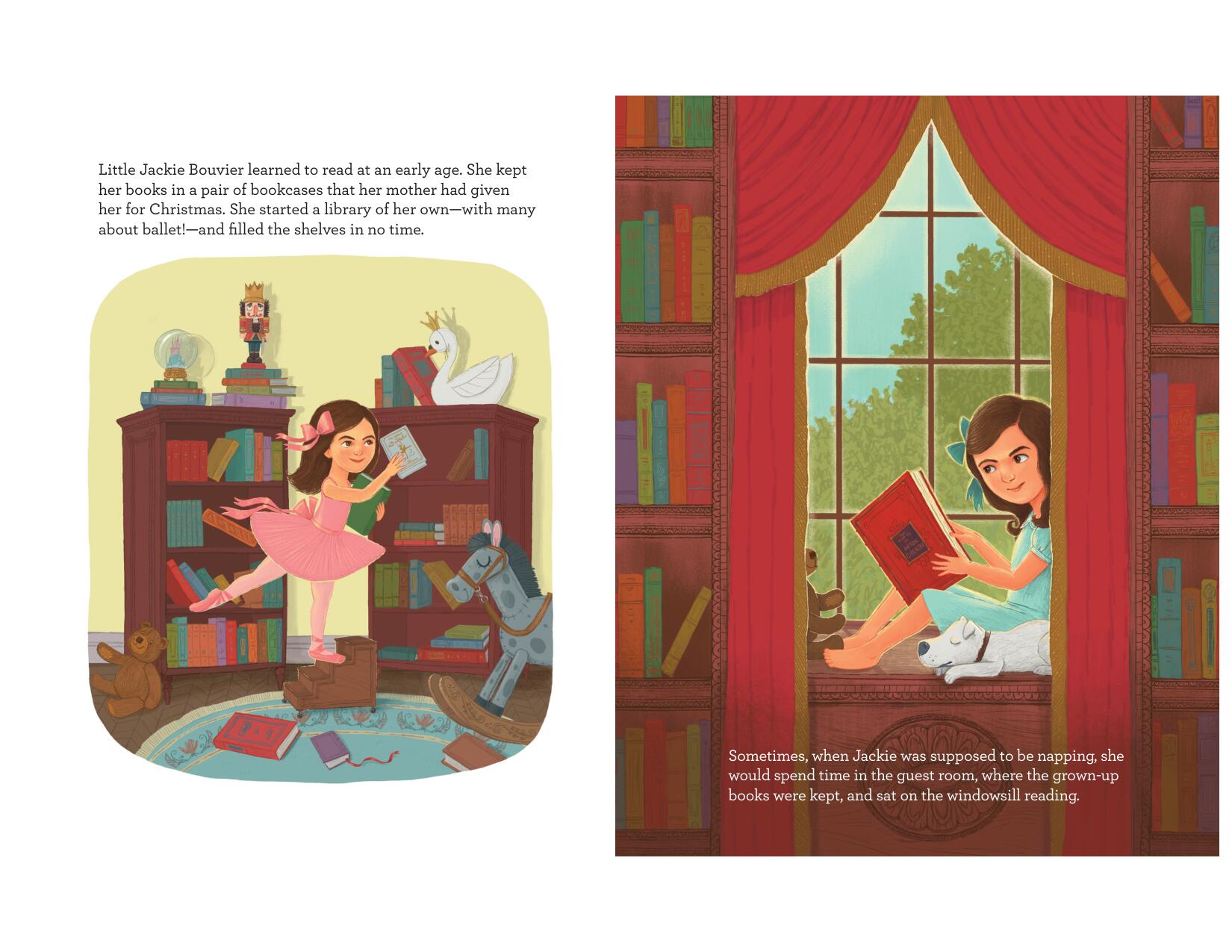
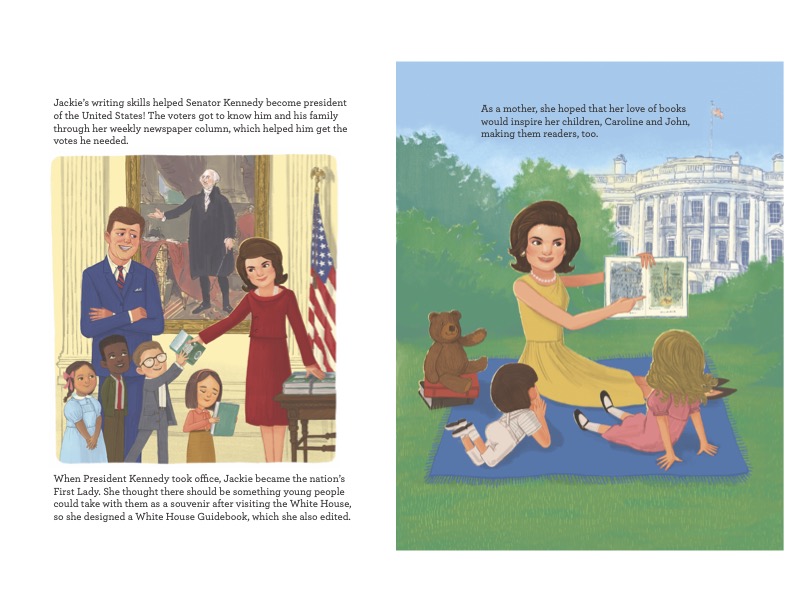
Please welcome author Ronni Diamondstein to Frog on a Blog! Ronni’s debut picture book is a biography about the life of iconic public figure Jacqueline Bouvier Kennedy Onassis, entitled Jackie and the Books She Loved. Ronni’s book is due out on November 7th by Sky Pony Press, but you can preorder it now. The art, by the talented Bats Langley, is gorgeous and so colorful, but what I think I like best about the book is getting a glimpse into the life of a young Jackie Bouvier, a little girl who loved reading, collecting books, writing and illustrating stories and poems, and animals. There’s so much I can relate to here!And I’m sure kids will too!
Ronni’s answered a few questions for us today about her special book and her writing life. Let’s hear from Ronni!
Congratulations on your fantastic debut picture book Jackie and the Books She Loved, which was beautifully illustrated by Bats Langley! Tell us a bit about the book and what inspired you to write it.
RD: First, I’d like to thank you, Lauri, for having me on Frog On A Blog.
JACKIE AND THE BOOKS SHE LOVED is my debut picture book biography and it truly was a labor of love. Having researched Jacqueline Kennedy Onassis for nearly thirty years, I was fascinated by her love of books and her career as an editor and was inspired to tell her story. The book introduces young readers to an independent and confident Jackie and the idea of how books guided her life. The story paints the portrait of a child captivated by reading and a love of literature and writing—from five-year-old Jackie reading Chekhov stories to a seasoned and confident Jackie at her desk as an editor in the last two decades of her life. Jackie never wrote a memoir but revealed herself in the nearly one hundred books she brought into print. Jackie and the Books She Loved is about the real woman behind this American icon of style and grace brought to life by the lovely artwork of Bats Langley.
Can you reveal one interesting fact you uncovered about Jacqueline Kennedy Onassis while doing research for your book?
RD: I knew a lot about Jacqueline Kennedy Onassis, but I was not surprised to learn that she preferred that the author be the star and insisted on staying in the background. Most readers had no idea that Jackie had acquired and shaped the book they were reading.
How does your experience as a school library media specialist and teacher influence how you write for children?
RD: Because I have read so many books in my more than three decades as a teacher and school library media specialist, I know what good writing looks like, and that can be a little daunting and intimidating. I also realize how important it is to read your work aloud as you write. I want to write something that will spark a child’s imagination. I always had this Einstein quote in my school libraries, “Imagination is more important than knowledge.”
How would you encourage children who aspire to be writers one day?
RD: I have done this as a school library media specialist. I ran writers workshops for students. Now that I am retired, I hope JACKIE AND THE BOOKS SHE LOVED will encourage children to be writers. I am doing an online launch with the Chappaqua Library on November 9th at 7PM. I am working with the children’s librarians to develop a craft kit that will include writing prompts for kids to write poems and stories and make their own little booklet of their writing with strings and ribbons just like Jackie! I will also have activities on my EXTRA page on my website.
Please share one of your favorite classic picture books and one of your favorite recent picture books.
RD: This is the hardest question for a librarian! I will say there are classics like Make Way for Ducklings by Robert McCloskey and Mr. Rabbit and the Lovely Present by Charlotte Zolotow that I think should be read to every child. Dominic by William Steig is one of my very favorite children’s books that I recommend to adults as well as children. It’s a brilliant book about life that I’ve read many times. The Boy Who Loved Words by Roni Schotter is a more recent beautifully written picture book. And for a recent picture book biography, a mentor text of mine is On the Wings of Words: The Extraordinary Life of Emily Dickinson by Jennifer Berne. I’m also loving the brand new pb bio by Lisa Rogers Beautiful Noise: The Music of John Cage.
What are you working on now, another biography perhaps?
RD: I have always loved interviewing people as a journalist, so it should come as no surprise to you that I am working on a biography even though people are always asking me to write about my dog, Maggie Mae!
Photo credit: Randi Childs
Ronni Diamondstein spent her life surrounded by books and immersed in the world of children’s literature. An avid reader since childhood, libraries, books, and writing are her life’s work. As a school library media specialist and teacher of gifted and talented students in the United States and abroad, Ronni nurtured her students’ creativity by sharing her love of reading with them.
Ronni is a graduate of Syracuse University. She attended Bread Loaf Writers Conference and led writing workshops and open mics to encourage people of all ages to tell their stories. Ronni served on the Board of the Chappaqua Children’s Book Festival and is a past President of the Chappaqua Library Board of Trustees. Jackie andthe Books She Loved is her debut picture book. Ronni lives in Chappaqua, New York, with her toy poodle, Maggie Mae.
To connect with Ronni and learn more about her book, visit her website and follow her on social media:
Publisher/Year: Simon & Schuster Books for Young Readers/2023
Favorite Line from the Book: She’s not here yet, but she’s already my little sunshine.
With so much heartbreaking news in the world right now, I was hesitant about posting this review because this book’s topic is, to put it simply, sad. But October is National Pregnancy and Infant Loss Awareness Month, and, if just one person who has experienced the grief of pregnancy loss finds comfort and healing in the message shared by author Saira Mir and illustrator Shahrzad Maydani in the pages of Always Sisters: A Story of Loss and Love, then it’s worth spreading the word here on Frog on a Blog about such a powerful picture book.
Always Sisters: A Story of Loss and Love, published August 22, 2023, by Simon & Schuster, is about a little girl named Raya who can barely contain her excitement that she will soon have a baby sister. She knows that they will be best friends and have so much fun together running, playing, laughing, eating chocolate ice cream, and watching their favorite cartoons. Raya tells all her schoolmates about her baby sister, though she’s not yet born. She even says she doesn’t need a birthday gift this year because her little sister, whom she calls Nura, will be her gift. But happiness and anticipation soon turn to sadness and confusion when she’s told Nura won’t be coming after all. Raya learns to handle her grief through expressions of love for Nura, like drawing pictures, talking with her family and kids at school, and helping her parents plant a magnolia tree on the day that would have been Nura’s birthday, a tree that will help them all remember how Nura would have grown.
Shahrzad Maydani’s soft colored illustrations, rendered in chalk pastels and watercolors, have a hazy, dream-like, quality about them, almost as if the whole story is made of memories, which I think is a good choice for such a heavy topic.
Grief is universal, felt by everyone who loses a loved one, but young children often have a difficult time processing it. Always Sisters: A Story of Loss and Love can help kids manage such a weighty emotion in a sensitive way, especially if shared in a safe environment with family or counselors. In an author’s note at the end of the book, Saira Mir speaks about her and her family’s own experience with the loss of a baby. She says, “Talking about sad feelings isn’t easy, but sharing what’s in your heart can help you feel better.”
I’m excited to share that I’ve been selected by the fabulous Elayne Crain for a two-month picture book mentorship through Inked Voices! I’m so glad Elayne liked my manuscript, and I’m incredibly grateful for the opportunity!
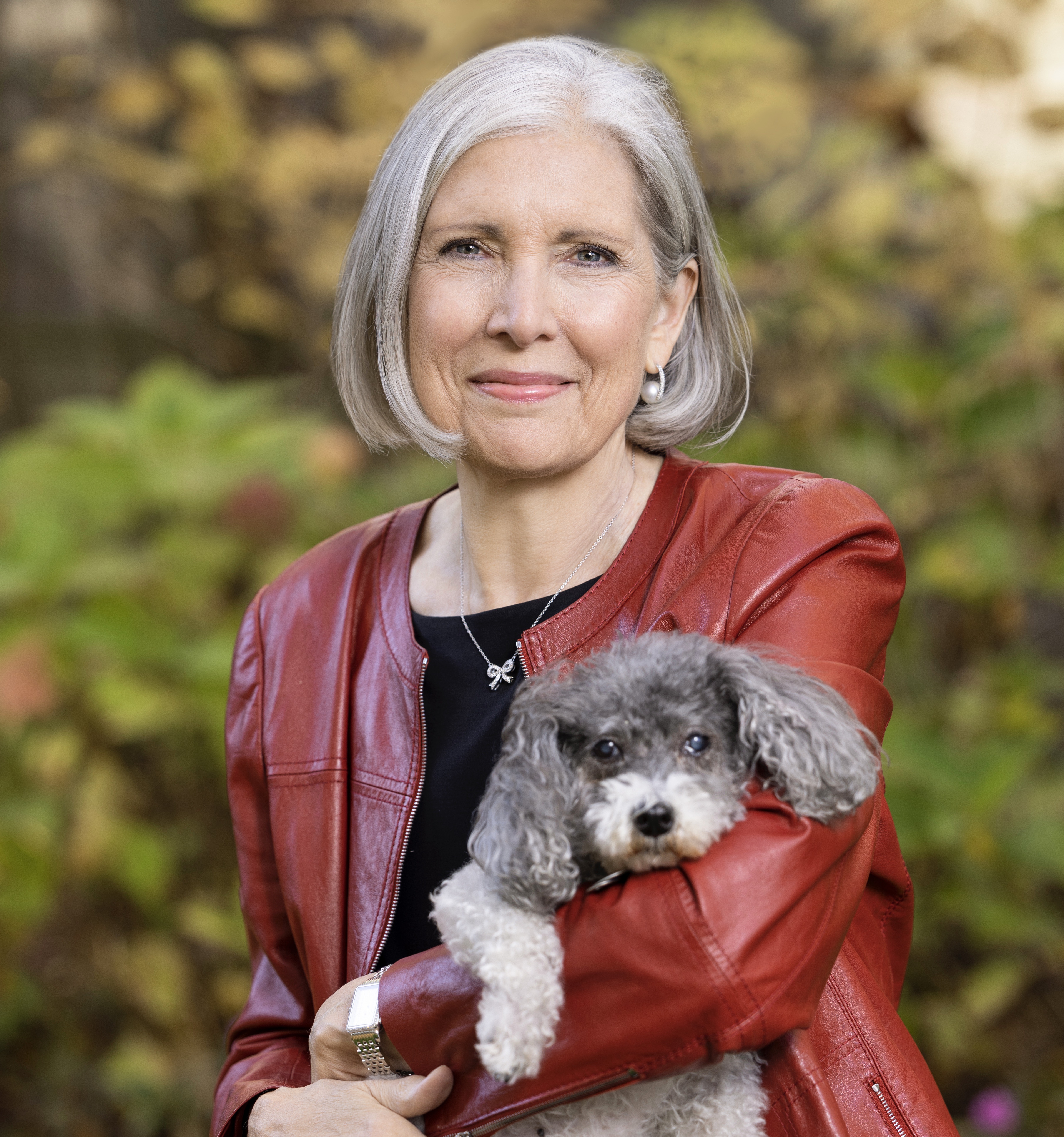
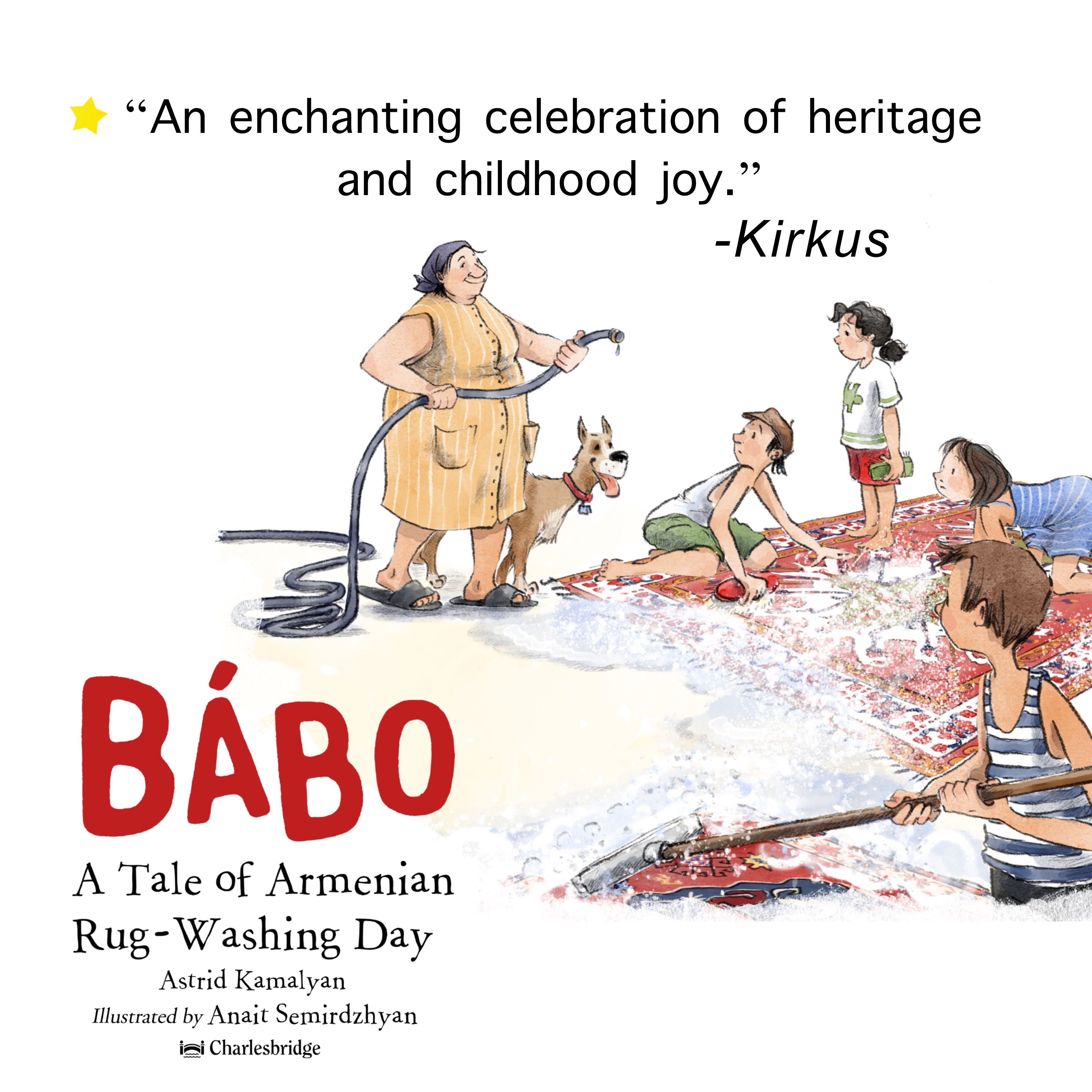
I’m honored to be a stop on author Astrid Kamalyan’s book tour for her debut picture book Bábo: A Tale of Armenian Rug-Washing Day. Her lovely book, just published September 19th by Charlesbridge, earned starred reviews from both Kirkus and The Horn Book and is a Junior Library Guild Selection. Bábo: A Tale of Armenian Rug-Washing Day is the first children’s book about Armenia traditionally published in the US in over 30 years and is the only one to feature Artsakh dialogue.
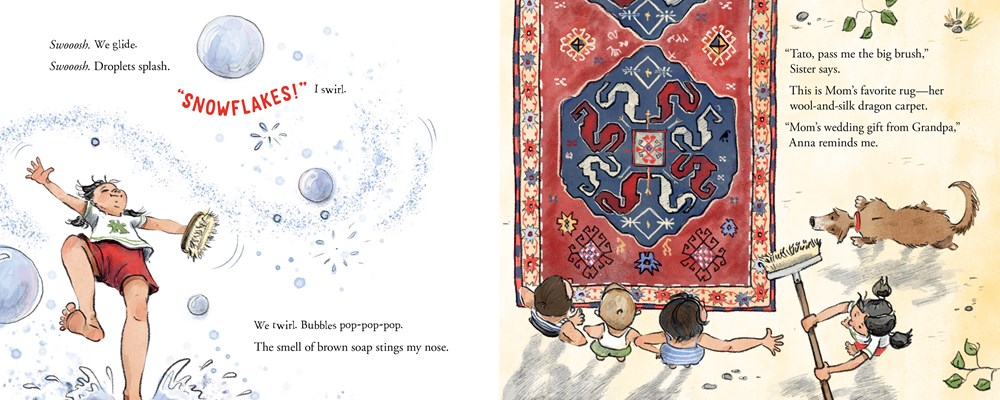
Beautifully detailed illustrations by Anait Semirdzhyan adorn this cozy, cultural tale that highlights the author’s childhood memories of time spent with her grandmother on rug-washing day.Astrid’s love for Armenia can be felt on every page, and, onher website, Astrid poetically writes of her Artsakh home, “The air in our mountains is the color of lavender and smells of wild thyme; the warmth of the sun is sometimes all you need for breakfast.”
Astrid Kamalyan stopped by today to share a bit about her emotional publication journey and authentically representing her culture, which has become even more important as her beloved Artsakhpeople were recently and tragically attacked by the rulers of the country Azerbaijan. As Astrid says, “It makes no sense to celebrate diverse books if we aren’t going to care about the actual people in those stories.” Let’s hear from Astrid.
It was on a cold autumn day in Chicago that the idea for BÁBO sparked in my mind, a warm memory shining straight from my childhood. I wrote it down while cozied up on our sofa. Was my first draft ready to go? Not yet. But it had something in it.
Something that came as a second-person POV, non-rhyming story, which I later turned into a rhyming one, and then changed into a first-person POV, non-rhyming story. BÁBO, unlike my other manuscripts, required experimentation.
Our busy, happy family always had visitors. All were welcome at our table. Neighborhood kids gathered in our dining room as my precious bábo cooked, and laughed, and gave the warmest hugs. But would that make too many characters for a picture book? Probably yes, at least for this one. And so, as if echoing all the other changes, one of the characters had to go during the revisions.
Writing from the heart doesn’t mean writing without a challenge. It sometimes means finding the right angle, focusing on the main feeling, and cropping out the distractions. It also means pressing the “stop editing” button at the right moment, before you over-revise it to the point of losing the heart of the story.
But BÁBO was more than a story about my family. It was a story representing my culture. The first picture book in more than three decades to be traditionally published about Armenia. And as this realization came to me, so did the sense of responsibility. How do I do justice to something so ancient, so rich, and so deeply loved by me? Growing up surrounded by precious Artsakh rugs was not enough. Researching and meeting experts wasn’t either. Being inspired by a video of an Armenian woman weaving a carpet was the magic ingredient. The backmatter wrote itself in an instant. All the research and hard work were there just to support this magical moment of cherishing the beauty of Armenian carpet weaving.
In the summer of 2020, I submitted the manuscript for a critique at the SCBWI’s LA conference. My first time doing so. Did I expect it to get me an agent or to sell? No. All I wanted was a professional opinion. But BÁBO disagreed. It got me an agent and a book deal.
And here’s where cluster munitions enter the picture.
My wonderful editor, Karen Boss, asked for revisions before acquiring the manuscript. But at that very moment thinking about revisions wasn’t something I could afford. On September 27th, 2020, my homeland, Artsakh, was attacked. My people were forced out of their homes, our churches were bombed, and our cultural monuments desecrated. After the war, everything I knew, everything I belonged to was shuttered. How do I sing our joy now?
Decisions had to be made. One of them was that I chose to not give in to the darkness, singing our joy and unapologetically celebrating our culture, while facing more evil than I ever knew existed. BÁBO didn’t turn into a book it didn’t intend to be. It stayed the sunshine that it is. Because, in this darkness, our kids deserve a space where childhood is just that–carefree, sun-filled, barefoot . . . childhood.
And also because, no matter how much others try to destroy us, this is who we are–a people who embrace people and embrace the sun.
Was I done with the challenges? Almost there. I had to make one more leap and gather the courage to suggest an Armenian illustrator, Anait Semirdzhyan, whose work I admired. It was a proactive move on my side, yet it wasn’t driven by whimsy but by a need for authentic representation. Both my agent and my editor loved Anait’s amazing work, and so began the journey of BÁBO. Need I tell you how much joy the sketches, the color versions, and seeing the cover brought to my heart? How much it meant to me, my family, and now to my community?
And in the spring of 2023, when I received my author copy, something magical happened. For a moment, I was no longer homesick. I was home.
Update from Astrid:
One day after this post was submitted for publication, on September 19th, 2023, Azerbaijan attacked the indigenous Armenian population of Artsakh. That after 10 months of starving them by an illegal blockade of the region. Civilians were attacked by cluster bombs and drones. There are hundreds of victims, including children. Thousands are missing, mostly kids. Currently, the civilians are being held hostage–the road for evacuation is blocked, while Azeri forces continue killing and kidnapping people. What is happening in Artsakh is a genocide organized by the dictatorial regime of Azerbaijan, backed by countries such as Turkey and Russia. If you want to help, please check out this link for the latest updates, and please do not be indifferent to your Armenian friends who are all suffering right now.
And please join me in sending love and prayers for the Armenian people in Artsakh. ❤️
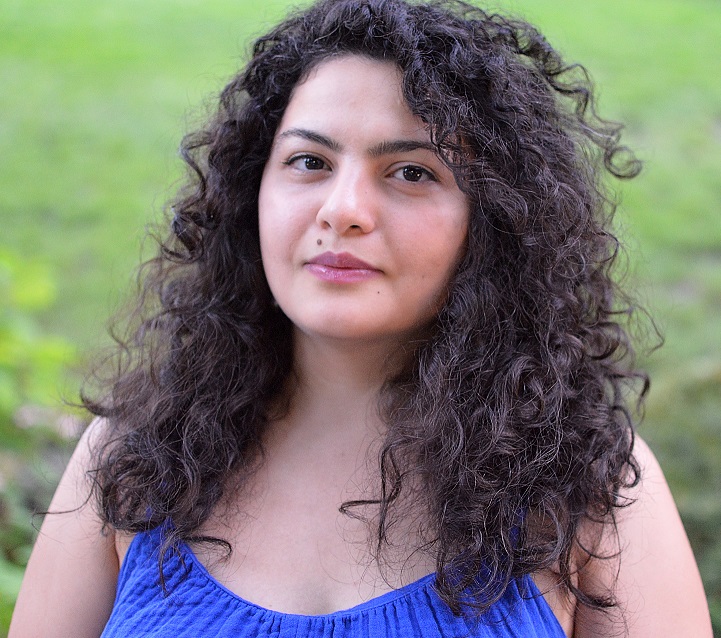
Astghik (Astrid Kamalyan) comes from a big, happy Armenian family, where she is the oldest of five siblings. Childhood summers spent in Artsakh are what inspired her to paint with words. Astrid is a member of SCBWI, IALA (International Armenian Literary Alliance), and 12×12. Astrid’s debut picture book Bábo: A Tale of Armenian Rug-Washing Day is a Junior Library Guild Selection and received starred reviews from Kirkus and The Horn Book.
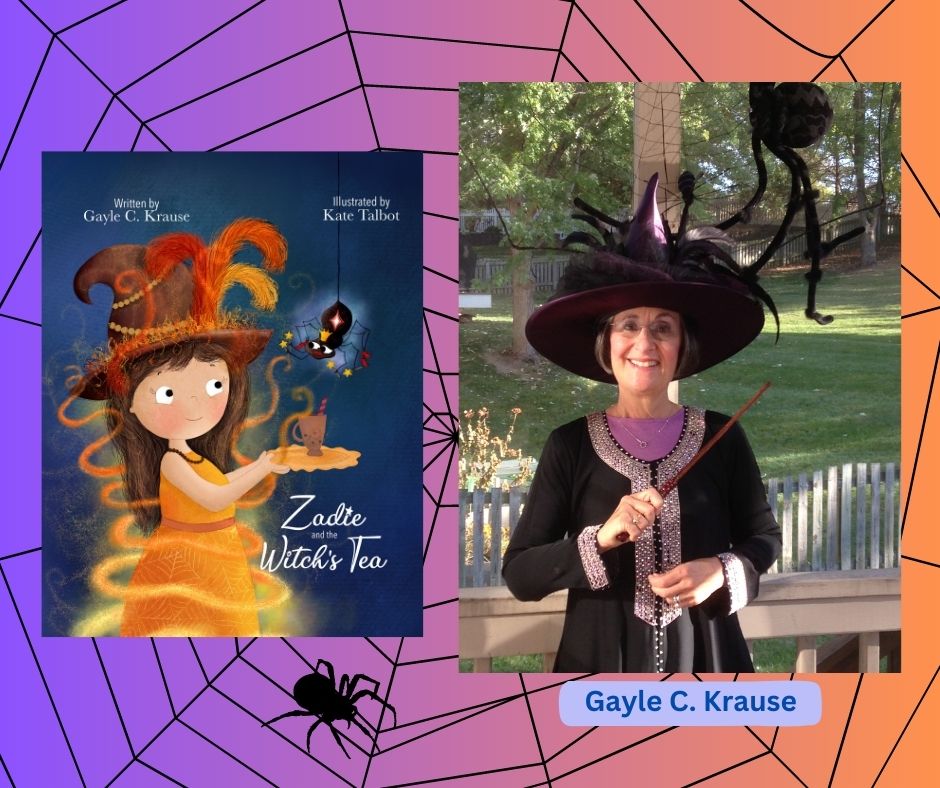
Please welcome multi-published children’s book author Gayle C. Krause to Frog on a Blog. Gayle’s new picture book, Zadie and the Witch’s Tea, was just released this past July from Trowbridge Books. The book stars an adorable little witch, and absolutely no prince, in this clever reimagining of the Cinderella story. Perfect for Halloween or anytime, Zadie and the Witch’s Tea will enchant kids with Gayle’s delightful rhyming text and Kate Talbot’s bold, colorful illustrations.
Gayle is definitely a fan of both fairy tales and holiday stories, as evidenced by a few of her published books, including the picture books Once Upon a Twisted Tale and Rock Star Santa. Let’s hear more about Zadie and the Witch’s Tea from Gayle in the interview below. Be sure to read to the end for information on how you can win your very own signed copy of Zadie and the Witch’s Tea along with some fun swag!
Congratulations on your fantastic new picture book Zadie and the Witch’s Tea, which was charmingly illustrated by the talented Kate Talbot! Tell us a little bit about the story and what inspired it.
GK: As a Pre-K Director in a Laboratory Program in an upstate New York Career/ Technical Center, I trained prospective Early Childhood Education teachers and incorporated Children’s Literature, most specifically fairy tales, into the secondary and preschoolers’ curriculums.
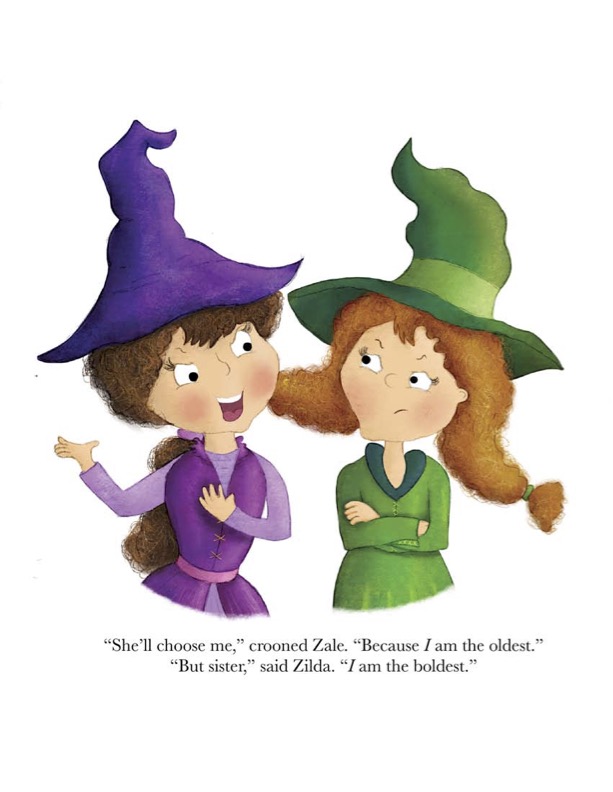
Since the Cinderella tale is well-known to children, and Halloween is a dress-up event they love, (it happens to be my favorite holiday), coupled with my own family fun time (Witchy Sisters Weekend), I couldn’t help but write Zadie’s story. Zadie and the Witch’sTea is a retelling of Cinderella with a little witch, a Hairy Godspider, and no prince.
When a little witch’s two older sisters dash her hope of attending the biggest event of the Halloween season because she has no magic, her determination and a surprising spider enchantment sends her there. The adult witches compete to become the assistant to the most powerful witch in the land, The Grand Witch. But a kind gesture from Zadie wins the night and the title, proving kindness is stronger than magic!
As someone who’s authored picture books, middle grade novels, and young adult novels, which type of book is your favorite to write?
GK: That’s an interesting question, Lauri. When I met with my editor and the editorial director of Scholastic Books for my first picture book, Rock Star Santa, I distinctly remember telling them that I loved to write in rhyme, but thought I had a YA voice. They disagreed with me.
Truth be told, as the years have passed, I’ve been attracted to writing MG novels as well as picture books. So, I guess they were right. At this point I switch back and forth. After completing a picture book (which is usually in rhyme), I write a MG novel (a whole different mindset).
How does your experience as a teacher influence how you write for children?
GK: Another great question. Yes. My students, both high school and preschool, have played significant parts in my writing. I had a little boy in the nursery who was so shy he wouldn’t talk to anyone, but a junior girl, who was also painfully shy. (She went on to become an actress in Hollywood.) Go figure! 😊
I had another boy who, at the time, was not diagnosed as neurodivergent, but, looking back, was clearly on the spectrum. Brilliant! And an expert on dinosaurs. He could identify a dinosaur by its footprint cast. (I do have a picture book about him, but it was never published.)
I also had a little girl who was adopted from China and shared her favorite Chinese holiday and folktale with the class. I have a picture book about her life story, as well, but unless I get her to co-author it with me, it won’t be published.
And, of course, the high school kids will recognize their personalities in the attitudes of my novels’ characters.
How important were books to you as a child?
GK: I loved to read. I still have my favorite Little Golden Book from, let’s just say, a very long time ago, Uncle Mistletoe. A few years ago, one of the department stores in NYC came out with an Uncle Mistletoe stuffed doll and a Christopher Radko ornament of both Uncle Mistletoe and Aunt Holly. They are on my tree every year.
I also read every Grimm’s fairy tale, and it wasn’t until I studied Children’s Literature in college, that I was introduced to the other creators of fairy tales like Carlo Collidi (Pinocchio), Hans Christian Andersen (The Snow Queen, Little Mermaid), and Charles Perrault (Little Red Riding Hood, Puss in Boots, Cinderella, and Sleeping Beauty) to name a few. I could go on forever about fairy tales. 😊
What do you believe makes picture books so magical?
GK: I believe it starts with the author’s vision. For me, I see the pictures as I write. It’s important to leave room for the illustrator, but it’s equally important to make sure the story stays true to your vision. I couldn’t see Zadie as a black-outlined graphic or an abstract illustration. Kate had the exact style and vision that coincided with mine. We were a perfect fit. I especially love how she portrayed the magic of the Hairy Godspider transforming Zadie’s dress into a spooktacular spidery sensation.
Please share some words of advice for aspiring children’s book authors.
GK: This business is so much harder than it looks, but don’t give up on your dream. Here is a mantra to follow:
Persevere! Persist! Proceed!
And even when you get frustrated and you think your dream will not happen, just take a break. The drive and creativity never leave you. It always comes back stronger and better. And, this time, it might be the manuscript that delivers your dream!
Thank you for having me, Lauri, and letting me share Zadie’s story with your readers.
Giveaway
Gayle is generously offering a signed copy of Zadie and the Witch’s Tea + some fun swag to one lucky winner who comments on this blog post by October 4th. And if you share news about the book on social media, mention it in your comment here for additional chances to win. I’ll choose a winner at random and connect them with Gayle. Good luck! (Giveaway open to US residents only)
Named the 2022 MG first-place winner of the Kid’s Choice KIDLIT Writing Contest, Gayle C. Krause is a PAL SCBWI member and a past member of The Historical Novel Society, and The Poets’ Garage. She served on the National Rhyme Revolution Committee, choosing the best rhyming picture book from 2015-2018. She teaches writing seminars to published kid-lit creatives and new children’s writers. She’s a former Education Academy Chair in an upstate NY Career and Technical school, where she taught prospective Early Childhood educators and directed a Laboratory Pre-K in conjunction with her program.
She writes PB, MG, and YA and has six published books. Her picture book Rock Star Santa (Scholastic – 2008) was performed as a play in Australia and presented at Storytime in Montserrat, British West Indies with a real British Rock Star. Her picture book Daddy, Can You See the Moon? (Clear Fork/SPORK – 2019) shares royalties with Our Military Child, an organization that helps veteran’s children deal with their parent’s war injuries. And her new picture book, Zadie and theWitch’s Tea, a retelling of the Cinderella tale with a little witch and no prince, emphasizes kindness and has an international following.
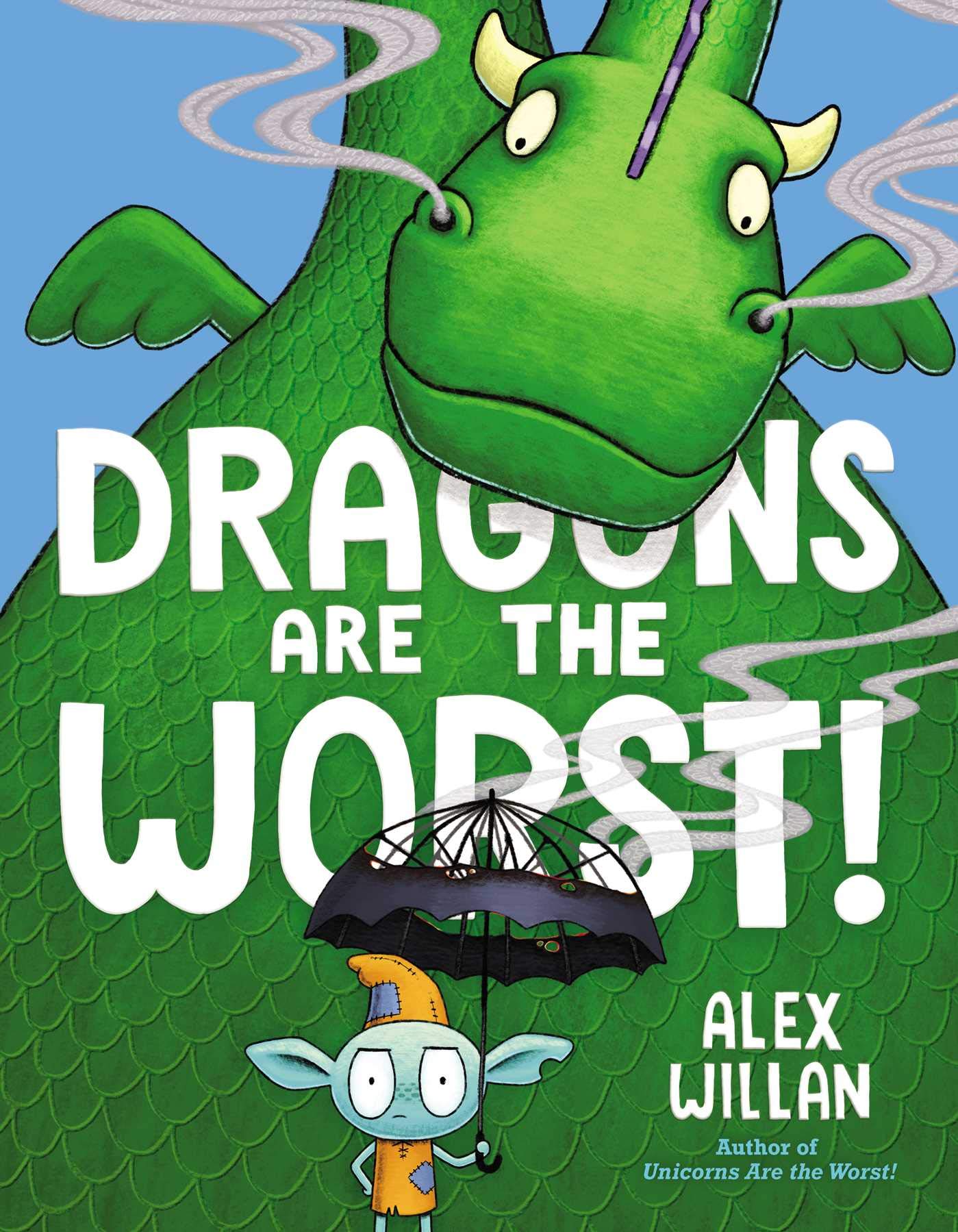
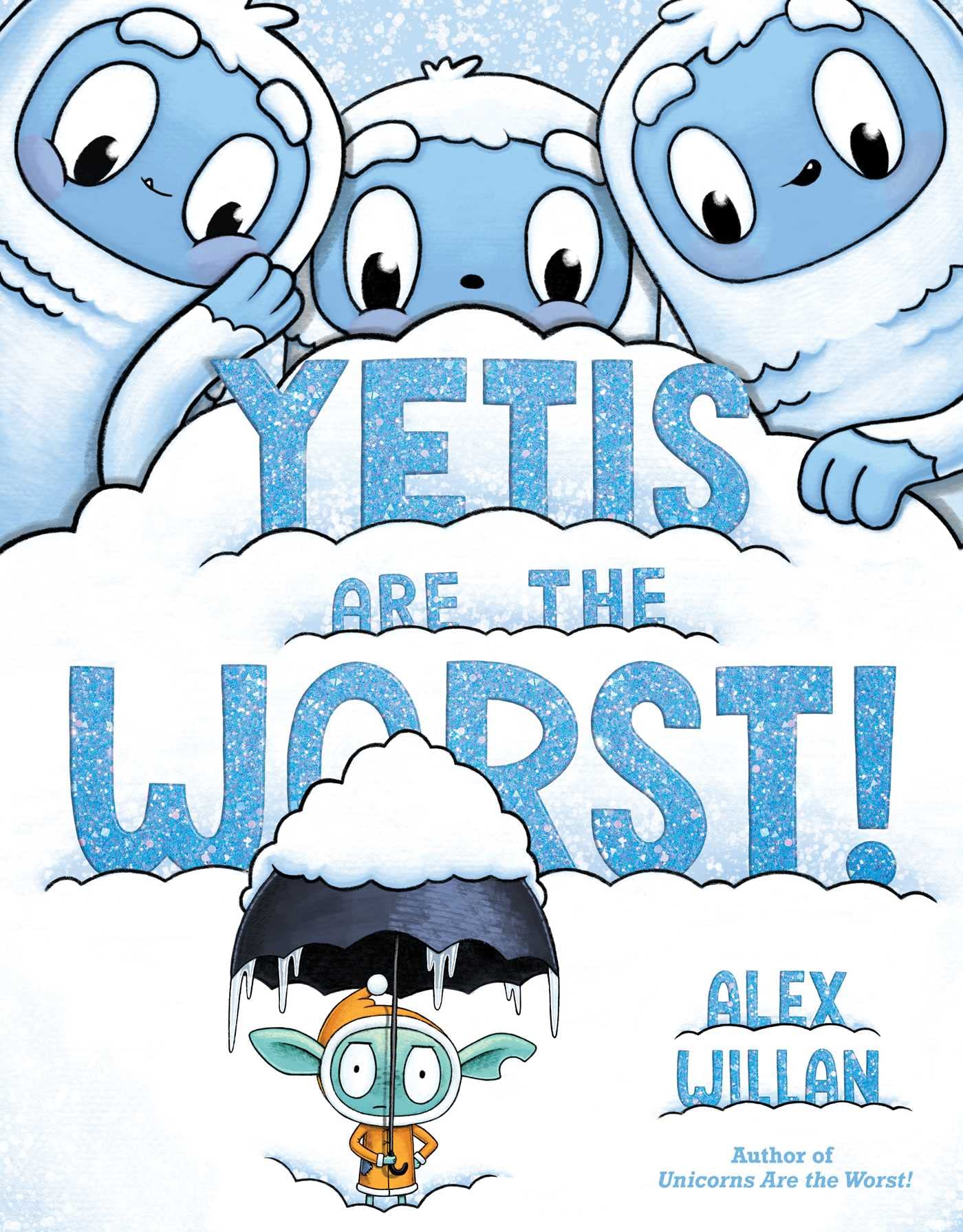
Please join me in wishing a very Merry Christmas, er, I mean a very Happy Book Birthday to the hilarious, multi-published author/illustrator Alex Willan for his brand-new picture book Elves Are the Worst! This book is sure to be a holiday (or anytime) favorite with kids. It’s the latest in his The Worst! series and should prove to be just as popular as the other three: Unicorns Are the Worst!, Dragons Are the Worst!, and Yetis Are the Worst! All of these books are filled with humor, color, and lovable characters. And they are so much fun to read. Just like the others, Elves Are the Worst! stars the adorable, ever persistent Gilbert the Goblin, but, this time, he must prove himself to be just as good as, if not better than, any elf at the North Pole. What will he learn this time? You’ll have to read the book to find out.
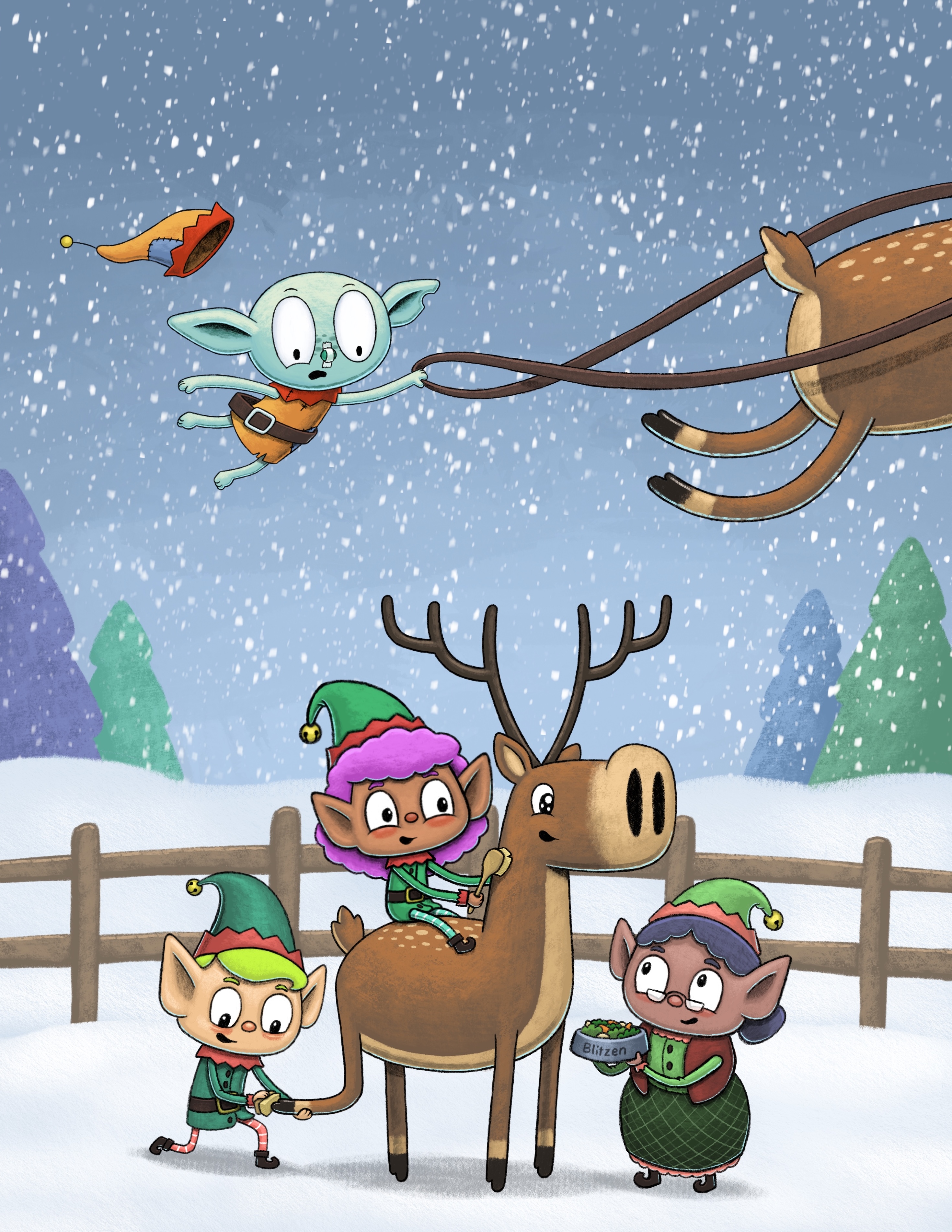
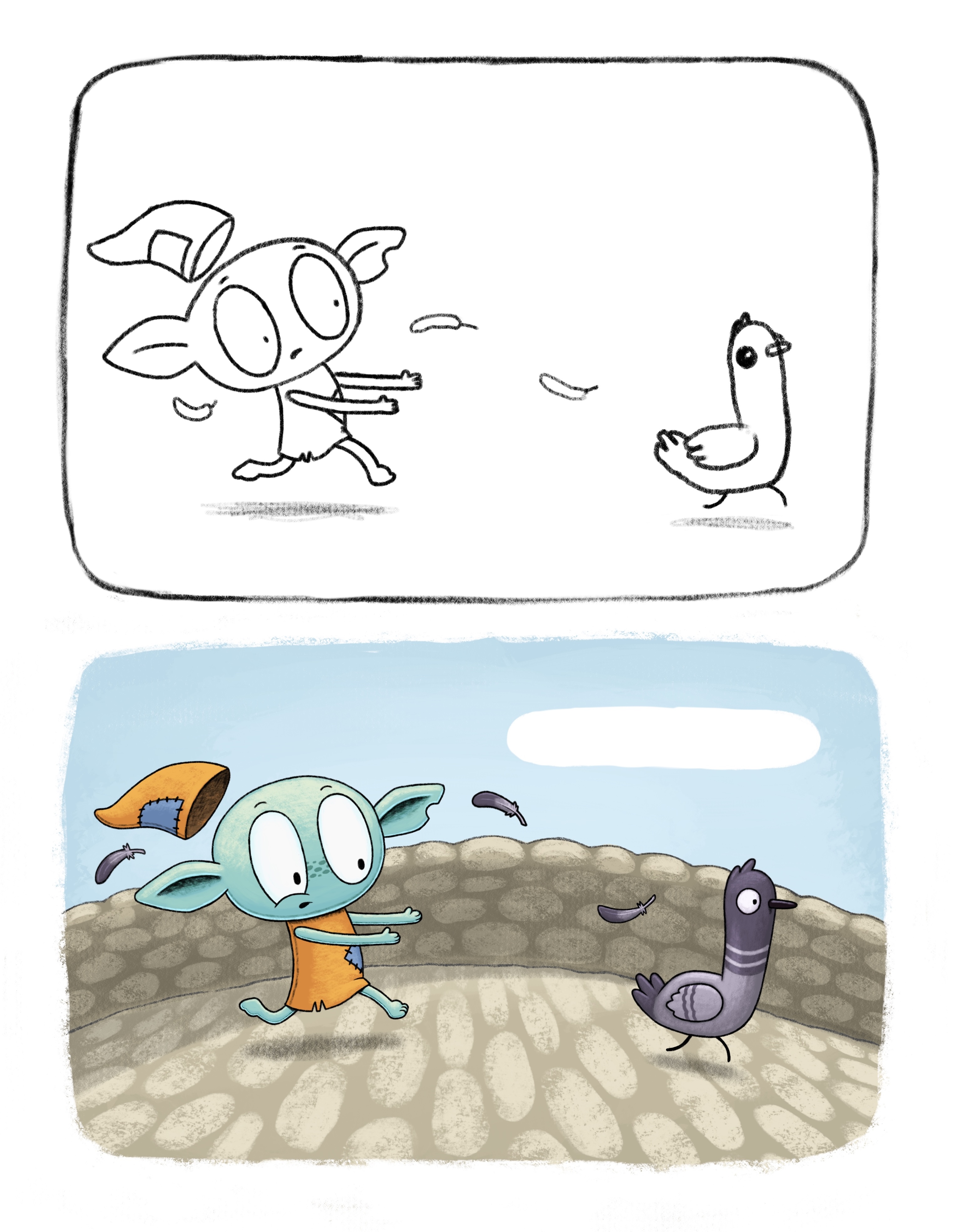
Alex has stopped by today to share more about his new book, the series, and Gilbert. And, as a special treat, he’s included a few in-progress illustrations. Let’s hear from Alex!
Congratulations on the newest picture book in your hilarious The Worst! series, Elves Are the Worst! Please tell us a little bit about the book and the inspiration behind the series.
AW: Thank you so much! In Elves Are the Worst!, Gilbert the Goblin is back with a fresh set of complaints, this time about elves. He decides to go undercover to Santa’s Workshop, disguised as an elf, to prove that goblins are just as hard working as any elf.
The first book in the The Worst! series, Unicorns Are the Worst!, was about how sometimes our feelings lead us to false conclusions. Gilbert says that his unicorn neighbors are the worst, but really he is just jealous that they get all of the attention. (And he’d really enjoy an invitation to their tea parties.) The fun challenge with each new book in the series is to figure out what Gilbert is trying to prove and what he learns along the way, both about his neighbors and about himself.
Gilbert the Goblin and his pals are so adorable. Which came first, the characters or the stories, and how does Gilbert feel about starring in his own book series?
AW: I’ve had ideas for books come to me in both ways. Sometimes it starts with a character in my sketchbook and the story grows from there, and sometimes it starts with the story. This series started with the story. In fact, when I first wrote Unicorns Are the Worst! The main character was actually a gnome named Gnelson. My wonderful agent, Lori Kilkelly, liked the idea, but wasn’t completely sold on my initial designs for Gnelson. I played around with mythical protagonists and, when I landed on goblin, I suddenly had such a better understanding of his motivations. Gilbert always has a bit of a chip on his shoulder and that made so much more sense given that people generally have a negative opinion of goblins.
I must tell you, Gilbert would very much appreciate you acknowledging that he is, in fact, the star of these books, as opposed to the unicorns, elves, etc. I think that Gilbert had grown quite used to living alone, tucked away in his corner of the forest, but, for a character that claims to want to be left alone, he sure seems to enjoy talking at length with the reader. One of the biggest joys for me in working on this series is seeing his world continue to expand. Finding his place in the larger world has been good for him, although I doubt that he would ever admit it.
What is your art process like when creating your books, and what media do you use?
AW: I create my illustrations digitally using the Procreate App on my iPad Pro. When I was in school, I learned to create art traditionally and I was very hesitant to switch to digital. Eventually though, the technology became so advanced that working on the iPad felt as natural as drawing in my sketchbook. I’m still grateful that I learned to draw and paint by hand, but I now find working digitally to be quite freeing. I can take risks and try new things without the risk of ruining several hours of work. The undo option has truly been a gift.
What do goblins like Gilbert do in their free time?
AW: Gilbert takes his work as a goblin very seriously, but I like that with each installment in the series, we get to see more and more of his interests outside of his important magical pursuits. In Elves Are the Worst! we see that he enjoys gardening, baking, and organizing events for his sock slugs. I also really like how much his friendship with Chicken continues to develop with each new installment.
Can you give us a sneak peek of any upcoming books you may have? Will we be seeing Gilbert again?
AW: I am happy to say that I am working on two new Gilbert books (not yet announced), as well as a brand new title. I’ll be able to share more about these projects soon, and I’d encourage people to follow me on Instagram at @alexwillan for news. I am so grateful to have the opportunity to make these books, to work on them with so many incredible people, and to be able to share them with readers of all ages.
If it was ALEX WILLAN, and not Gilbert the Goblin, who was in charge of writing the stories, he’d make a book called Anchovies Are the Worst!. Alex is the author-illustrator of Unicorns Are the Worst!, Dragons Are the Worst!, Yetis Are the Worst!, and the Jasper & Ollie series, as well as the illustrator of Got Your Nose, written by Alan Katz. Alex lives in Chicago with his dog, Harley, who is the absolute best. Visit him online at AlexWillan.com.
Favorite Line from the Book: Fortunately, stomachs growl in the same language, and Abuela knew just what to do.
Happy National Grandparents Day to all the grandmothers and grandfathers out there who share their hearts, stories, wisdom, and homes with their families! Did you know, according to AARP in 2017, the United States is in the midst of a “grandparent boom” with more grandparents than ever before, over 70 million, as the baby boomers, followed closely by Gen X, become grandmas and grandpas. That’s a lot of grandparents! And, according to Census.gov in 2021, over 6 million grandparents lived with grandchildren under the age of 18, and over 2 million of them were responsible for the basic care of their grandchildren.With numbers like those, it’s no wonder that grandparents play such an important role in our lives.
I was fortunate to have both of my grandmothers living with us when I was growing up. I’ll always remember the two of them sitting side by side in the living room, one in a rocking chair and the other with a cat in her lap, watching soap operas. My dad’s mom was a whiz at crocheting. I’ll never forget the countless pairs of colorful mittens we wore each winter. And I still have two of her afghans. My mom’s mom was a writer and self-taught poet who was published numerous times in various magazines and newspapers. I dedicated my first picture book to her.
A bond between a child and a grandparent is like nothing else, and that’s why I’ve chosen to highlight a picture book on Frog on a Blog today that features that very special grandchild/grandparent connection. I Love You Mucho Mucho, written and illustrated by Rachel Más Davidson and just published by Beaming Books, is a super sweet story about a little girl named Rosie who visits her grandmother, but her grandmother doesn’t speak English, and Rosie doesn’t speak Spanish. Rosie and Abuela spend time together, eating, drawing, playing dress up, gardening, and exploring nature, and, through the universal language of love, they find a way to communicate with very few words.
Just like Rosie and Abuela, spending time together is an important way to strengthen family bonds, create fond memories, and establish a foundation of love, something that every child benefits from and deserves (grandparents too). One activity that grandparents and grandchildren can do together is read picture books, and I Love You Mucho Mucho is a great choice!
Delightfully detailed illustrations (check out Abuela’s high top sneakers) with subtle but interesting background images and an adorable little black cat adorn this deceptively simple tale inspired by the author’s own experience in a family with language barriers. A glossary of Spanish words is included at the end.
I’m thrilled that Frog on a Blog is a stop on multi-published author Sue Heavenrich’s book blog tour today! Sue is one of the nicest people you’ll ever meet. And she just happens to be a member of the West/Central Upstate NY Chapter of the SCBWI, just like me, and our paths have crossed a few times at local conferences. She may have even given me a writing tip or two.
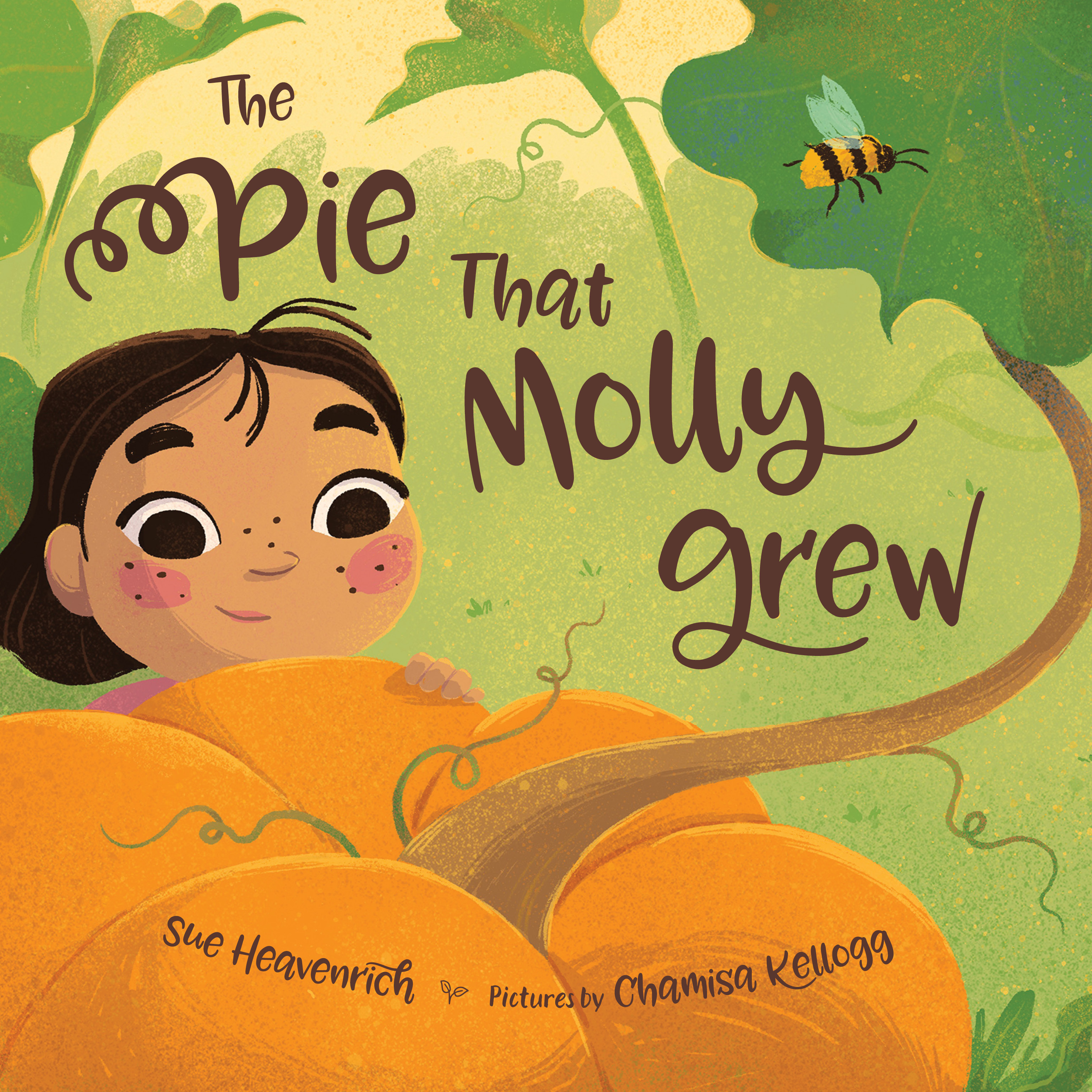
Sue is also a former science teacher, a nature lover, an avid gardener, and an insect enthusiast, so it’s no wonder that she likes to write children’s books and magazine articles that highlight science and nature subjects. Sue has combined those interests with another one. Baking! And the result is her brand-new picture book and star of this blog tour The Pie That Molly Grew, which released August 15th from Sleeping Bear Press and features charming illustrations by Chamisa Kellogg. I jumped at the chance to ask Sue some questions about herself and her lovely book, which, by the way, cleverly uses the cumulative rhyme pattern of the familiar tale The House That Jack Built!Let’s hear from Sue!
Congratulations on your fabulous new picture book The Pie That Molly Grew, which was beautifully illustrated by Chamisa Kellogg! Please tell us a bit about it and what inspired you to write it.
SH: The Pie That Molly Grew begins with the planting of a single seed and shows the vine growing and flowering and finally producing a pumpkin. At the end, Molly’s pumpkin is turned into a delicious pie for the community to share in a celebration of gratitude.
I’m pretty sure that the idea germinated in my brain one year while I was planting seeds and dreaming about the salads and pies those fruits would become. Then I came across a post by Susanna Leonard Hill. It was National Pie Day and she challenged us to write a story …. about the biggest pie; the smallest pie; pies stacked sky high. I started thinking about apple pie and blueberry pie, pecan and key lime, and pumpkin pie. A line came to mind and got stuck, like an earworm, until I finally wrote it down: This is the seed that Molly sowed.
Where do you think your love of nature comes from?
SH: My parents took us kids camping and hiking. I loved the ranger talks at National parks and filled a notebook with lists of animals and plants I met. My dad loved geology, and, when he found an interesting rock, he’d tell the story about where it came from. My mom loved to watch the night sky and once woke us up in the middle of the night to drive up a mountain so we could see a comet. Being outside, in nature, was where adventures happened. And then I discovered … field guides! And Euell Gibbons’s books about eating wild plants.
Why do you feel it’s important to share science and nature with children through books?
SH: Children are curious about the world around them, so let’s make sure they have the tools and inspiration to explore that world. My kids asked questions about everything. Why do ants walk in a line? What happens if you roll a toy car down a board? How can we launch a cork to fly over the garage? As a writer, I want to create books that can nurture curiosity and help children (and maybe some adults, too) discover answers to their questions.
Your book Diet for a Changing Climate: Food for Thought, which you cowrote with Christy Mihaly, talks about edible weeds, amongst other unexpected and unusual foods. What weed, in your opinion, is the tastiest? Please share a simple recipe.
SH: Thanks for a shout out for our book. Christy and I had a lot of fun tasting recipes and writing the book. As for eating wild plants, I have a soft spot for dandelions. They are pretty, and a great pollen source for early pollinators. Plus they are easy to grow – all you do is … nothing! Dandelions were the first wild plant I tried when I was a kid. My friend and I collected leaves from her yard and boiled them. They were so stringy and bitter! I learned my lesson: pick young leaves.
I have a recipe for dandelion quiche in my book. But here are some very simple ways to add dandelions to your menu: sprinkle dandelion flowers on the top of your salad (pull individual flowers from the head); mix individual flowers into pancake batter and tortilla dough; pick very young leaves and toss into a stir-fry. Just make sure that the dandelion plants haven’t been sprayed by chemicals. I source my dandelions from my organic garden, where I have a continuous supply season after season.
You also love to write about insects. Which insect do you find to be the most fascinating and why?
SH: Oh, man! That’s like asking which of my kids is my favorite. I love bees – big, bumbly, bumble bees and tiny, shiny, metallic green bees. But then there’s flies, which look like bees (and one I found just the other day that looks like a huge yellowjacket!), and beetles (who doesn’t love beetles?). Oh! And pseudoscorpions. They’re not insects – they have eight legs – but they are related. They’re not scorpions either, even though they wave their big* pincers just like a real scorpion. (*Big is a relative term. Pseudoscorpions are often only a quarter of an inch long.)
What book projects are you working on right now?
SH: I’m working on a couple ideas, but I’m still at the stage of throwing words on the page to see what sticks. Meanwhile, I continue to learn more about the insects and spiders that inhabit my garden and share those discoveries on my blog, Archimedes Notebook.
Sue Heavenrich used to teach science. Now she writes magazine articles and books for children and their families. When the ground is warm and the sun is shining, Sue plants pumpkin seeds in her garden. She mulches and weeds and waters her plants. She watches—and counts—the many kinds of bees that visit her flowers. And when it’s time, she slices and dices and mixes and spices . . . and bakes up her favorite kind of pie!
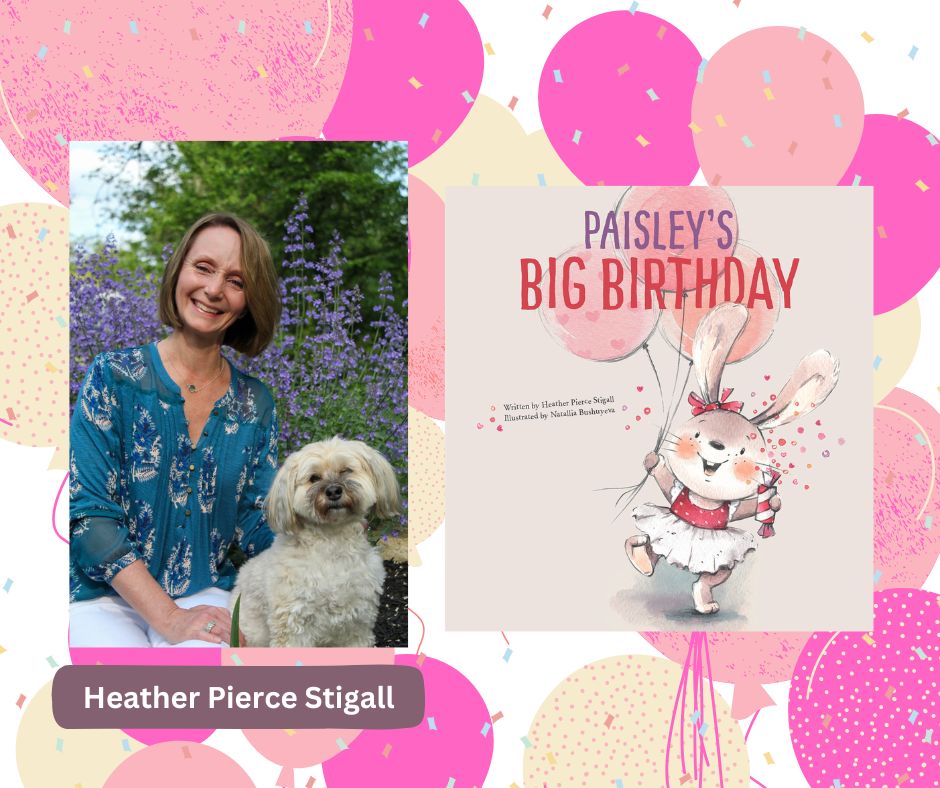
Hooray! Please join me in wishing Heather Pierce Stigall’s debut picture book, Paisley’s Big Birthday, a very Happy Book Birthday today! This book, released by Clavis Publishing and illustrated by Natallia Nushuyeva, is Adorable, with a capital A, in both text and artand will ultimately be published in four additional languages besides English.
Heather is an active member of the kidlit community, especially in the Eastern Pennsylvania Chapter of the SCBWI where she is the Critique Group/Meet & Greet Coordinator. I’m so glad our paths crossed over on Julie Hedlund’s 12 x 12 Picture Book Challenge membership forum. With experience as a counselor for children and families, Heather loves to write stories that truly resonate with kids. Let’s learn more about Heather and Paisley’s Big Birthday!
Congratulations on your adorable debut picture book Paisley’s Big Birthday! Please tell us a bit about the story and who or what inspired it.
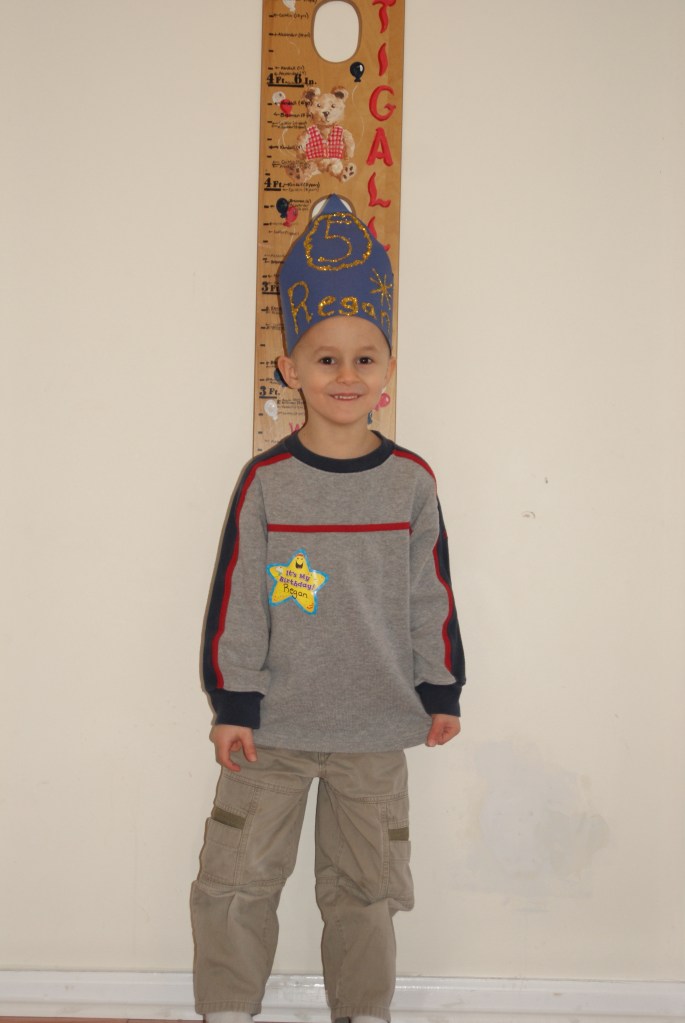
HS: Thank you so much, Lauri! The origins of PAISLEY’S BIG BIRTHDAY began nine years ago when I picked up my youngest child from preschool on his birthday. He climbed into his car seat, wearing a glittery birthday crown and a slight frown. The conversation began something like this:
Birthday Boy: “When is my birthday?”
Me: “Today!”
Birthday Boy: (shakes his head) “No. When is my real birthday?”
Me: “Today is your real birthday!”
Birthday Boy: “It doesn’t feel like it.”
Heather Stigall’s son Regan donning his birthday crown
My mind began to spin. Why didn’t he feel like it was his birthday? Did something happen or not happen at school? What would it take for him to feel like it was his “real” birthday? A few questions later, I realized that he believed that on his birthday he would instantly “feel” older; he would magically be able to do things he wasn’t able to do the day before. But I kept the conversation going during the ride home, through lunch, and for some time after that. I asked lots of questions and listened as he shared evidence for why it was most definitely not his birthday. I was enamored with his reasoning and determination, while underneath it all, I felt his disappointment that this day, one that was supposed to be special, didn’t meet his expectations. Not long after, I wrote a draft of a story about a bunny who hops out of bed the morning of her birthday, expecting to be all things “big bunny.”
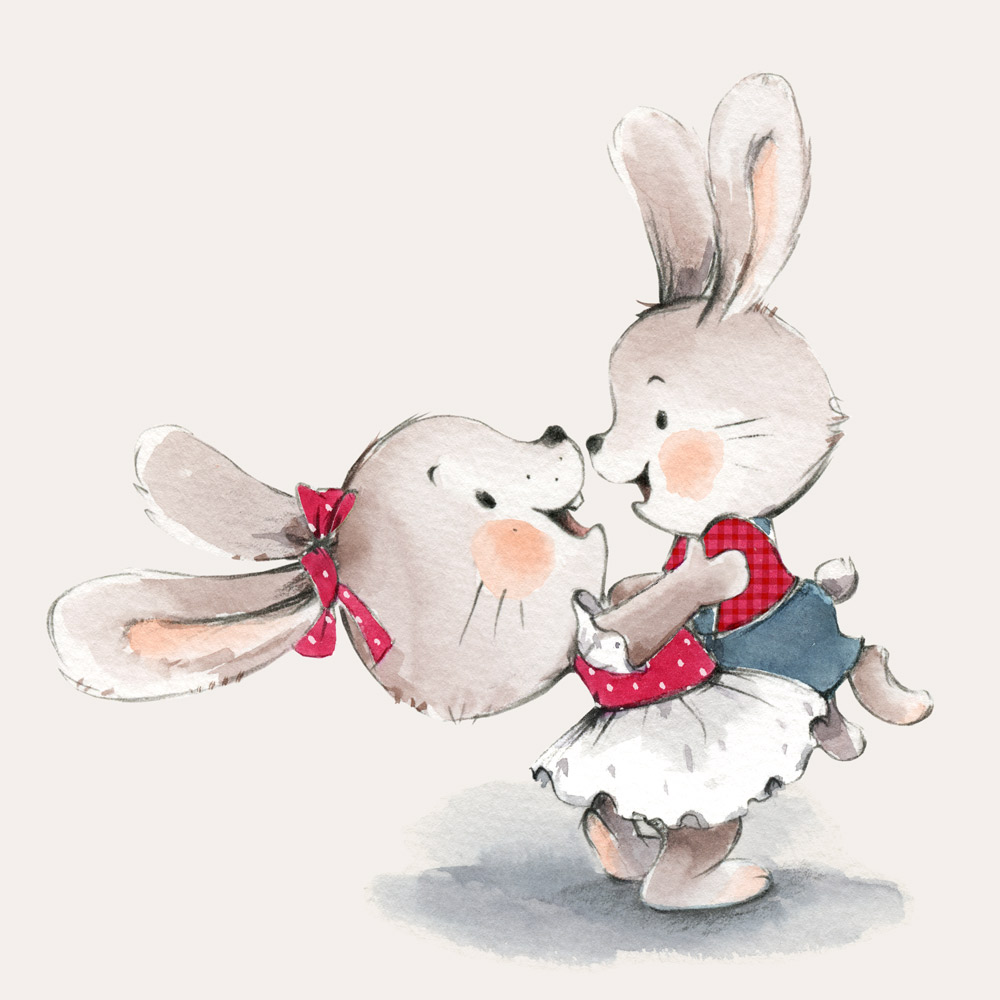
Illustrator Natallia Bushuyeva’s artwork is so sweet and complements your text so perfectly. Were you able to offer input into what the illustrations would look like? Did Natallia’s work exceed your expectations?
HS: I really hit the jackpot when Clavis chose Natallia to illustrate Paisley’s Big Birthday, didn’t I? Clavis always produces beautifully illustrated picture books, so I knew I would be in good hands, but seeing the way Natallia brought our characters to life was really special—she absolutely exceeded my expectations! I just love her art style and think she was the perfect choice for Paisley. Unlike most U.S. publishers, Clavis (who is based in Belgium) makes it a practice to connect author and illustrator so they may collaborate if they wish. But I have no business telling an illustrator what to do, so I put my full trust in Natallia, and I think that worked out beautifully.
How have your degrees in Child Development, Psychology-based Human Relations, and Social Work influenced how you write for children?
HS: I have always felt a connection with children, so I pursued my degrees because I wanted to learn more about the “why” and “how” behind the way people, particularly children, behave and think. I used that education and training as a counselor for children and families, and it came in handy when raising my own children. Now, as a writer, I think that background and experience inform me about how children relate to others and the world, and I hope to have that come across when I create stories about and for them.
Please share one of your favorite classic picture books and one of your favorite recent picture books.
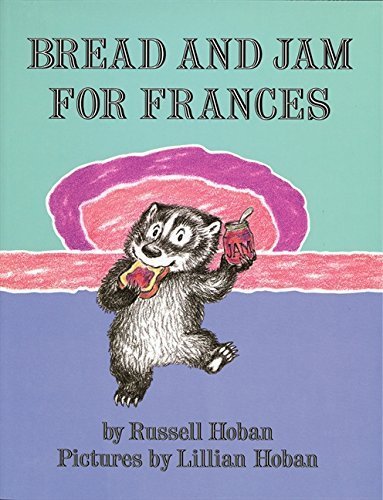
HS: That is such a difficult question to answer! I have fond memories of many classic picture books, and I read SO many picture books regularly, that it’s hard to choose just one of each. But, if I must answer, I’m going to cheat a little. What comes to mind as a childhood favorite “classic” is the Frances series by Russell and Lillian Hoban. I love them all, but I particularly like Bread and Jam for Frances and A Bargain for Frances in that series. I think they capture the mind and antics of a child so well, they have the perfect balance of humor and heart, and they bring back memories of me being read to as a child.
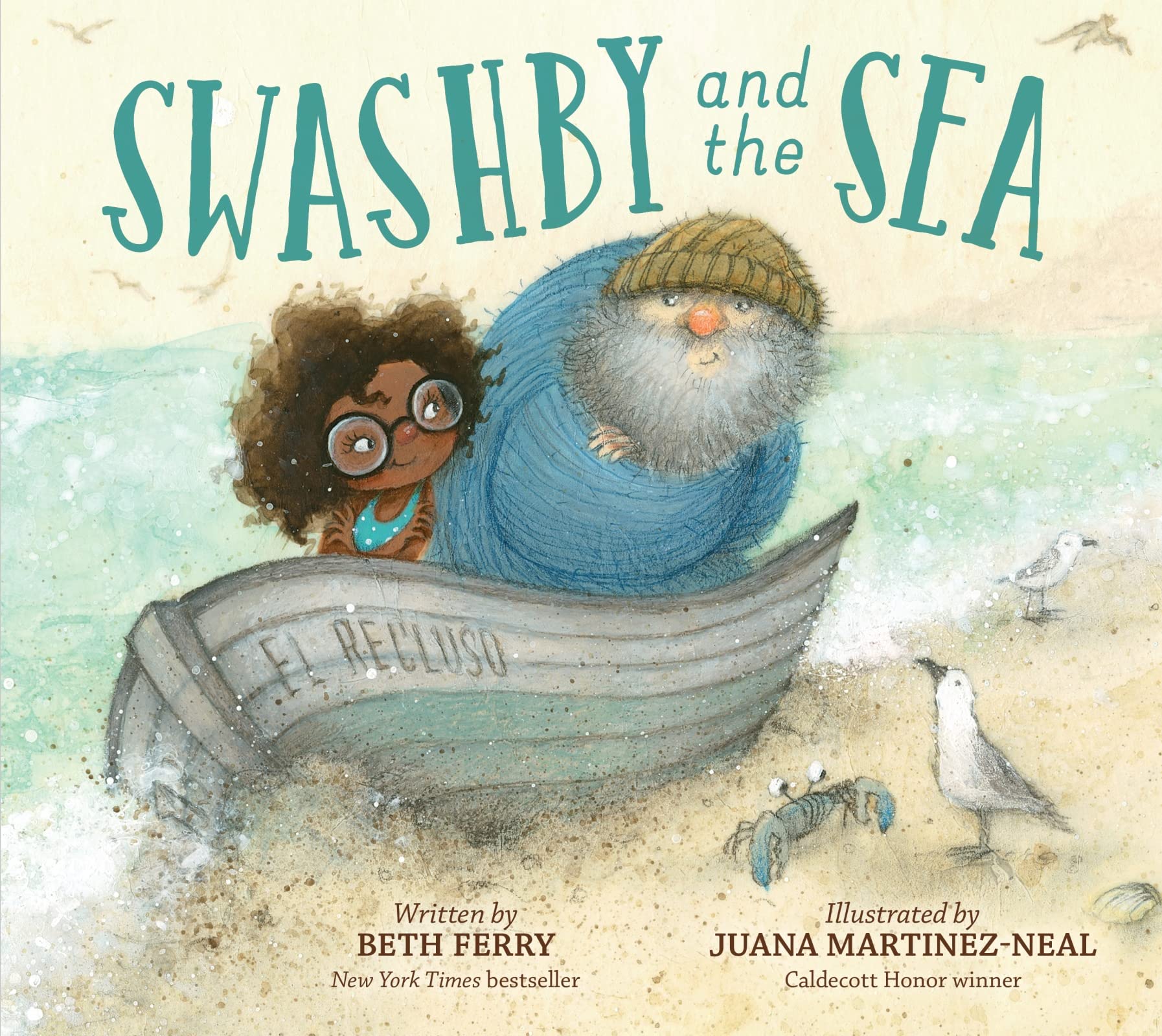
As for more recent favorites, I’ll narrow it down to two as well: I love Swashby and the Sea by Beth Ferry and Juana Martinez-Neal (Houghton Mifflin Harcourt/2020) for its gorgeous art, clever plot, giggle-inducing humor, and heartfelt theme—all around brilliance! I also love Off-Limits by Helen Yoon (Candlewick Press/2021) because it so perfectly captures the curiosity, imagination, creativity, and antics of a child, and because it makes me laugh out loud—more brilliance!
How involved are you in the writing community?
HS: I would say very! I have been a member of SCBWI (The Society of Children’s Book Writers & Illustrators) since 2012, and that started me on a path deeper and deeper into the woods of children’s literature. I have attended numerous conferences and webinars over the years and found my first critique group through our local chapter. Our group still meets regularly, and I wouldn’t be the writer I am today without them. Currently, I am the Critique Group/Meet & Greet Coordinator for the Eastern PA Chapter of SCBWI, where I have organized webinars and workshops as well as matched and mentored children’s writers and illustrators in peer critique groups, have contributed to our Chapter’s blog by conducting faculty interviews and writing articles, have acted as group facilitator in Chapter run events, and have spoken at conferences.
Outside of SCBWI, I am also a long-time member of the 12×12 Picture Book Challenge, I have attended webinars and courses through The Writing Barn and the Highlights Foundation, I have been a member of Storyteller Academy and Children’s Book Insider, I am a member of the Picture Book Pals promotion group, I am active on social media where I connect with other kid-lit creatives, and I am a regular visitor to my local library where I read tons and tons of children’s books.
Why do you believe picture books are important?
HS: Oh, for so many reasons! Picture books are often a child’s first introduction to reading (a “gateway” book, if you will) that will hopefully open the floodgates to the wonderful world of books. They not only introduce kids to the mechanics of books, but show them how reading can entertain, inform, and teach them something about themselves, others, and the world, all wrapped up in a beautiful piece of art. Plus, picture books are meant to be shared, so they foster a connection between reader and listener. I know some of my fondest memories of picture books are not just about the stories themselves, but of the time spent on the lap of a loved one or with a loved one on my lap.
I know you have another picture book set to be released next year. Can you share a little bit about it?
HS: Absolutely! My next under-contract project is another picture book called Gilbert and the Ghost. It’s about a boy who believes a ghost lives in his neighborhood, even though no one else believes. But Gilbert knows how hard it is to make friends, especially when you feel invisible, so he tries every gesture he can think of to befriend the ghost. This sweet tale of overcoming obstacles and finding friendship in mysterious places, for kids who often feel unseen, will be illustrated by Jess Mason and published by Beaming Books. The original publication date was set for fall 2024, but I recently found out that it will be delayed until fall 2026. I’m disappointed I won’t be able to share Gilbert with everyone for another three years, but these things happen in publishing!
Heather Stigall uses her experience with children and her degrees in Child Development, Psychology-based Human Relations, and Social Work to create stories that speak to kids. She is the Critique Group/Meet & Greet Coordinator for the Eastern PA SCBWI Chapter, a member of the 12×12 Picture Book Challenge, and a parent to five children and one pup.
When she’s not writing, you can find Heather hanging out with her kids (hopefully at the beach), reading, eating chocolate, baking, or creating all sorts of treasures.
Her debut picture book, PAISLEY’S BIG BIRTHDAY (Clavis Publishing) will be released in August 2023 and is/will be published in four additional languages. Her second picture book, GILBERT AND THE GHOST, (Beaming Books) is due out fall 2026.
It’s my pleasure to welcome author, educator, attorney, and motivational speaker Dr. Artika Tyner to Frog on a Blog. Artika designs programs to drive Diversity, Equity, and Inclusion (DEI) initiatives for companies and organizations of all sizes from Fortune 500s to startups and grassroots groups.
Artika is passionate about inspiring social change, which includes closing the literacy gap, and one of the many ways that she does that is through writing children’s books. Artika has published more than 30 children’s books, both fiction and nonfiction. Since we’ll only be mentioning a few today, I encourage you to seek out Artika’s other wonderful books.Let’s get to know Artika!
Tell us a bit about your picture book Justice Makes a Difference: The Story of Miss Freedom Fighter, Esquire. Why was this story important for you to tell?
A.T.: Justice Makes a Difference was a story important for me to tell since it allowed me to reflect on my childhood and inspiration for becoming a civil rights attorney. I chose my grandmother as the central character since she taught me about leadership and challenged me to lift my voice for justice. She exemplified the best of servant leadership by ministering to the needs of the sick, poor, and those with unmet needs. She was not concerned about position or title. She simply expressed a willingness to be a blessing in the lives of others. Her example guides my daily work as an author, educator, lawyer, and community advocate.
You have written over 30 books for children from nonfiction and biographies to fiction and readers. Which type of book do you most enjoy writing? Please share two or three of your favorites.
A.T.: I enjoy writing nonfiction books related to Black history, culture, and heritage. My education was missing many chapters of Black history. Therefore, I never had the opportunity to fully immerse myself in the richness of American history. Each day, I am discovering new dimensions of the impact of Black innovators, creatives, and disruptors.
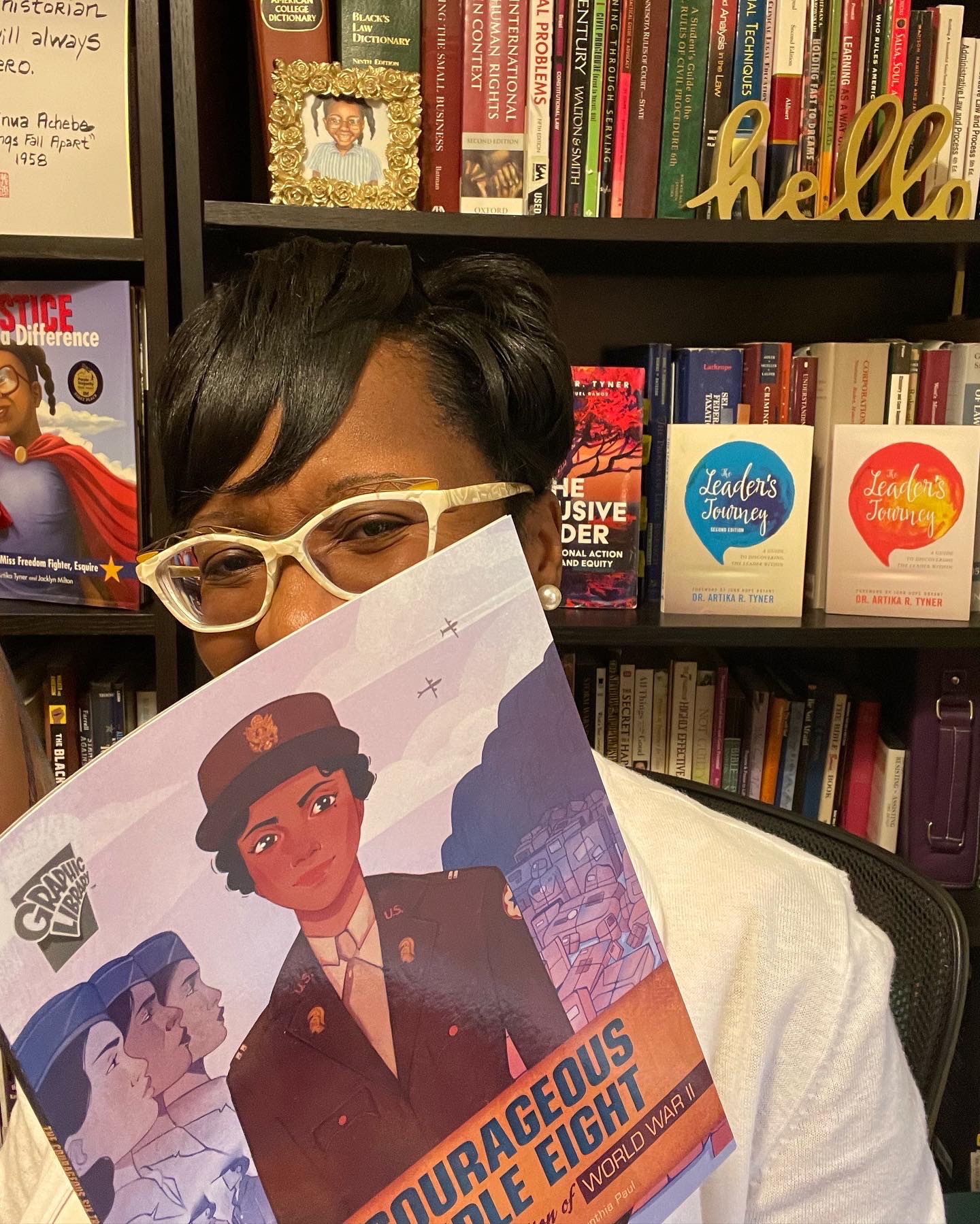
My recent books are two favorites. I wrote my first graphic novel, The Courageous Six Triple Eight. It celebrates the legacy of the all-Black female battalion that served an instrumental role in World War II. They organized millions of pieces of mail. They were guided by the mantra: “No mail, low morale.” Their efforts served as a vitally important connection between soldiers abroad and their families.
The Untold Story of Annie Turnbo Malone: Hair Care Millionaire is another favorite. While writing this book, I was inspired to continue my work as an entrepreneur. Ms. Malone created jobs for the community and empowered women around the world to be their own bosses. She also modeled excellence in philanthropy by investing in education and supporting children in need.
How does your experience as a civil rights attorney influence you as a children’s book author?
A.T.: My experience as a civil rights attorney influenced my work as a children’s book author. I decided to write for justice and inspire youth to discover joy in reading. This is personal and important to me because as a civil rights attorney, many of my clients learned how to read in prison. This is unacceptable but somehow we created a RULE OF 4:
1 in 4 American children are not reading at grade level by 4th grade.
If you are not reading at grade level by 4th grade, you are 4 times more likely to drop out of school.
And here’s the connection, you are also three and a half times more likely to be arrested during your lifetime.
This is UNACCEPTABLE. This is an opportunity for change. Where we can create new pipelines for the future and work to end mass incarceration.
Tell us about Planting People Growing Justice Press and its mission.
A.T.: Planting People Growing Justice Leadership Institute (PPGJLI) was founded in 2017 to address the community’s concerns regarding the school-to-prison pipeline and mass incarceration. I witnessed these concerns firsthand as far too many of my clients learned to read while in prison. Characterizing this as a miscarriage of justice, I brought the community into my living room to create a solution to the tangled web of mass incarceration which has far too many entry points and very few exit points. Together we designed a literacy campaign to strategically bridge the literacy gap by promoting diversity in books. Those of us involved in the solution remain actively involved today sharing the gift of reading and learning with children of color who live at the margins of society as we did.
MISSION: With a mission to plant seeds of social change through education, training, and community outreach, we work to disrupt the school-to-prison pipeline and end mass incarceration by bridging the literacy gap through intergenerational reading circles. We do that by helping Black children discover joy in reading by promoting literacy and diversity in books, supporting leadership development at the grassroots level, and building intergenerational circles with a focus on advocacy. Reading is leveraged as a direct intervention to our community’s concerns regarding the school-to-prison pipeline and mass incarceration since there’s a direct connection between reading failure and future incarceration according to the Department of Justice.
Please share some words of inspiration for aspiring children’s book authors.
A.T.: For aspiring children’s book authors, I encourage you to keep writing, exploring, and leading change in our global community. Here are a few pearls of wisdom:
Join a writing circle
Perfect your craft by participating in writing workshops like the ones sponsored by the Highlights Foundation
Connect with children since they are the best beta readers
Discover your inner child by unleashing your natural curiosity and imagination
Dr. Artika Tyner is committed to creating a world of inclusive leaders who will meet the pressing needs of today and work towards a better future where racial justice and economic justice reign supreme. As a motivational speaker, author, and educator, Dr. Tyner helps people of all ages connect with their gifts and develop tangible tools for bringing forth sustainable, durable change in the family, workplace, community or school. By building and leveraging the tools in The Inclusive Leader she has inspired thousands of people to lead with their own gifts and plant a seed of social change.
Dr. Tyner’s work is grounded in extensive experience as a law and leadership professor, lawyer, social change agent, researcher, and nonprofit founder and leader. She is well-known as a thought leader, author, and designer of high-profile programs to drive organizational DEI initiatives and create inclusive leaders. Her impact spans Fortune 500 companies, start up tech companies, healthcare providers, government services and agencies, higher education institutions and grassroots organizations.
Dr. Tyner is deftly able to ask the big questions, strategically innovate real solutions and then lead the way. She intentionally invests her time and energy in inspiring change and welcomes opportunities to present, collaborate and innovate with key stakeholders seeking to impact social change and do what no one has done before.
To connect with Dr. Artika Tyner, follow these links:
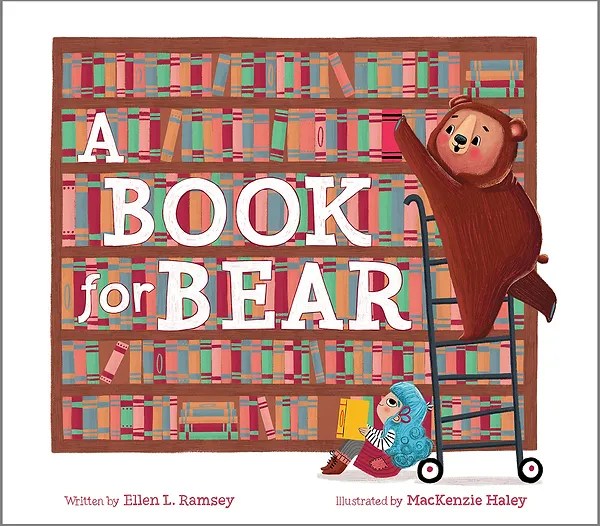
Publisher: Flamingo Books/Penguin Books for Young Readers
Release Date: July 18, 2023
Format: Hardcover
Summary: A book-loving bear and a book-loving girl hatch a plan to find the perfect book for them to read together. But sneaking a bear into a school, a library, and a bookstore proves harder than they thought. Will Bear ever find a book of his very own, a book the color of ripe, red raspberries and delicious to read?
Do you have a children’s picture book coming out soon? I’d love to wish it a Happy Book Birthday here on Frog on a Blog! CLICK for more information.
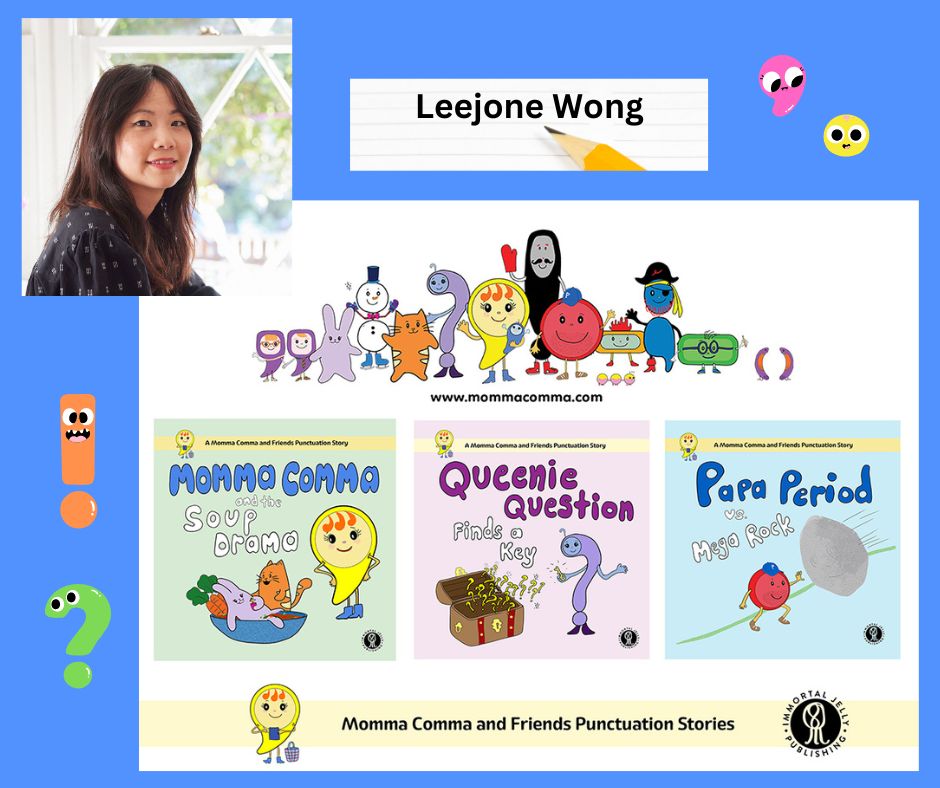
Please welcome author and illustrator Leejone Wong to Frog on a Blog! The third book in her Momma Comma and Friends picture book series, Queenie Question Finds a Key, came out last month. This series features adorable punctuation mark characters, cute animal characters, and bright colors. And the charming stories introduce kids to the concept of punctuation in a way that is entertaining and fun. Kids won’t even realize they’re learning!
These books would make great additions to an elementary school teacher’s classroom library. In fact, Leejone got feedback from teachers as she was writing the first book in the series, Momma Comma and the Soup Drama. She speaks about this below. I also asked Leejone about how the Momma Comma and Friends series got started as well as about her illustration process, something I always find fascinating when interviewing illustrators. Let’s hear from Leejone!
I love your MOMMA COMMA AND FRIENDS picture book series! Please tell my blog readers about the books.
LW: Thank you so much! The books are lighthearted mystery or adventure stories that introduce children, ages 4 to 8, to the concept of punctuation. Throughout the series, Momma Comma helps Queenie Question to find a missing pet and return a lost key to its owner or encourages Papa Period to save the neighborhood school. These aren’t (boring) grammar books, and some kids may not even realize that they’re educational!
At the same time, the stories do encourage children, even those who aren’t reading on their own yet, to notice and talk about punctuation. What are they called? Where do you find them in sentences? What role do they play in understanding what’s being said? The series is perfect for parents and teachers who are looking for vividly imagined picture books that make learning effortless and fun.
What inspired you to write the series, and which came first, the story concept or the characters?
LW: The concept for the series came first! Years ago, I tutored international graduate students at New York University who struggled to understand grammar rules. I discovered, over time, that it was helpful to them if I drew diagrams, used visuals, or read short stories aloud; they were then able to better see and hear how to use punctuation, if that makes sense. I guess there’s a similar concept at work in the Momma Comma and Friends picture books—but I didn’t think about creating the series until I became a mom!
My daughter inspired me when she was four years old! One afternoon, she pointed at a comma and asked me what it was; she wasn’t even reading or writing yet. I suppose ideas are born when they’re ready to be—and that’s when the Momma Comma and Friends characters popped into my imagination. I could actually see a picture book in my mind—and that book eventually became Momma Comma and the Soup Drama! That said, I sat on the idea until the COVID-19 pandemic required so many of us to isolate and stay at home.
How did feedback from elementary school teachers help shape the stories in your MOMMA COMMA AND FRIENDS series?
LW: When the idea for the books first got into my head, I brushed it aside because I assumed I’d find something similar to what I was envisioning in bookstores and libraries. Then when I didn’t find anything, I thought maybe it was because nobody cared or wanted books like these. Still, I really loved and believed in my idea, so I went ahead and put together a version of the first book, Momma Comma and the Soup Drama. I thought it was important to test the concept, and I was fortunate that a dozen or so elementary school teachers invited me into their classrooms to read it to their students.
I left a survey with the teachers, asking them for feedback. I wanted to know if the book was useful to them, how their students had responded to it, and if they all liked the story. Thankfully, there was only positive feedback and a lot of support—which was significant because it gave me the greenlight to move forward and told me that there was an audience and desire for my books.
Getting to read the book to kids was also helpful, and I made some small edits based on their reactions—for example, I changed the title to something a little more silly and intriguing, and in one scene, I felt that Nathan Exclamation’s teeth were a little scary, so I took them out. Overall, though, the published book is very similar to that early version!
Your characters are adorable! Can you share a little about your illustration process when working on the art for the series?
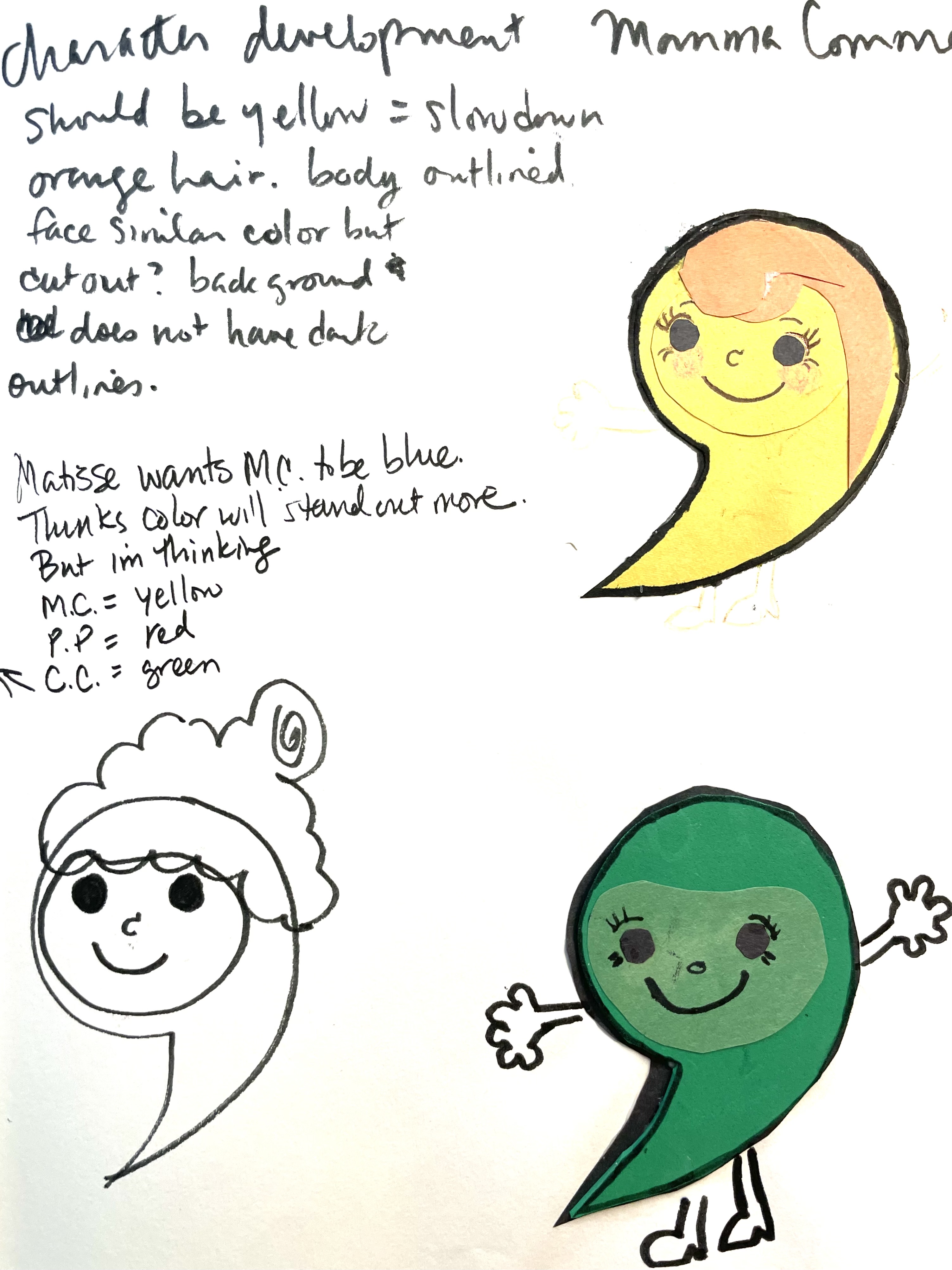
LW:I’ve always thought that each punctuation mark has its own personality. For example, in my mind, of course Nathan Exclamation is going to express strong emotions, and he’s going to love eating spicy food and engaging in exciting activities like bungee jumping! And Papa Period will naturally be more serious because he’s the Stopper of All Things, and Momma Comma will be the kind of person that likes to make lists and take meandering walks. In fact, the reason that Momma Comma is yellow is because, on a traffic signal light, yellow means “slow down.” Papa Period is red because that means “stop.”
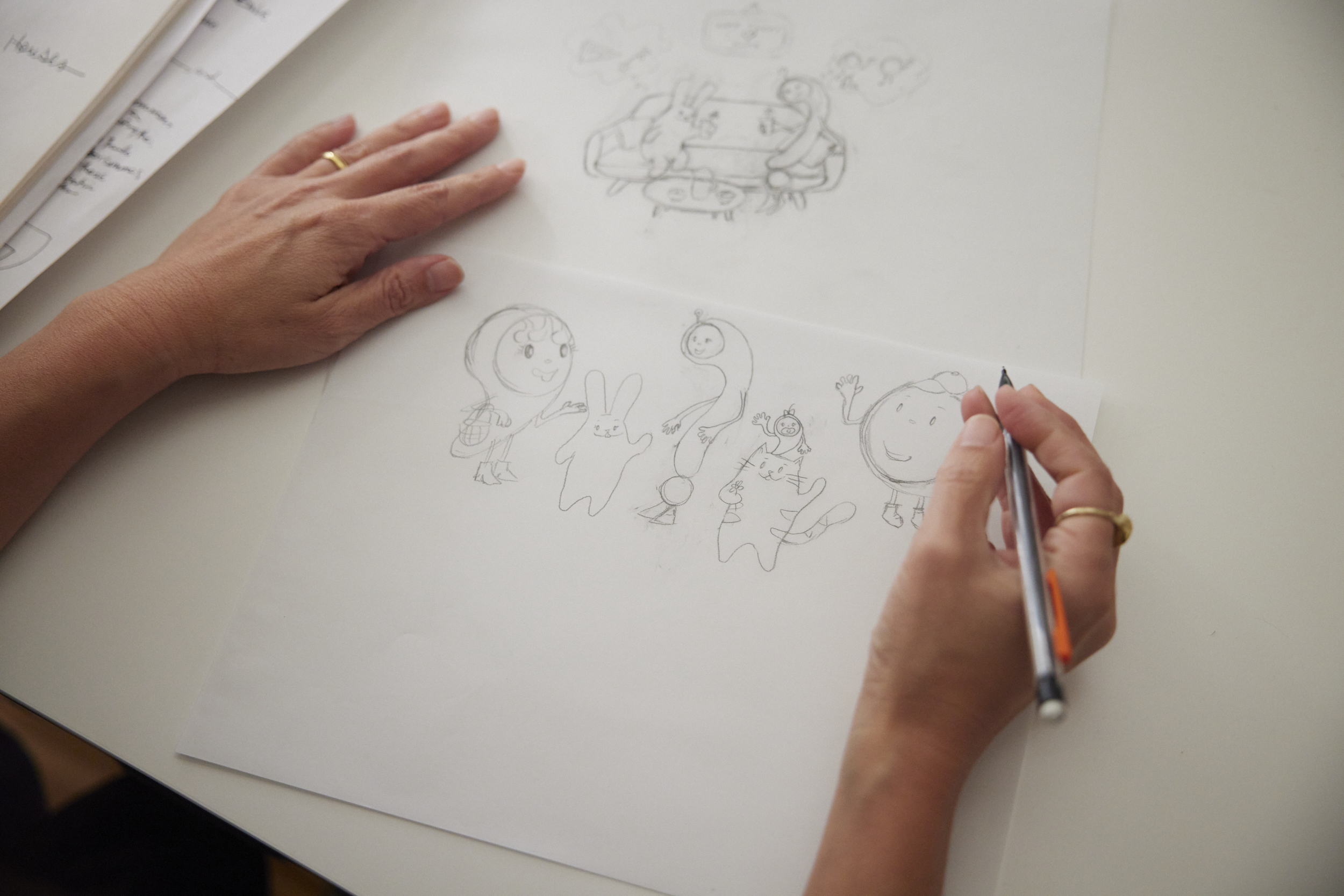
When I designed each character, I wanted to make sure that their personality came through. That’s also why I include an “About the Characters” page in each book, which shares a character’s favorite thing to say or do. I’ll share a few development notes from my sketchbook so that you can get a glimpse into the process. When I’m just trying out ideas, the characters look more like doodles. After I settle on a direction, I sketch their outlines in pencil on Bristol paper. The last step is to scan them into my computer, and then I use digital tools to refine them. In general, I work fairly intuitively on the computer and make a lot of decisions about color, texture, and composition at that point in time.
Currently, there are three books in the MOMMA COMMA AND FRIENDS series. Do you have plans to write more?
LW:Yes. I’m currently working on a book for Nathan Exclamation, and then I’ll write one about Aly Apostrophe. After that, I’ll see if my readers want any more! If you, blog readers, end up reading and liking my books, kindly let me know by writing a review. Momma Comma and the Soup Drama, Papa Period Versus Mega Rock, and Queenie Question Finds a Key—are the ones that are available now. Thank you!
Find more information about Leejone Wong and her books:
Leejone Wong is the creator of the Momma Comma and Friends picture book series; her third book, Queenie Question Finds a Key, was released through Immortal Jelly Publishing in May (2023). Before her life as an author and illustrator living in Los Angeles, Leejone previously taught writing at New York University, wrote film and art reviews, and created online content and games for television networks.
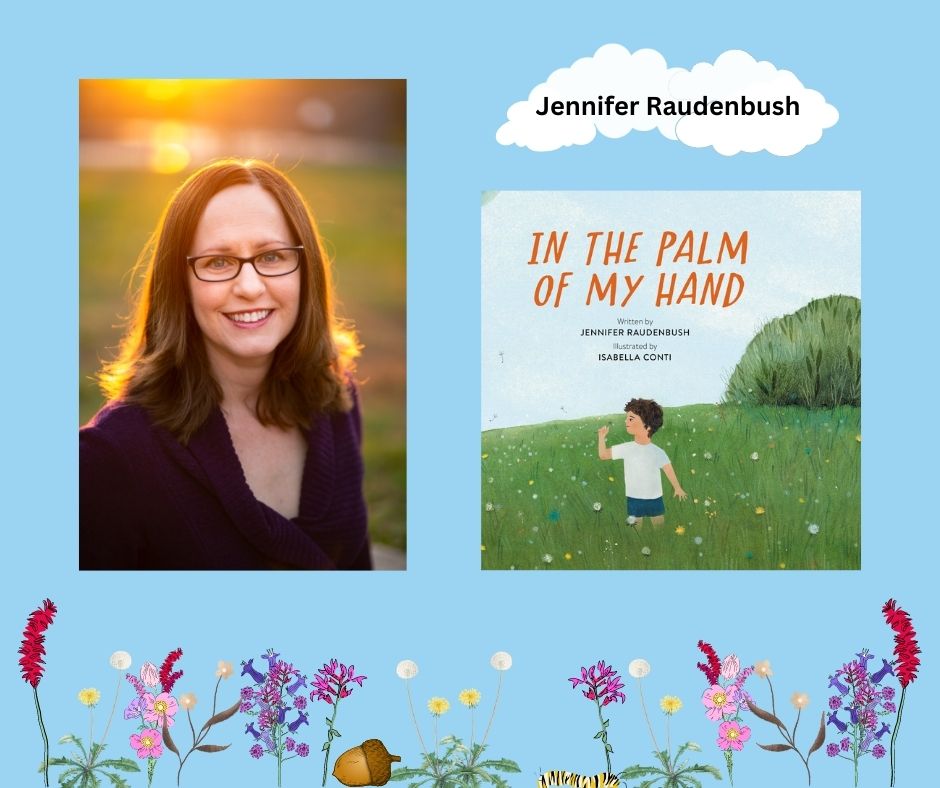
Please welcome children’s author and poet Jennifer Raudenbush to Frog on a Blog. Jennifer and I first crossed paths during a critique session on the online writing platform Inked Voices. I’m thrilled to have her with us today to talk about her beautiful debut picture book In the Palm of My Hand, which just released in March by Running Press Kids. Jennifer and I are both nature lovers, and clearly the natural world was a huge inspiration for her when she wrote the text of this expressive book. Let’s hear more from Jennifer about the book and what inspires her creativity.Be sure to read to the end to find out how you can win a signed copy of In the Palm of My Hand!
Congratulations on your lovely and poetic debut picture book In the Palm of My Hand! Please tell us a little bit about it and why this story was important for you to tell.
Thank you so much for having me on your blog today, Lauri!
In the Palm of My Hand, released by Running Press Kids, is about a child who takes a nature walk and discovers tiny things—like an acorn or a wildflower—hold big possibilities, big potential, just like he does. Ultimately, it delves into the big picture ideas of connection and self-esteem.
I hope it encourages little (and big) people to go outside and explore their corners of the world. To stop and notice. To savor. The book is a bit meditative and invites taking a rest from all the doing to just “be” for a while. When my son was younger, he was rambunctious, to say the least. Time in nature always calmed and focused him.
My goal with In the Palm of My Hand, a lyrical love letter to the natural world, is for readers to fall in love with both the beauty of words and the beauty of nature.
How did you feel when you held your new picture book for the very first time? Did Isabella Conti’s beautiful artwork blow you away?
It was a thrill to hold my debut for the first time! I call it “the heart of my heart,” and it reminded me of what it feels like for a new mom to have her child, her heart, walking around outside her body.
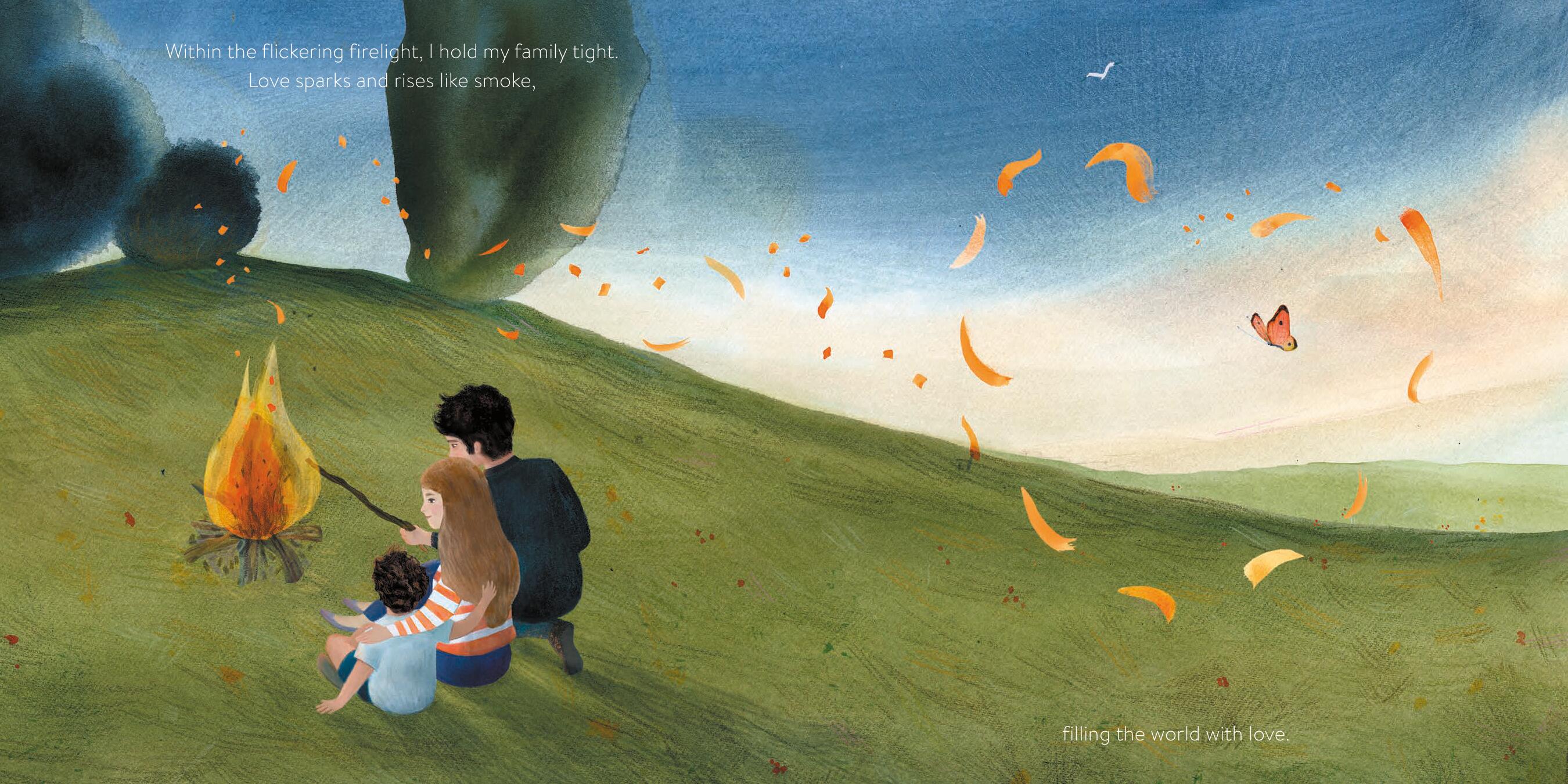
I’d gotten to see Isabella’s sketches along the way, but it did not prepare me for seeing the entire, amazing colorized version. Especially in her landscapes, she captures nature’s wonder and awe. I love the way the text and pictures pair together to tell a stronger story and create depth of feeling.
Isabella also had a professionally produced video made showing how she painted the illustrations. Your readers can watch her 2 ½ minute video HERE (scroll down the page).
As a picture book and middle grade novel writer as well as a poet, what most inspires your creativity?
This is an easy one to answer! Nature. My husband, teenage son, and I are surrounded by eastern Pennsylvania woods, and I walk my Westie pup Mazy every day. But whenever we travel, all of nature inspires me.
Another big source of creativity for me is reading. I try to begin every morning by reading poetry. Later in the day, I’ll read both fiction (mostly middle grade) and writing craft books. I tend to binge picture books after a trip to the library or while browsing in a bookstore.
How does your experience as a Pediatric Speech-Language Pathologist influence your picture book writing?
You’ve really done your homework, Lauri! While a Speech-Language Pathologist, I specialized in pediatrics because I loved children. I definitely bring that love of children into my picture book writing. Also, I’ve always been smitten by words and language, which I both studied and used every day in that profession.
Why do you feel picture books are important?
For so many reasons! First, reading picture books forges a bond between parent, relative, teacher, or librarian and the child or children. This bond is special, meaningful, and deep. Reading together helps children learn vocabulary, story, and the sounds of words. It helps teach them to read, as they follow the words on the page. It develops in them a love of literacy. Finally, picture books, like all books, encourage compassion and understanding of other human beings through inhabiting other perspectives and understanding other viewpoints.
Please share some of your favorite picture book authors.
In the picture book space, my favorites include Beth Ferry, Carter Higgins, Joyce Sidman, Dianne White, and Pat Zietlow Miller. I tend to gravitate toward lyrical, poetic texts, because that’s my strength, but I also really enjoy humorous picture books.
What’s next for Jen Raudenbush? What projects are you working on right now?
I’m continuing to work on picture books, but I spend the bulk of my time writing middle grade novels. I’m currently revising my fourth (my third is on submission with editors). What I’m really excited about is taking my first verse novel class with Laura Shovan in May. I’ll be able to meld poetry with middle grade novels, and I can’t wait to tackle this new challenge!
Where can fans connect with you online?
Thanks for asking! I love connecting with people. The easiest way to reach me is through my Linktree HERE, where I have a fun newsletter your readers can sign up for. I’ll also list my links separately:
Jennifer is generously giving away a signed copy of In the Palm of My Hand to one lucky person who comments on this post! Just leave a comment by May 31st for your chance to win. I’ll choose a winner at random and connect them with Jennifer. This Giveaway is open to US residents only. Good luck!
Jennifer Raudenbush feels most alive when she’s creating stories, especially picture books, poetry, and middle grade novels. Jen lives with her husband and teenage son in eastern Pennsylvania, where its natural beauty provides endless inspiration. She has been published in Cricket children’s magazine, the 10.10 Poetry Anthology and Two Truths and a Fib Poetry Anthology. She is represented by Natascha Morris at The Tobias Literary Agency. IN THE PALM OF MY HAND, illustrated by Isabella Conti, Running Press Kids (Hachette), is Jen’s first published picture book.
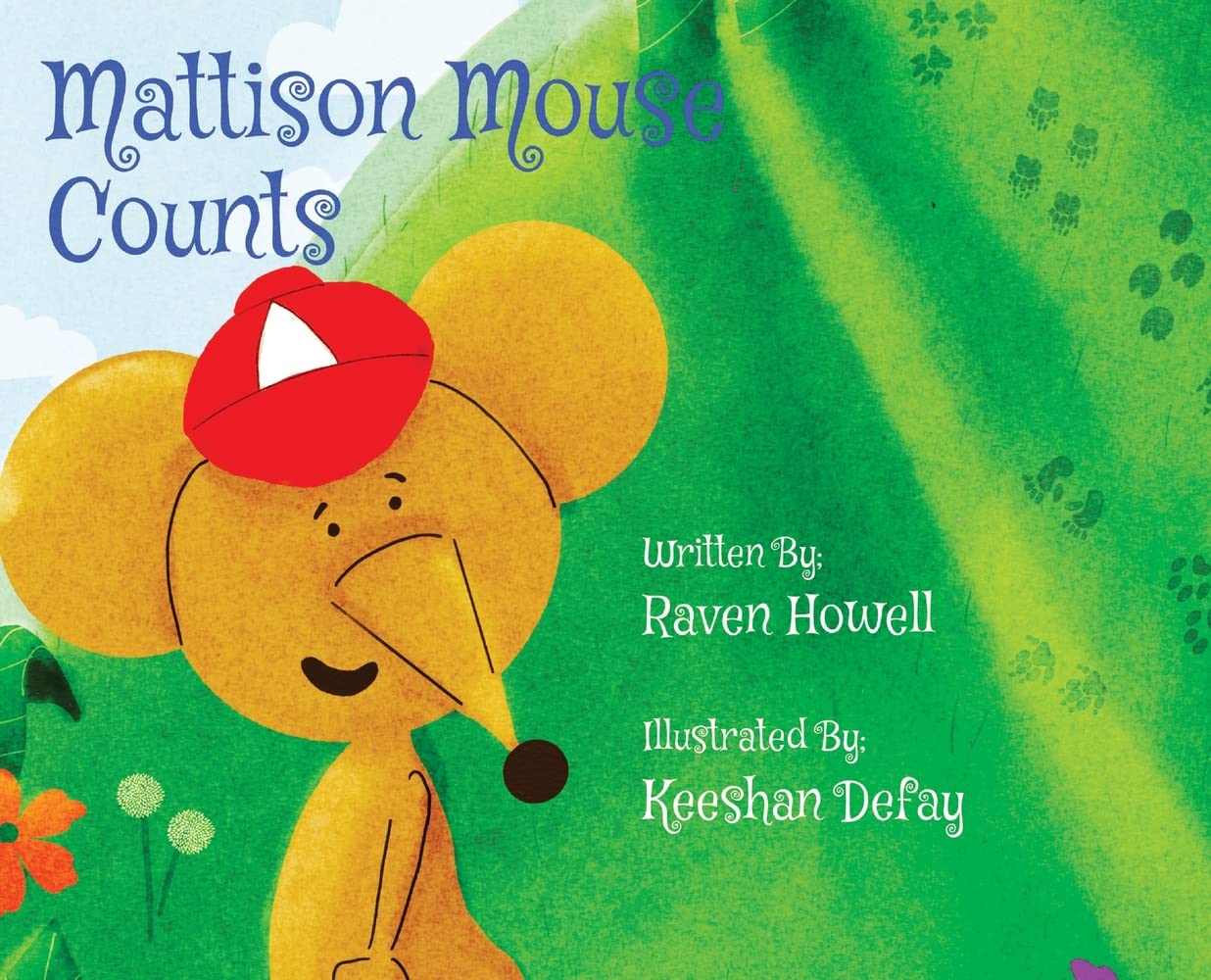
Summary: Wearing his favorite hat, Mattison Mouse is happy to venture outside on a beautiful day. But soon the little mouse hears mysterious footsteps. Mattison and his animal friends help young children count from one to ten as, joyfully, the day’s counting adventures lead to a surprise birthday party.
Do you have a children’s picture book coming out soon? I’d love to wish it a Happy Book Birthday here on Frog on a Blog! CLICK for more information.
It is my extreme pleasure to welcome multi-published author/illustrator Sarah Kurpiel to Frog on a Blog. You may be familiar with Sarah’s other books, including her debut Lone Wolf, which received a starred review from School Library Journal and was a Summer 2020 Kids’ Indie Next Pick.
Today, we get to celebrate the birthday of her brand-new book Snake’s Big Mistake! Sarah has a knack for creating adorable animal characters and kid-relatable stories with lots of heart. She’s shared a lot in this interview, and I know you’re all going to love learning more about her, her new book, and her art process.You may even be inspired!
Congratulations on your new picture book Snake’s Big Mistake! What inspired the story?
Thanks so much for welcoming me on Frog on a Blog to talk about my latest picture book, Snake’s Big Mistake! The story is about a young snake determined to make the best, most spectacular, positively greatest clay pot in art class. But when disaster befalls his clay creation, he makes a terrible decision that just might ruin his friendship with Turtle forever. The story was loosely inspired by true events—sort of. Way back when I was in kindergarten, my class made little clay pots (nothing like the grand sculptures created by the kids in Snake’s class!). I don’t remember much about my kindergarten days, but I distinctly remember this project—how excited I was to sculpt and paint my clay pot, how impatient I felt waiting for it to be fired in the kiln so I could take it home and show my parents, and how disappointed and embarrassed I felt when I saw my finished clay pot sitting alongside all the much better ones. At the end of the day, we each went up to the table at the front of the classroom to find the clay pot marked with our initials on the bottom. I remember thinking: “Mine is so bad. Maybe I should take someone else’s instead.” Now, in the end, I did not. But what if I had? That’s how the story got its start. This small event in my life—making a little clay pot—was the source of so many big emotions for me as a kid—both good and bad. No wonder this project has stayed with me when most of my memories of kindergarten have not. The ups and downs of the experience felt like something plenty of kids could relate to, so I ran with the idea, and the result was Snake’s Big Mistake.
The characters in Snake’s Big Mistake are adorable! Tell us a little bit about your art process when creating the illustrations for the book.
Thank you! I love drawing cute animal characters. A few years ago, for no reason at all (which is the best reason to draw, in my opinion), I drew a “portrait” of a very serious snake sitting in a chair with perfect posture. It made me laugh. I knew right then that I wanted to draw more snakes in the future. So, I included an argyle sweater-sporting snake in my picture book Elephant’s Big Solo, which was published last year. When it came time to make a follow-up book, who better to take the lead this time around than Snake? I had a blast doodling him. I already knew what he looked like, so I focused on experimenting with creative ways a snake might express emotions through body language. Then, I thumbnailed the story, which is my favorite part of the picture book making process. I draw digitally in Photoshop using a Wacom tablet, so it’s easy to make adjustments and move things around as I change my mind. From there, I worked with my agents and editor to finalize the story. For the final art, I mostly used digital dry media brushes, and I applied overlays I created to give the characters added texture. While I needed to stay stylistically consistent with Elephant’s Big Solo, I also knew this book called for a brighter, bolder color palette to match Snake’s bright, bold personality. I’m pleased with the way the colors pop on the page.
As both an author and an illustrator, which comes easier to you, writing or illustrating, and which usually comes first when you get an idea for a story, the words or the art?
Illustrating comes much easier for me—not because I’m particularly confident in my drawing skills (I’m not), but rather because I enjoy it so much. If I wasn’t drawing for publication, I’d be drawing anyway. I tend to think about picture books wholistically from the start—including the cover, endpapers, title page, and so on. If I can’t envision the whole thing, then that’s usually a good sign I’m not ready to make the book. Writing the words, on the other hand, is a slow process for me. So, when I have a story idea, I usually start with a loose outline and maybe a few key lines, doodle the characters and thumbnail the story (which leads to new ideas), and then work out the precise words. My process isn’t always so straightforward as that, but it’s generally what happens.
Since you’re a librarian, you obviously love books. What are some of your favorite picture books? Or who are some of your favorite picture book authors or illustrators?
Oh, this is a tough question. There are too many to name! A few of my favorite picture books are Birdsong by Julie Flett, Extra Yarn by Mac Barnett and illustrated by Jon Klassen, A Sick Day for Amos McGee by Philip Stead and illustrated by Erin Stead, Small in the City by Sydney Smith, and Truman by Jean Reidy and illustrated by Lucy Ruth Cummins. A few of my favorite picture book creators are Julie Flett, Rebecca Green, Lucy Ruth Cummins, Christian Robinson, Sydney Smith, Ebony Glenn, and Kate Berube.
Why do you feel picture books are important?
The books we love as kids have a way of staying with us all our lives. That’s a powerful thing. Picture books can help kids see themselves in the world, learn about people different from themselves, face complicated emotions, grow their imaginations, learn something fascinating, descend into a fit of giggles—or, in many cases, some combination of these things. I think no matter what age we are when we read them, picture books can have a lasting impact on us. When I come across a picture book with that just-right combination of words and pictures needed to express something authentic, it reminds me all over again why I love picture books so very much.
You’re not shy about sharing that you have a disability and use a power wheelchair. In what ways do you hope to inspire other authors and artists who may be struggling with disabilities too?
Every disabled person experiences disability differently, so I can only ever speak from my own lived experience. In my case, I’ve always loved to draw, but for most of my life, I considered it just a hobby because my disability significantly limits my arm strength and range of motion. But about seven years ago, I realized something important that changed everything for me: my limitations are my style (or, at least a big part of it). I can’t use most traditional media, so I work digitally; I can’t naturally draw a straight line, so I embrace the wobbly line; I don’t have the stamina to do study after study or draw all day, so I lean into simplicity and only spend my energy drawing things I truly want to draw. Once I reframed my mindset on my style, that’s when things started happening for me. I wish I knew earlier in my life that you don’t need to go to art school or use certain media or draw certain subjects or follow certain rules or wait for permission from anyone in order to make art and share it with the world. As long as it’s authentically you who is making the work, there’s no right or wrong way to make art.
Sarah Kurpiel is a librarian by day and self-taught picture book author/illustrator by night and weekend. Her stories are inspired by animals, nature, and everyday life. Sarah’s debut picture book, Lone Wolf (Greenwillow Books, 2020), received a starred review from the School Library Journal and was a Summer 2020 Kids’ Indie Next Pick. Her latest book, Snake’s Big Mistake (Greenwillow Books, 2023), was a May/June 2023 Kids’ Indie Next Pick and a Junior Library Guild Gold Standard Selection. A few of Sarah’s favorite things include libraries, elephants, the ocean, drawing, flannel shirts, iced coffee, miniature books, summer, new pens, sci-fi stories, and the color green.
It is my pleasure to welcome multi-published, award-winning children’s book author and poet extraordinaire Kathleen Long Bostrom back to Frog on a Blog. I featured Kathleen in the summer of 2020 when her board book Will You Be Friends with Me? came out. She spoke about the connection between writer and illustrator and trusting the publisher and illustrator to help bring your story to life. To read that post, please click HERE.
Today, Kathleen’s here to share her latest picture book Since the Baby Came: A Sibling’s Learning-to-Love Story in 16 Poems and talk a bit about her process of writing a book in different poetic forms.This book officially released this week from WaterBrook and features adorable, playful, and detailed illustrations by Janet Samuel. It’s perfect for Mother’s Day, Father’s Day, and baby showers or simply to help a child navigate welcoming a new sibling into the family. It’s also a great choice for children and adults to learn about different poetry styles, including the very tricky Villanelle, of which Kathleen gives an example below. Let’s hearfromKathleen!
Dr. Seuss taught me how to read. Not literally, of course (I read once that he didn’t particularly like children!) but through his marvelous books. The Cat in the Hat was my favorite. Through these playful, rhyming stories I not only learned to read but also fell in love with poetry.
When I began to write books for children, I felt drawn to writing in rhyme. I kept hearing that editors did not want to look at manuscripts in rhyme. Why not, I wondered? Don’t most children love rhyming picture books? As I began attending writer’s conferences, I learned the reason. Time and again, editors declared, “We get so many poorly rhymed manuscripts, we don’t even want to see them anymore.”
If I was going to write in rhyme, I had to do it well. No forced rhymes, no using stanzas that rhyme by twisting a sentence into something a person would never say. I worked hard at it, yet it never felt like work. I loved it! When I began to get books accepted for publication, many of them were written in rhyme.
After twenty-five years of publishing books, I am still learning, still loving the process of writing in poetry.
Around the time I retired from serving as a pastor and turned to writing full-time, my best friend and I attended a children’s writing conference. She was then working as an editor in educational publishing. During lunch, I asked, “What are the areas in early education where more good books are needed?” Without hesitation, she replied, “Poetry.”
“Aha!” I thought. “I can do that!”
But what would make a story told in poetry unique? I researched the books currently on the market and looked for the gaps.
Then it hit me: write a single story in verse, but not limited to the rhyming couplets that I and most other authors used. Could I write a single story using a variety of styles of poetry? I read books that described different poetic forms. Was I surprised! I knew about haiku, limericks, sonnets. But Villanelle? Cinquain? Triolet? Fascinating!
I had to tell a story with all the necessary components: beginning, middle, end, including an arc with conflict and resolution. I wanted to write a story that would be pertinent to the lives of young children. I wanted to tell a story that would engage young readers, and in the playfulness of poetry, whether they were old enough to learn the specifics of the forms or not.
I pondered many potential topics but landed on the story of a young child learning about the imminent arrival of a new baby who must then face the reality of this huge change. I wanted to explore all the possible emotions—excitement, confusion, frustration, and ultimately joy—thus affirming that all emotions are part of the journey, to be welcomed and honored.
Once I carved out an idea for the full story, I needed to figure out which poem forms to use for each component. This took months! Each of the sixteen poems had to work within the story arc, but also to be a complete and independently executed poem.
Take the Villanelle: nineteen lines of poetry comprised of five tercets (three-line stanza) and one quatrain (four-line stanza). The first and third lines of the first stanza repeat alternately in the following stanzas. And the two lines of the refrain also form the final couplet (two lines) in the ending quatrain!
Here’s how it looks in my poem, “When Will This Baby Go Away?”
When will this baby go away?
He’s all mixed up with day and night.
Don’t tell me that he’s here to stay.
***
He cannot even talk or play.
Those dirty diapers are a fright!
When will this baby go away?
***
He sleeps and eats and cries all day.
Such bad behavior isn’t right.
Don’t tell me that he’s here to stay.
***
Please send him back. I’ll even pay!
I took his hand—he took a bite!
When will this baby go away?
***
Oh, why do babies act this way?
That belly button! What a sight!
Don’t tell me that he’s here to stay.
***
Will he become more fun someday?
I can’t imagine that he might.
When will this baby go away?
Don’t tell me that he’s here to stay.
This one poem took months. I worked on the book for two years. What fun I had! On my writing days, I could hardly wait to get up and get started. The hours flew by. Hours and hours and hours, rewrite after rewrite.
I could go on and on about all the forms, but I’d end up writing a book about writing a book! Instead, read the book first, and simply enjoy the story (and the fabulous illustrations by Janet Samuel). Then read the descriptions of the poem forms at the back. Which ones catch your fancy?
Try writing your own. Start with a limerick, or haiku (senryu), or a simple, rhyming couplet. Have fun with it! Let the words dance and sing on the page.
Maybe even try your hand at a Villanelle? You can do it!
I’d love to read your poetry. Thank you for reading mine.
Kathleen Long Bostrom is an award-winning author of over fifty books for children. Her books are published in over twenty languages. She is an ordained pastor in the Presbyterian Church (USA) who now writes full time. As a middle child, Kathy was both the new baby and the older sister who later became a mother of three herself. She knows whereof she rhymes!
Title: Since the Baby Came: A Sibling’s Learning-to-Love Story in 16 Poems
Author: Kathleen Long Bostrom
Illustrator: Janet Samuel
Publisher: Waterbrook & Multnomah Kids
Release Date: May 2, 2023
Format: Hardcover
Summary: Since the Baby Came offers a unique take on a timeless topic. The heartfelt and humorous drama unfolds completely in verse, addressing the full range of emotions a young child experiences when a new baby joins the family—from surprise and confusion to feelings of neglect and jealousy to wholehearted tenderness and affection. The book also introduces young children to the playfulness and fun of various forms of poetry, from senryu to villanelle.
For more information and parent/teacher resources, click HERE!
Also, please come back and visit this Friday when Kathleen will stop by to talk about her process of writing a book in different poetic forms. Don’t miss it!
Do you have a children’s picture book coming out soon? I’d love to wish it a Happy Book Birthday here on Frog on a Blog! CLICK for more information.
Please welcome author, educator, and poet Laura Shovan to Frog on a Blog! Laura is perhaps best known for her award-winning middle grade novels, including A Place at the Table, written with Saadia Faruqi. But today we celebrate the publication day of her new children’s book Welcome to Monsterville, which is perfect for Poetry Month and features 16 poems she wrote to accompany artist Michael Rothenberg’s whimsical monster illustrations. Welcome to Monsterville is a “celebration of friendship, emotional intelligence, and creative play as a form of healing.” Laura and Michael’s collaboration began during the pandemic as just a sharing back and forth between friends before it morphed into this special book that can help kids cope with all sorts of feelings. Let’s hear more from Laura.
A monster bought the house next door…
Imagine that this is the first sentence of a poem, or a story. What happens next? This was the question I asked myself a few years ago, when my dear friend Michael sent me this picture:
“Neighbor”
A poet and artist, Michael Rothenberg had been working with an art therapist since the death of his son. Most of his illustrations were abstract, so I was surprised when this creature appeared in our message thread. With its fishy red lips, slick purple hair, and tail of flames (or bacon, depending on your perspective), this being seemed to emerge straight out of Michael’s imagination.
Inspired by the playfulness of Michael’s artwork, I started writing. I didn’t think too hard, but followed my friend’s lead, incorporating details from the drawing into my poem.
A monster bought the house next door. When it moved in, I wasn’t sure just how this creature, tall and wide, would squeeze its blobby form inside.
Its lips went first, then purple hair, then six pink feet climbed up the stair. It wore a jumpsuit, denim blue. I called out, “That looks great on you!”
Within minutes, I had a draft. I wasn’t concerned about polishing. This was a casual gift from one friend to another. I made a recording of the poem and sent it off to Michael, hoping it would bring a smile to his face.
“This is fun,” he wrote back. “I am already curious what monster might reveal itself tomorrow.” What revealed itself was this:
“Birthdays”
Once again, I began with a sort of story-starter.
Monsters don’t have birthdays. I think that is unfair!
I trusted my gut. As with the first poem, the narrator here is a child faced with a problem. “What do I do when…” a monster moves into my neighborhood, or I find out my monster friend doesn’t celebrate birthdays? The solution here seemed obvious. The kid-narrator plans a surprise party for Monster, of course!
The end of my first draft for this poem reads:
Surprise! The guests all shouted, but Monster wasn’t scared. He laughed and hugged each friend and said, “I never knew you cared.”
This was how our two-year-long collaboration began. Michael would lead off with a monster illustration. Sometimes he’d send me the initial pencil sketches and we’d discuss details or color options. In response, I’d send a poem. Michael thought of the poems as a form of translation. I became an interpreter, putting words to the creatures living in his imagination. He shared feedback on phrasing and musicality—we revised several of the poems together.
Our resulting project is Welcome to Monsterville, a book of sixteen illustrated poems for young readers. Michael approached the monsters with such creative abandon that I was encouraged to take similar risks in my writing. Partnering on this project helped us both stretch, learn, and grow as artists. Whether you’re working with an illustrator, another author, or a musician, that is the joy of creative collaboration.
Michael Rothenberg and Laura Shovan in January 2020. Michael passed away in November 2022.
Laura Shovan is a novelist, educator, and Pushcart Prize-nominated poet. Her work appears in journals and anthologies for children and adults. Laura’s award-winning middle grade novels include The Last Fifth Grade of Emerson Elementary, Takedown, and the Sydney Taylor Notable A Place at the Table, written with Saadia Faruqi. An honors graduate of NYU’s Tisch School of the Arts (BFA, Dramatic Writing) and Montclair State University (Master of Arts, Teaching), Laura is a longtime Maryland State Arts Council Artist-in-Education, conducting school poetry residencies. She teaches for Vermont College of Fine Arts’ MFA program in Writing for Children and Young Adults. To learn more about her life and work, visit: www.laurashovan.com.
Happy Earth Day, everyone! Please welcome physician, scientist, and children’s book author Dr. Bruce F. Scharschmidt to Frog on a Blog. Bruce’s new picture book Tina the First Tooth Fairy officially launches today. This colorful, rhyming story subtly introduces the concept of environmental sustainability, which you’re never too young to begin learning about. Bruce’s daughter’s curiosity was piqued by a science experiment when she was young, which led her to a scientific career. Now, Bruce enjoys sharing his books (and science, too) with his grandchildren. I asked Bruce to stop by and speak a bit about his book as well as his thoughts on sustainability and how we can celebrate Earth Day with kids.
Let’s hear from Bruce.
I am a strong believer that our collective future depends on instilling in our children a sense of curiosity and an interest in discovery and innovation. Science centers on asking questions and seeking answers. It should be taught not like a collection of facts to be memorized, but in a way that responds to our natural sense of wonder.
While President of the American Society for Clinical Investigation, I helped initiate a summer scholarship program for high school science teachers which afforded them hands-on scientific training so they could incorporate actual experiments into their classroom curriculum in a way that made science fun and exciting. High school, however, is often too late. California’s K-12 Science standards suggest that science education should begin in Kindergarten, but meaningful exposure often doesn’t come until later.
Our impressions of the world are formed early. We all enjoy hearing stories, particularly young children. Even preverbal children have reasonably sophisticated reasoning skills. Having grandchildren of our own was the impetus I needed to expand my writing audience from physicians to children and turn my bedtime stories into children’s books. While first and foremost meant to be fun, my books are intended to stimulate curiosity and prompt questions and dialogue.
My newest book, Tina the First Tooth Fairy, is centered on the theme of sustainability and is scheduled to launch on Earth Day, April 22, 2023. Building on the universal childhood experience of losing baby teeth and children’s natural curiosity (Why does the tooth fairy want our teeth? Where do the teeth go?), it introduces kids to repurposing and recycling, two of the Five R’s (Refuse-Reduce-Reuse-Repurpose-Recycle) that collectively constitute sustainability.
I hope this story will inspire you to celebrate Earth Day with your children and grandchildren. When they ask questions, try creating experiments to prove your hypothesis right (or wrong!). Show them the sky and the stars and let them feel the wind in their hair. Share stories about your outdoor experiences growing up and talk about ways to preserve the Earth’s beauty. And please read to them. Your children are our future.
Bruce F. Scharschmidt, MD crafts children’s books written in verse that make kids smile–and think. His stories build on his background as a physician-scientist with academic, business and non-profit experience. For Bruce, science is not just a collection of facts and statistics, but more fundamentally a sense of curiosity and desire to learn more about the world around us. In his academic career, he was Professor of Medicine and Chief of Gastroenterology at the University of California, San Francisco (UCSF), where he helped start the UCSF liver transplant program. He has authored over 200 scientific papers and book chapters and served as Editor-in-Chief of the Journal of Clinical Investigation and President of the American Society for Clinical Investigation. He also served on the National Board of Directors of the American Liver Foundation and has participated in the development of multiple vaccines and therapeutics which are approved in the US and elsewhere. For more information about his life and work, visit: https://brucescharschmidt.com/.
It is my pleasure to welcome freelance writer and children’s book author Nadia Ali to Frog on a Blog. Her brand-new picture book Humphrey the Egg-Splorer officially released today! Just look at that fabulous cover by illustrator Valentí Gubianas! Nadia has several published books, including the recently-released four-book series Animal Societies, which feature animal families, homes, communication, and jobs.
I invited Nadia to share a little about the inspiration for Humphrey the Egg-Splorer and a bit about herself too. Read to the end for information on how you can win a copy of Humphrey the Egg-SplorerfromYeehoo Press.Let’s get to know Nadia!
Congratulations on your upcoming picture book Humphrey the Egg-splorer! Please tell us what inspired you to write it and a little bit about it.
Nadia: Thank you, Lauri. The inspiration came from Dan Santat’s After the Fall (How Humpty Dumpty Got Up Again), which got me thinking about Humpty in today’s world. I imagined Humpty to be a grandpa and his grandson Humphrey wanting to become a great egg-splorer like his grandpa. But with one big difference – he doesn’t want to have a great fall and so, discovers how to become stronger.
Valentí Gubianas’s illustrations in Humphrey the Egg-splorer are so colorful and cheery! What did you think when you saw the completed book for the first time?
Nadia: The completed book took my breath away! Valentí chose orange, red, and yellow, which made the illustrations vibrant and warm. Yeehoo Press utilized this by creating numerous double-paged spreads, creating a stunning visual impact.
You are a freelance writer who not only writes children’s books, but also books, magazine articles, and online content for adults. How did you begin your career as a writer and which do you like best, writing for kids or adults?
Nadia: I began writing as a greeting card writer in the days when that market was booming and have numerous cards to my name. From there, I branched out to writing for adults and found a niche in the travel and pet industry. I enjoy writing for both adults and kids as it challenges me in different ways. For adults, I learn about a topic in a structured informative way that transforms into an article. And, when writing for kids, they learn about a topic in an entertaining, fun way that evolves into a picture book story.
Why do you think picture books are important?
Nadia: Picture books encourage children’s literary, language, and vocabulary skills but also because they help with tough topics never discussed before, such as diversity, belonging, and anxiety.
Who are your favorite authors or illustrators?
Nadia: There are many that I admire. The legendary Beatrix Potter is a definite favorite, both an author and illustrator having created the much-loved character of Peter Rabbit. Hena Khan (author), Vashti Harrison (both), Raissa Figueroa (illustrator,) Hatem Aly (illustrator) and, of course, illustrator extraordinaire Valenti Gubianas for the wonderful job he did of bringing Humphrey to life!
Where can fans connect with you or find out more about your books online?
Do you have any words of advice for aspiring picture book writers?
Nadia:Publishing a picture book by a traditional publisher takes time…lots of time! From the moment you get a yes to your submission to signing a contract, writing revisions, and holding the completed book in your hands – the whole process could span two years! So my words of advice is patiently persevere and be in no rush.
Giveaway!
Nadia and Yeehoo Press are generously giving away a copy of Humphrey the Egg-Splorer to one lucky person who comments on this blog post! Just leave a comment by April 22nd. I will choose a winner at random and connect them with Nadia. The giveaway is open to US residents only. Good luck!
Nadia Ali was born in London, UK, and currently resides in the Caribbean where she lives with her husband and has two married daughters. She enjoys writing features and articles which are published online and in magazines. As a children’s author, she writes fiction and nonfiction picture books. When she is not writing, she can be found in the kitchen whipping up a super sweet dessert.
More about Humphrey the Egg-splorer from Yeehoo Press:
A rollicking story that expands the famous tale of a fragile egg to a new story about bravery, creativity, and forging your own path.
Summary:
Eggs are fragile and bought specifically to be cracked. . . but what if they don’t want to be cracked and have their own ambitions and goals for life like becoming a great egg-splorer? Humphrey has long known the cautionary tale of his grandfather, Humpty Dumpty. Being an egg means he can easily slip and crack at any time . . . but what does that mean for his dreams of becoming an egg-splorer and going on grand adventures? But Humphrey is determined, and he’ll do whatever it takes to become a brave adventurer―even if that means putting himself through the fieriest trials to get there. Inspired by the beloved nursery rhyme, author Nadia Ali and artist Valentí Gubianas deliver a rollicking story that expands the famous tale of a fragile egg to a new story about bravery, creativity, and forging your own path.
Please welcome children’s book author Kari Gonzalez to Frog on a Blog! Picture books that encourage a love for books and reading are some of my favorites, and Kari’s debut How to Hatch a Reader, which launches this summer from Gnome Road Publishing with adorable illustrations by Rachel Suzanne, does exactly that. Full of clever puns, How toHatch a Reader follows a little girl as she shows you, the reader, how to teach your chickens to read. Including the “learning to read” aspect is what takes this fun book to the next level.
Kari likes to combine humor and STEAM concepts in her stories, especially when tackling tough topics. I asked her to stop by and talk a little bit about her process and how we can pair those two seemingly very different elements in our own writing too. Be sure to read to the endfor a fabulous giveaway offer from Kari, your chance to win either a picture book manuscript critique or a 30-minute AMA (ask me anything) session!
I can’t help but laugh when I mention I am a writer to a new acquaintance and they say, “Oh, writing picture books sounds so easy!”
Wrong!
Writing picture books geared toward the harshest of critics, ones that won’t hesitate to walk away from a book in a heartbeat if it doesn’t suit them, is tough work! As an author, we have an economy of words and have to make each count to tell our stories in such a small word count.
When I started watching my kids pick their favorite books, they were always humor driven. And my favorite? Humor and STEAM to further connections and spark some great conversations.
After getting backyard chickens, an idea sparked. I knew immediately I wanted to write about the funny concept of teaching chickens to read. It was hilarious to picture, and I knew it would be a funny read-aloud. And when I sat down, How To Hatch A Reader poured out of me.
I wrote my story in one draft and mailed it off to my editor.
Kidding!
This story went through many revisions. The first version focused on the story. I knew I wanted to add STEAM language arts concepts, so that was my next pass at revision. The concepts came easily because I was in the thick of teaching my own emerging readers at home. So, I built in concepts like practicing letter sounds, pointing out sight words, and helping chickens practice their chicken scratch.
Then, my very favorite part…the humor! When I tackle a funny picture book idea I love to research idioms and puns. In fact, I started with a pun on the very first page!
I played off chicken-related idioms, like shake your tailfeathers and the early bird gets the worm. I also had a blast with subverting expectations at key page turns. And, as a nod to the parents, I even included some subtle and not-so-subtle jokes, like when I referenced dancing dinosaurs. Chickens are one of the closest living relatives to the T-rex!
These created such fun opportunities for illustrator, Rachel Suzanne, to bring her own brand of humor to our project. Each bit of humor played a role in driving the story forward while also pairing a fun read-a-loud story with STEAM concepts.
Writing a picture book isn’t as easy as some think. But tackling a tough topic like learning to read with humor and STEAM concepts made my book a standout submission when it hit my publisher’s desk. So dive deep into revisions. Try tackling tough topics with humor and STEAM and watch the magic unfold!
Giveaway!
Kari is generously giving away, to one lucky person who comments on this blog post, a winner’s choice of either a non-rhyming picture book manuscript critique or a 30-minute AMA (ask me anything) session via Zoom. Just leave a comment by April 15th. I’ll choose a winner at random and connect them with Kari. Good luck!
Kari loves writing funny and sometimes lyrical children’s books. Her first draft writing process is fast and furious to get stories out of her head, which of course makes room for more! Six chickens, three fish, and one cat are kind enough to share their home with Kari, her husband, and their two little girls. HOW TO HATCH A READER, Kari’s debut picture book, releases in 2023, and an unannounced book in 2024. She is represented by Stacey Kondla at The Rights Factory.
Summary: After being called “just a worm” by two children, Worm embarks on a journey around the garden to prove them wrong. Debut author-illustrator Marie Boyd seamlessly incorporates concepts of nature, natural selection, habitats, and interdependence in this picture book beautifully illustrated with a cut-paper technique called quilling.
Do you have a children’s picture book coming out soon? I’d love to wish it a Happy Book Birthday here on Frog on a Blog! CLICK for more information.